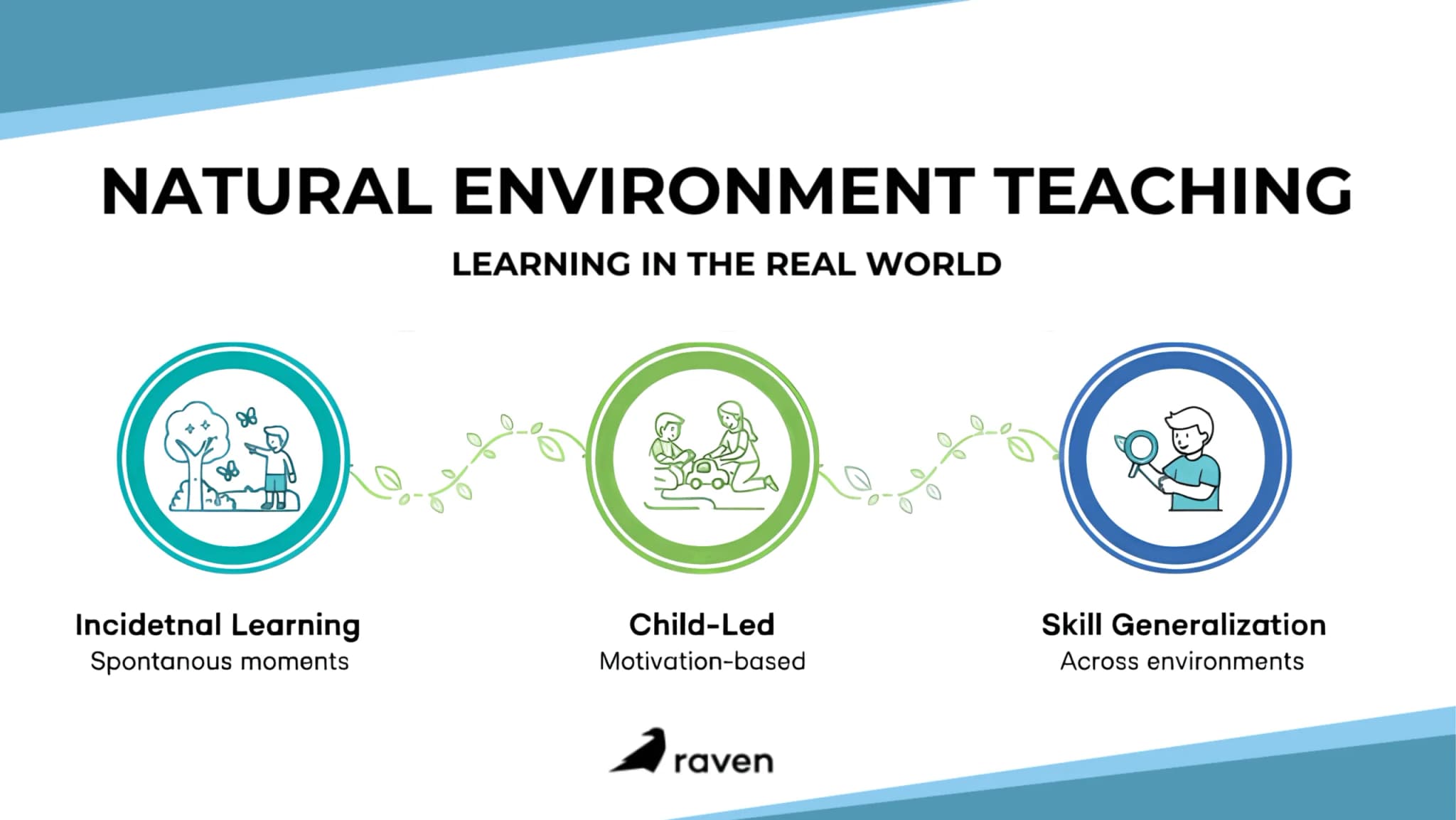
Natural Environment Teaching (NET) is an evidence-based approach within Applied Behavior Analysis (ABA) that emphasizes learning in everyday contexts. Rather than limiting instruction to structured sessions, NET incorporates teaching moments into activities such as play, meals, and community outings. In this article, you will explore more about NET, including its benefits and how it is applied in daily life.
What Is NET?
Natural Environment Teaching is a way of teaching where learning happens during everyday activities, not just at a table. In NET, therapists and teachers use real-life moments like playtime or meals as “teachable moments.”
For example, during snack time a child might be encouraged to ask for a cookie by name, and when they do, they get the cookie immediately. This makes learning feel like part of normal life. NET is often used in ABA therapy for children with autism because it turns the child’s own environment into a classroom.
NET vs Discrete Trial Training (DTT)
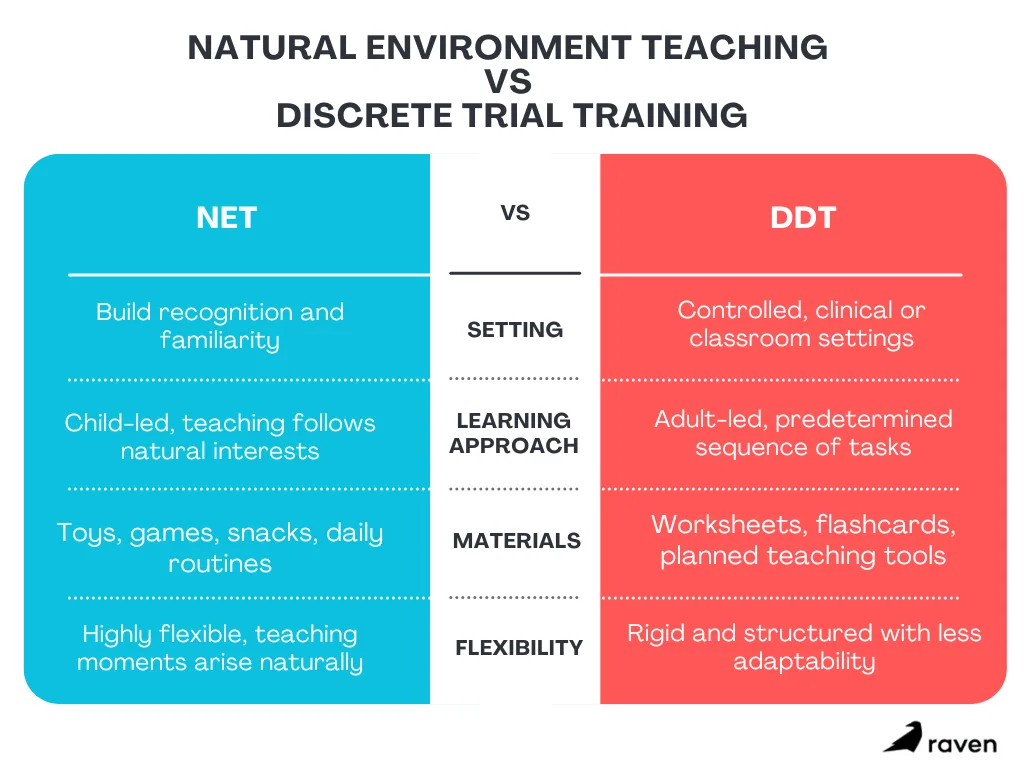
Discrete Trial Training (DTT) is a very structured, adult-led method. In DTT, a skill is broken into tiny steps and taught one by one in a quiet setting. For example, a therapist might show a child a green block and ask, “What color is this?” every time, giving a sticker or praise for correct answers. This happens at a table with few distractions.
NET, by contrast, is flexible and child-led. It weaves teaching into what the child is already doing. Instead of flashcards, the therapist might say “cracker” when a child reaches for a cracker, so they learn to ask for it.
In NET, the setting can be any place the child naturally goes. It could be the playground, the kitchen, or even a walk outside. The key difference is that DTT separates learning from life, while NET teaches skills in the moment by responding to what the child is doing.
Benefits of NET
NET has many advantages, especially for kids with autism who need to use skills in real life:
1. Learning in Real Life
NET happens in real settings (home, park, etc.), so skills learned are directly useful. For example, a child learning how to use a chair during play is more likely to remember to sit on a chair later. Studies show that NET helps children pick up practical daily skills (like feeding or dressing) better than drills alone.
2. More Engaging and Fun
Because NET uses the child’s interests (favorite toys, games, or snacks), kids stay excited to learn. They often don’t even realize they are in a “lesson,” and so it feels like play. NET is built on the child’s own interests. It turns learning into a natural and engaging experience rather than a task. Hence, keeps a child’s motivation high.
3. Immediate Natural Rewards
In NET, the child usually gets the reward or response right away. For instance, if a child requests a toy correctly during play, they immediately get the toy. This clear link between action and outcome teaches why the skill is useful. When children could say “cracker” to get a cracker, they quickly learn to communicate in that moment.
4. Skills Stick and Generalize
Because skills are practiced in different places with different people, children learn to use them in many situations. Learning in varied real-world contexts helps skills “stick” and carry over outside therapy.
For example, identifying colors practiced during play is more likely to be used at home or school than colors learned only at a table. Research even found that toddlers with autism made bigger gains in everyday abilities when NET was added to their therapy, compared to using structured trials alone.

Examples of NET in Action
Some common examples of daily life NET are as follows:
Teaching Colors During Play
A therapist might use colorful toys and ask the child, “Can you hand me the red block?” as they build something together. When the child finds the correct red block and gives it, they continue playing as a reward. This way, the child learns colors naturally while having fun.
Practicing Greetings at the Park
If a child sees a familiar person at the playground, the therapist might encourage them to say “hello” or “goodbye.” The friendly smile and wave they get back become a reward. This makes learning social greetings meaningful because it happens in a relaxed, real-world setting.
Asking for Snacks or Toys
During snack time or play, if a desired item is just out of reach, the therapist waits for a hint of interest. Then they prompt the child to ask for it (saying “cookie” or using a gesture). As soon as the child does, they get the snack or toy. This immediate connection teaches them communication in context (what to say to get what they want).
Each of these examples shows NET teaching a skill directly where it is used. The child sees the point of the lesson right away.
When and Why Therapists Use NET?
Therapists use NET when they want learning to feel natural and relevant. In practice:
Anytime a child is active in an everyday setting (like playing with toys, eating a meal, or dressing), therapists can turn it into a quick lesson. For example, if a child is stacking rings, a therapist might use that moment to teach counting or colors. The lesson happens in the flow of play, not as a separate drill.
NET is especially helpful for teaching social words and actions. Therapists might use greetings (“hi,” “please,” “thank you”) at lunch tables or on the playground when real people and social cues are around. This gives the child practice saying these words with real reactions (smiles, attention) as immediate feedback.
Often, a therapist will first teach a new skill in a structured lesson (DTT) and then use NET to help the child apply it in different settings. For example, after learning number names at a table, a child might practice counting during a counting game on the floor. This combo; teach, then practice, helps the child use the skill on their own.
Research supports this blend: toddlers with autism showed better adaptive skills when therapy included NET opportunities, because they could use what they learned in real life.
Conclusion
In short, therapists use NET whenever there is a natural opportunity. If a child shows interest in something, the therapist seizes the moment to teach a related skill. This approach works well for children with autism, especially those who find routine drills difficult. By using the child’s own environment and interests, NET makes learning meaningful, keeps the child interested, and helps skills transfer to everyday life.
Clinicians can track NET progress and apply ABA strategies more efficiently using tools like Raven Health. Request a demo to see it in action.