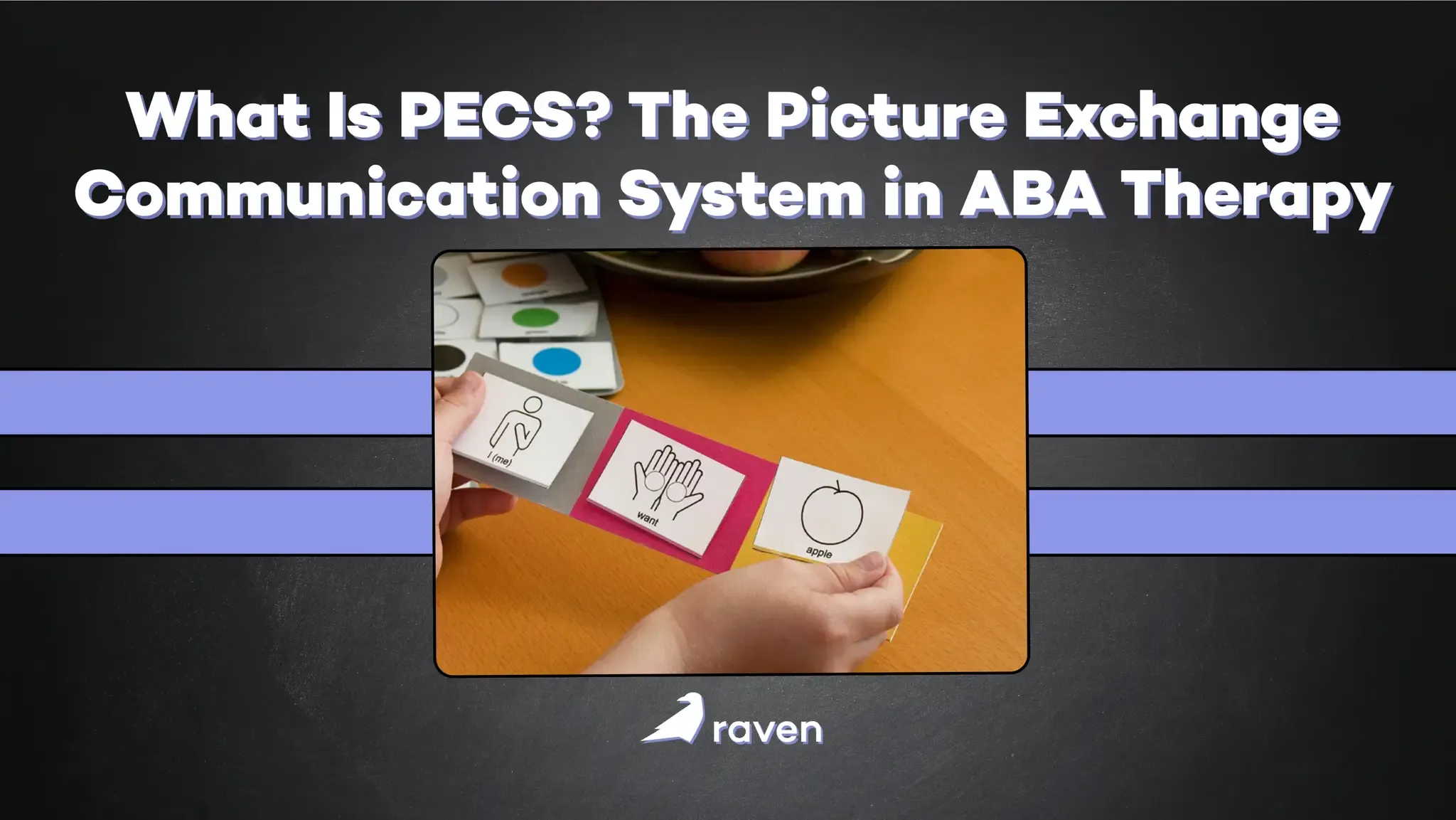
This clear cause-and-effect teaches the learner that pictures can be used to ask for things. PECS was developed in the 1980s by Andy Bondy and Lori Frost and is used worldwide for learners of all ages with diverse communication challenges. Its primary goal is to teach functional communication, which is a way for the person to express needs and wants effectively, even if they aren’t speaking yet.
In this article, you will explore what PECS is and how picture exchanges help learners build functional communication.
Who Uses PECS?
It’s commonly used with children and adults who have autism spectrum disorder, but it isn’t limited to autism. Learners with cerebral palsy, Down syndrome, hearing loss, or other conditions have also used PECS successfully.
How Does PECS Work?
PECS is built on ABA principles (prompting, reinforcement, and systematic teaching) to build communication skills. More importantly, PECS does not require speech. In fact, speech development isn’t the main goal; the focus is on getting messages out.
Research shows that using picture communication like PECS does not harm speech development and can even encourage some learners to talk over time.
A picture stands for a real item or activity. Every time the learner gives a picture, they get what the picture shows. This immediate exchange reinforces that communication works, so learners start to ask more and more on their own.
How Does Picture Exchanges Build Communication?
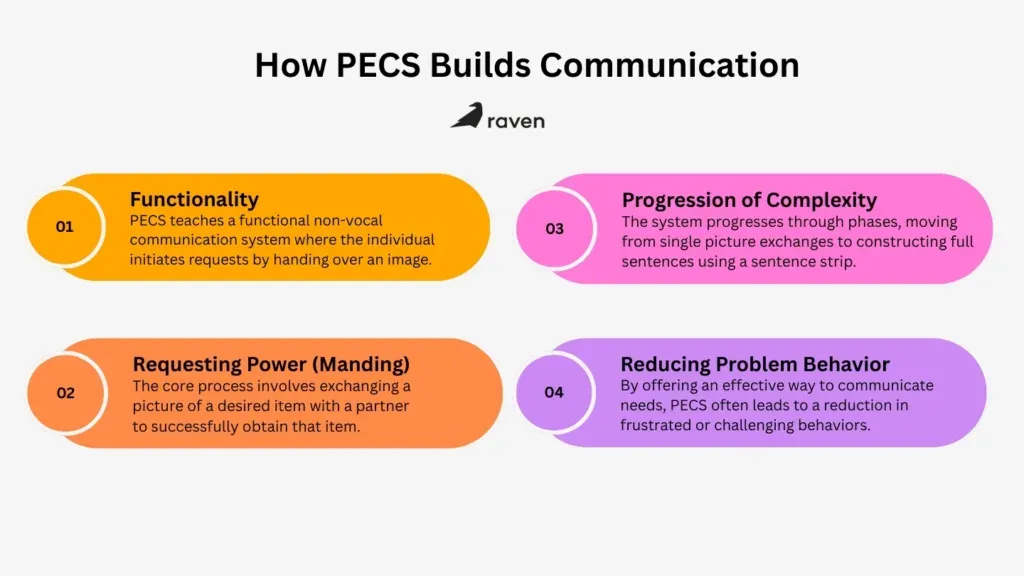
Using pictures gives learners a concrete way to express needs instead of guessing or acting out. Each successful exchange makes communication feel rewarding. Over time, learners connect the act of giving pictures with getting things they want. Here’s how PECS helps step-by-step:
1. Picture-Based Requests
The learner is taught to pick up a picture card (say, of a cookie) and hand it to a teacher or parent. The adult immediately gives them that item (a cookie) and praises them. That simple exchange means the learner just asked for the cookie without words.
2. Initiating Communication
PECS makes the learner the initiator. Instead of waiting for an adult to ask, the learner approaches the person with a picture to start the exchange. This active role of handing over a symbol is key: it shows the learner, “This is how I can tell someone what I want.”
3. Reducing Frustration
When kids can’t speak, they often act out to get their needs met. PECS cuts down tantrums and frustration because it gives a clear, effective alternative. For example, if a child is crying because they want juice, a parent might not know why at first.
But with PECS, the child can simply hand over a picture of a drink and get it, solving the problem quickly. Research and practice have shown that learners using PECS tend to have fewer tantrums and problem behaviors as they gain this communication tool.
4. Building Independence
As the learner succeeds, the prompts are faded. Over sessions, they learn to find the right picture, use it without help, and even go get their picture book on their own. PECS encourages them to be persistent; for example, learners practice walking across the room to hand a picture to a teacher. This practice in real-world settings helps them generalize the skill.
PECS works wherever pictures can be used: at home, in school, in therapy, or in community settings. It’s a flexible system that caregivers, teachers, and speech therapists can use together.
The Phases of PECS
PECS is taught in a series of stages, often called phases. Each phase adds new skills once the learner masters the previous one. Here’s a quick rundown:
Phase I – How to Communicate
The learner picks a picture of a desired item or activity and hands it to a partner. The partner immediately gives the item. The focus is on the learner realizing that exchanging a picture brings the thing they want.
Phase II – Distance and Persistence
The learner uses the single-picture exchange in different situations. They might walk farther to give the picture or use a communication book. This phase teaches them to be persistent. They keep the interaction going until they hand over the picture and get the item.
Phase III – Picture Discrimination
Now multiple pictures are presented. The learner must choose the right one from an array; for example, picking “apple” from “apple” vs “banana.” This shows they understand that each picture represents a specific thing. The chosen picture usually comes from a binder or book.
Phase IV – Sentence Structure
The learner starts building basic phrases. A sentence strip is used, usually beginning with “I want.” For example, a learner might arrange an “I want” card plus the card for “ball.” Then they hand over the whole strip (“I want ball”). This teaches combining symbols into a request sentence.
Phase V – Answering Questions
The learner learns to respond to simple questions like “What do you want?” If the teacher gives a prompt, the student puts the “I want” strip and the picture together, such as “I want cookies.” This turns PECS into a more natural back-and-forth communication.
Phase VI – Commenting
Finally, PECS goes beyond requests. The learner is taught to comment on the environment. For example, the teacher might show a picture or an object and ask, “What do you see? ” or “What do you hear? ” The learner uses pictures to say things like, “I see a dog” or ‘I hear a car.” This phase helps the learner use PECS for social interaction, not just getting needs met.
Each phase generally takes practice and may last days, weeks, or months, depending on the learner. Therapy teams (teachers, therapists, and parents) follow specific PECS guidelines to move the learner through these stages.
By the end of Phase VI, a learner is using PECS to initiate requests and share observations, a big leap from no communication at all.
Conclusion
PECS is a practical, structured way to teach communication when spoken language isn’t yet available. It gives learners a clear message system: handing over pictures leads to tangible rewards. This builds confidence and independence. Over time, with each phase, learners expand from asking for basic needs to making simple comments. In short, PECS helps turn a desire (like wanting a toy or snack) into a clear communicative action.
Research and clinical experience show that PECS is effective for many learners, reducing frustration and giving them a genuine voice. It’s been used successfully with thousands of children and adults around the world. By focusing on real-life communication and gradually building sentence skills, PECS lays a foundation for functional language.
Sources
nationalautismresources.com
kennedykrieger.org
sccmha.org
pecsusa.com
pubmed.ncbi.nlm.nih.gov
pecsusa.com