
Published on
It’s common for parents to feel concerned when their child isn’t speaking at the age they expected. One of the most common questions is whether the child has a speech delay or autism. While both can affect communication, they are not the same condition. Understanding the difference helps families seek the right support early and avoid unnecessary stress.
This article explains how speech delay and autism differ in communication, social interaction, and development. It also highlights when to seek professional evaluation and how early support helps children in both situations.
What Is a Speech Delay?
A speech delay means a child is slower than expected in producing speech sounds or words, but may still understand language and want to communicate. Speech refers to the physical ability to produce sounds using the mouth, tongue, and vocal cords.
Studies indicate that between 5–12% of children aged 2 to 5 experience speech and language delays, and without timely support, these delays can raise the likelihood of academic and learning difficulties later on.
Common Features of Speech Delay
- Limited spoken vocabulary for age
- Difficulty pronouncing words clearly
- Frustration when trying to speak
- Normal interest in social interaction
- Uses gestures, pointing, or eye contact to communicate
Many children with isolated speech delay still try to communicate socially even if words are limited.
What Is Autism and How Does It Affect Communication?
Autism Spectrum Disorder (ASD) is a neurodevelopmental condition that affects social communication and interaction patterns from early childhood and occurs across different autism levels. These communication differences are present from early development and affect daily functioning.
Autism communication differences are not just about speaking late. They often involve how communication is used socially.
Examples include:
- Difficulty using language socially (pragmatic language challenges)
- Trouble understanding jokes, tone, or sarcasm
- Repetitive speech patterns or echolalia
- Unusual tone, rhythm, or pitch of speech
Some autistic children may also show regression in language after developing early words. Research shows autism impacts social interaction and communication development across multiple areas, not just speech production.
Key Differences: Speech Delay vs Autism
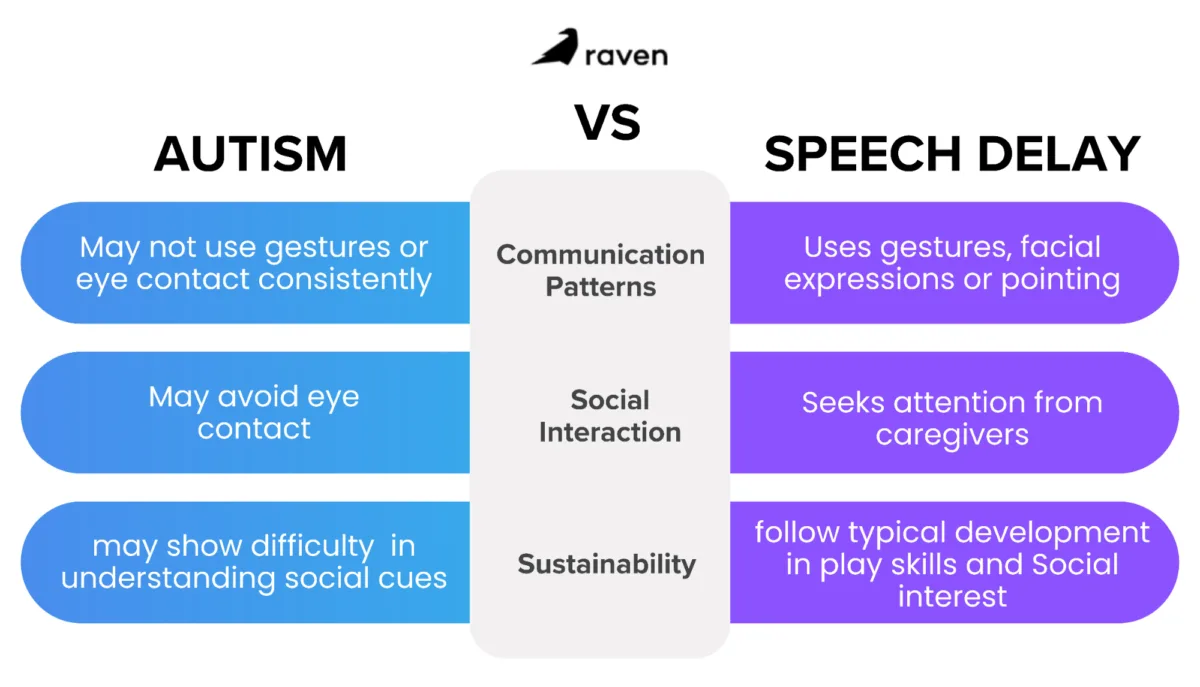
1. Communication Patterns
Speech Delay
- Child understands language but struggles to speak
- Uses gestures, facial expressions, or pointing
- Shows desire to communicate
Autism
- May have difficulty understanding social language
- May repeat phrases (echolalia)
- May not use gestures or eye contact consistently
Speech and language development can occur separately, meaning a child may have speech delay but normal language understanding.
2. Social Interaction
Speech Delay
- Seeks attention from caregivers
- Enjoys social games
- Responds to name consistently
Autism
- May avoid eye contact
- May not respond to name consistently
- May prefer solitary play
CDC guidelines highlight social communication differences as a core autism indicator.
3. Developmental Milestones
Children with speech delay often follow typical development in:
- Play skills
- Emotional connection
- Social interest
Children with autism may show:
- Limited pretend play
- Difficulty understanding social cues
- Repetitive movements or routines
Developmental screening is recommended if milestones are missed.
Signs Suggesting Speech Delay Alone
Parents may notice:
- Child understands instructions
- Uses eye contact naturally
- Shows interest in peers
- Uses gestures to compensate for speech
Many late talkers catch up, especially with early speech therapy support.
Signs That May Suggest Autism
Parents should consider evaluation if a child:
- Does not point to show interest
- Avoids eye contact frequently
- Shows repetitive movements (hand flapping, rocking)
- Has limited social interest
- Does not respond to name consistently
These patterns usually involve broader developmental differences, not just speech.
How Early Intervention Helps Both Conditions
Early intervention plays a critical role in supporting children with speech delays or autism, helping them build essential communication and social skills while reducing stress and frustration. Therapy is most effective when started as soon as concerns are noticed, as young brains are highly adaptable and responsive to structured learning. The benefits are as follows:
- Early therapy focuses on teaching children how to express their needs, thoughts, and emotions effectively. This helps children engage more confidently with family, peers, and teachers.
- Therapy often includes role-playing, turn-taking games, and structured social scenarios that teach children how to interpret social cues, maintain conversations, and form relationships.
- Early therapy provides tools to express needs constructively, reducing stress and behavioral issues. This helps with better communication where children feel understood, boosts confidence and decrease the likelihood of disruptive behaviors.
- Early therapy helps ensure children are better prepared to meet the social and cognitive demands of school.
Conclusion
Speech delay and autism can sometimes look similar early on, but they involve different developmental patterns. Speech delay mainly affects speaking ability, while autism affects communication, social interaction, and behavior together.
The most important step is early evaluation. If something feels concerning, parents should trust their instincts and seek professional advice. Early support can make a meaningful difference in communication and development outcomes.
Sources:
https://www.autism.org.uk/advice-and-guidance/about-autism/autism-and-communication
https://www.verywellhealth.com/autism-speech-patterns-11730556
https://en.wikipedia.org/wiki/Speech_delay
https://en.wikipedia.org/wiki/Late_talker
https://pmc.ncbi.nlm.nih.gov/articles/PMC10775292/