
Learning a new skill rarely happens in one big leap. Think about how a child learns to tie their shoes; they don’t just watch once and do it. They get stuck, they forget the order, they need someone to guide them through each twist and loop. Applied Behavior Analysis (ABA) recognized this reality long ago, and that’s exactly where chaining comes in.
Chaining is one of those techniques that sounds almost too simple until you actually see it work. It’s a structured way of teaching multi-step skills by breaking them apart and building them back up, one link at a time.
And for many learners, especially those with autism, developmental delays, or other learning differences, it can be genuinely transformative. In this article, you will explore ABA chaining in detail.
What Chaining Actually Is and Why It Matters?
Chaining is a behavior analytic strategy where a complex skill is broken down into its individual behavioral components, each of which can be taught, prompted, and reinforced separately before being connected into a full sequence.
The underlying principle comes from the idea that most meaningful behaviors like washing hands, making a sandwich, getting dressed, aren’t single actions. They’re chains of smaller behaviors where each step acts as both the result of what came before and the signal for what comes next.
In ABA, each step functions as a discriminative stimulus for the next response. What makes chaining so powerful is its precision.
Instead of hoping that a learner will pick it up through observation or general instruction, chaining gives practitioners a clear roadmap. Every step is identified, sequenced, and systematically taught.
Before beginning any chaining program, a task analysis is completed. This typically involves:
Observing someone performing the skill naturally
Breaking the task into the smallest teachable units
Writing each step in observable, measurable terms
Ordering the steps in the sequence they naturally occur
1. Forward Chaining
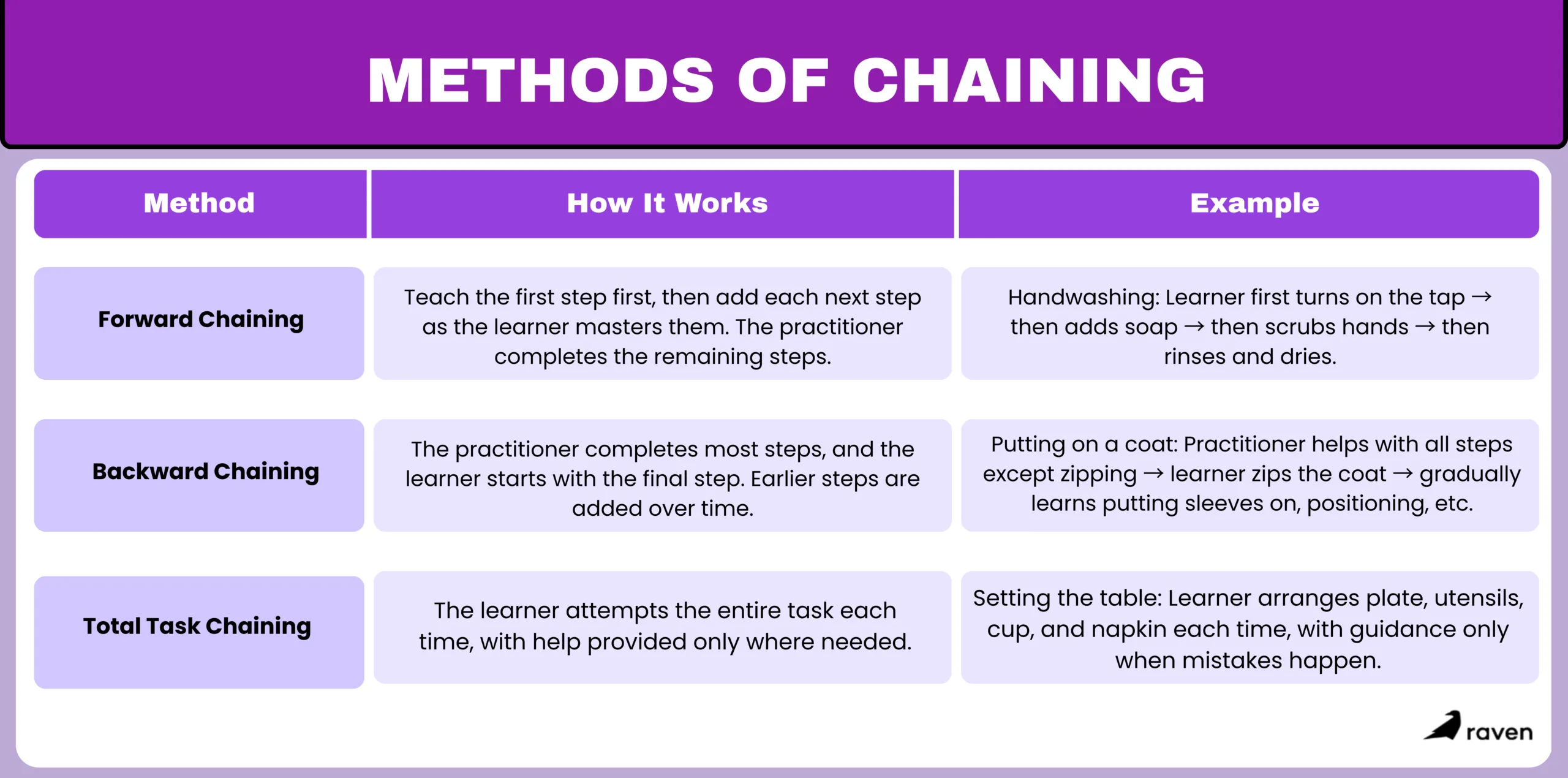
Forward chaining is exactly what it sounds i.e., teaching the chain from the very first step. The learner is taught step one until they can do it independently, then step two is introduced, and so on.
At each stage, the practitioner provides prompts or completes the remaining steps so the learner can experience the full task from start to finish.
Forward chaining works well when:
The learner is highly motivated by early steps in the sequence
The task has a natural momentum that builds (e.g., assembly tasks)
The beginning steps are the most difficult and need the most practice
The key advantage of forward chaining is early ownership. Since the learner masters and owns the first steps right away, there’s often a stronger sense of progress. They’re not just watching someone else finish the job, they’re contributing from the start.
2. Backward Chaining
Backward chaining flips the script. The practitioner completes all steps except the last one, which the learner performs independently. Once that final step is mastered, the practitioner pulls back to complete all steps except the last two and so on, working backward through the sequence.
This approach has a compelling built-in benefit: the learner always ends the task by completing it. Every single trial result in a finished product, which means reinforcement is consistently delivered at task completion.
Backward chaining is often preferred when:
The final steps of a task are the most naturally rewarding (e.g., eating the completed meal they helped prepare)
The learner needs frequent reinforcement to stay motivated
The practitioner wants to reduce frustration by ensuring task completion every time
Backward chaining is especially well-documented in research with learners who have autism spectrum disorder, where motivation and attention can be real barriers.
3. Total Task Chaining
Total task chaining takes a different approach altogether. Instead of isolating individual steps, the learner attempts the entire chain on every trial, from start to finish. Prompts are provided wherever the learner struggles, and reinforcement is delivered for the completed task.
This method works best in specific circumstances, such as:
The learner already has partial skills across the sequence
The task is relatively short with a small number of steps
The learner does well with full-task practice and doesn’t need step-by-step mastery first.
Think of it like learning to ride a bike with training wheels. You’re doing the whole activity like pedaling, steering, and balancing just with support in the parts you haven’t fully figured out yet. Over time, the support fades.
Total task chaining can be quicker to implement when a learner doesn’t need intensive step-by-step instruction. Research has shown it to be at least as effective as forward or backward chaining in certain populations, though learner characteristics should always guide the decision.
Choosing the Right Type for the Right Learner
There’s no universal answer to which chaining method is best. A good practitioner looks at the learner’s current skill level, what motivates them, the length and complexity of the task, and any history of success or frustration with similar programs.
Forward chaining works best when early steps are the hardest or most motivating. Backward chaining works best when task completion itself is the primary reinforcer. Total task works best for learners with stronger baseline skills or shorter task sequences.
What matters most is that whichever method is chosen, it’s implemented consistently, data is collected at each step, and the program is adjusted based on what the data actually shows. Chaining is a tool, and like any tool, how well it works depends entirely on how it’s used.
Frequently Asked Questions
How do you decide which chaining method to use?
It depends on the learner and the task. Forward chaining is great when early steps are tricky, backward chaining works well when finishing the task is motivating, and total task chaining is ideal when the learner already knows some steps or the task is short.
How do you track progress in ABA chaining?
Progress is tracked by looking at each step of the chain. Notes are taken on whether the learner completes a step independently, needs a prompt, or struggles. This helps guide the next steps and see real improvement over time.
Can chaining be done in a group setting?
Yes. Multiple learners can practice at the same time, each following their own chain. This works well in classrooms or therapy groups where everyone is working on their own skills.
What are common mistakes to avoid with chaining?
Skipping steps, teaching steps out of order, fading prompts too fast or too slow, not tracking progress, or using a method that doesn’t fit the learner can all slow down success.
Conclusion
ABA chaining isn’t a shortcut or a workaround. It’s a carefully structured, evidence-based approach that respects the complexity of real-world skills while meeting learners exactly where they are.
Whether a child is learning to brush their teeth or an adult is working toward independent meal preparation, chaining builds competence piece by piece until one day, the whole chain clicks together without any prompts at all. That moment when a skill becomes truly independent is what all the careful work is for.
Sources
https://iidc.indiana.edu/irca/articles/applied-behavior-analysis.html
https://pmc.ncbi.nlm.nih.gov/articles/PMC3251282/