
Last updated on
Starting an Applied Behavior Analysis (ABA) clinic is an incredibly rewarding venture, but the moment you decide to accept insurance, you hit a massive wall of administrative red tape. Two terms you will hear constantly are credentialing and contracting.
Before you dive into this article, you need to clear up a very common industry misconception: Credentialing and contracting are not an “either/or” choice. You do not choose between them. They are Step 1 and Step 2 of the exact same process.
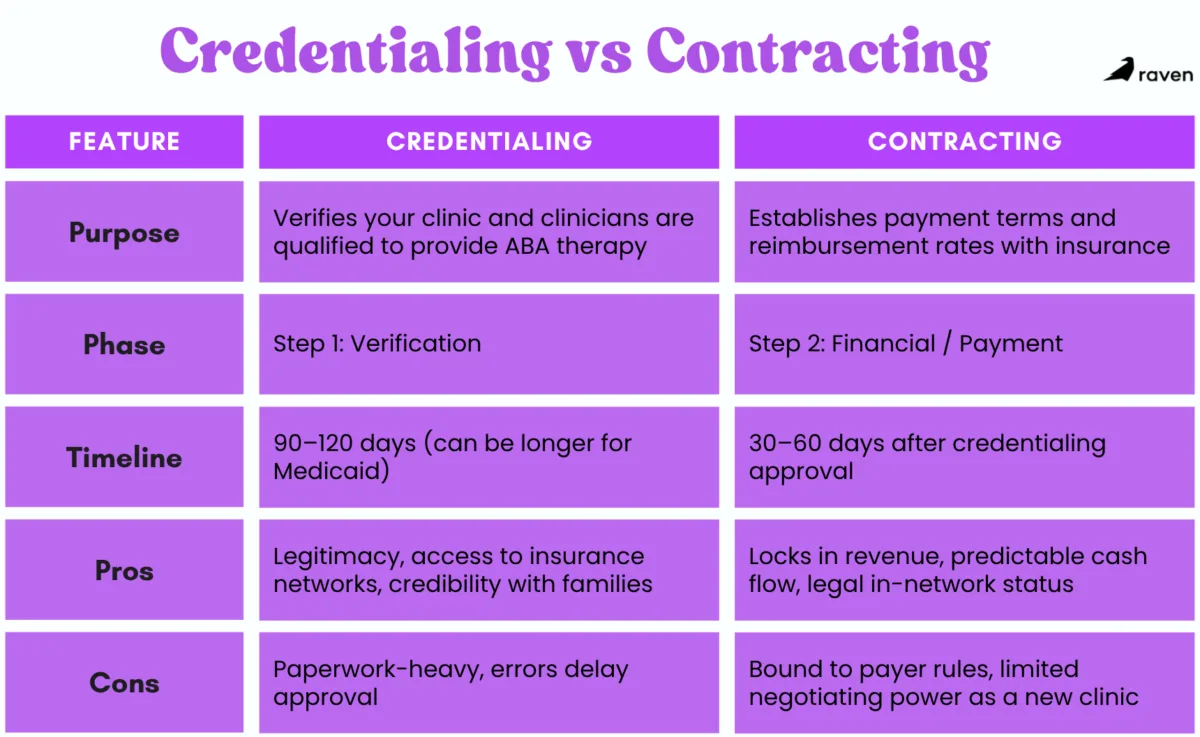
Credentialing is the verification phase. It is how you prove to an insurance company who you are and that you are legally and professionally qualified to provide ABA therapy.
On the other hand, contracting is the financial phase. It happens after credentialing and dictates how you get paid.
While you can’t choose one over the other, understanding the tone, timelines, and benefits of each phase is critical for keeping your new clinic’s cash flow alive.
Pros and Cons of Credentialing vs Contracting
Following are the pros and cons of what each phase demands from your clinic.
The Credentialing Phase
Pros: It establishes immense legitimacy. Once you pass credentialing, you are recognized as a verified, high-quality provider. It is the absolute prerequisite for getting into any major insurance network, which opens your doors to thousands of families who rely on coverage.
Cons: It is an administrative nightmare. The paperwork is complex, and tedious. A single typo on an NPI number or a missing malpractice insurance certificate can send your application to the back of the line, delaying your opening by months.
The Contracting Phase
Pros: This is where the money is. Contracting secures your legal status as an “in-network” provider and locks in your reimbursement rates. It provides predictable revenue and allows you to accurately forecast your clinic’s finances.
Cons: You are legally bound to the payer’s fee schedule and billing rules. Furthermore, as a brand-new clinic, you have very little leverage to negotiate higher rates during your first contract cycle.
Which One Is Better for New Clinics?
Since you must do both to take insurance, the real choice new clinic owners face is this: Should we go through the Credentialing and Contracting gauntlet (In-Network), or skip it entirely and operate as Private Pay/Out-of-Network?
For the vast majority of new ABA clinics, going fully In-Network (completing both credentialing and contracting) is the better, more sustainable choice. ABA therapy is highly intensive, often requiring 15 to 40 hours of one-on-one therapy per week.
At standard hourly rates, paying out-of-pocket is financially impossible for most families. If you choose to skip credentialing and rely solely on cash-pay clients, your potential client pool shrinks drastically.
Opting for both credentialing and contracting ensures your clinic scales faster and serves the community that actually needs you.
Timeline Expectations for Credentialing vs Contracting
This is where most new business owners panic. If you hire a BCBA today, they cannot bill insurance tomorrow. The timeline is notoriously slow.
Credentialing Timeline (90 to 120 Days)
Once you submit your application and CAQH profile, the payer initiates Primary Source Verification (PSV). They manually check your university transcripts, BACB standing, state licenses, and background checks. This phase alone typically takes 3 to 4 months. State Medicaid programs can sometimes take up to 6 months.
Contracting Timeline (30 to 60 Days)
After the credentialing team approves you, they pass your file to the contracting department. They will send you a proposed contract and fee schedule. Once you review, sign, and return it, it takes another 30 to 60 days for them to load your rates into their payment system.
From the day you submit your first document to the day you can legally bill for a session, expect a 4 to 6 month window. You must have enough startup capital to survive this gap.
Common Mistakes to Avoid
1. Assuming Credentialed Means Contracted
This is the most expensive mistake you can make. Do not start seeing clients the moment your credentialing is approved. If you provide services before the contract is fully loaded and effective, the payer will deny your claims, and you will work for free.
2. Letting CAQH Profiles Expire
Your Council for Affordable Quality Healthcare (CAQH) profile is the master database payers use to check your credentials. You must re-attest to your CAQH profile every 120 days. If you forget, payers will pause your applications or drop you from their network.
3. Applying Everywhere at Once
Don’t apply to 15 different payers on day one. Research your local market, identify the top three or four insurance providers that the majority of families in your area use, and focus your administrative energy on those first.
Getting Started with Credentialing
- Obtain your NPIs: You need a Type 1 NPI for your individual clinicians (BCBAs) and a Type 2 NPI for your clinic/business entity.
- Build a Flawless CAQH Profile: Upload crystal-clear PDFs of your state licenses, BACB certificates, malpractice insurance, and a gap-free resume. Many clinics use a credentialing tool to streamline this process and avoid errors.
- Submit Applications: Go to the provider portals of your target insurance companies (e.g., Aetna, BCBS) and submit a “Letter of Interest” or start the online credentialing application.
Getting Started with Contracting
- Wait for the Welcome Letter: Once credentialing clears, the payer will reach out with a contract offer.
- Request the Fee Schedule: Never sign a contract blindly. Always request the specific fee schedule for ABA CPT codes (like 97153 and 97155) so you know exactly what you will be paid.
- Sign and Track: Sign the agreement and aggressively follow up every two weeks until you receive an “Effective Date.” Only after that date can you begin billing for services.
Conclusion
Successfully navigating the insurance landscape is a fundamental step in building a sustainable ABA clinic. While the process requires time and careful organization, understanding that credentialing and contracting are simply two halves of the same process makes it much easier to manage.
Completing this process ensures your clinic becomes an accessible, in-network resource for the families who need your clinical services.
Sources
cubetherapybilling.com/step-by-step-credentialing-guide-for-healthcare-providers
cubetherapybilling.com/aba-credentialing-made-simple-a-guide-for-starting-an-aba-practice