
Published on

When a family begins their journey with Applied Behavior Analysis (ABA), the focus is almost always on the child. We think about the hours of therapy, the Registered Behavior Technician (RBT) coming to the house, or the daily drop-offs at the clinic. But there is a silent engine that actually drives the long-term success of any ABA program: you, the parent.
ABA Parent Training isn’t just an add-on service or a mandatory box to check for insurance companies. It is the bridge between a child learning a skill in a controlled room and actually using that skill at the dinner table, in the grocery store, or at grandma’s house.
In this article, you will explore what ABA parent training involves and why caregiver involvement is critical for skill generalization and long-term progress.
Clinic Owner Note: Parent training is a billable service under most insurance plans (CPT codes 97156 and 97157). Beyond reimbursement, it’s one of your strongest levers for reducing early dropout; families who understand the “why” behind the work are far more likely to stay engaged through the full course of treatment.
What is ABA Parent Training?
Parent training is a coaching model. It transfers the tools of behavior analysis from the clinician’s hands into yours. It is not about turning you into a therapist; you are a parent first. Instead, it is about giving you a new lens to understand why your child does what they do.
The clinical term for this is generalization. Without parent involvement, generalization rarely happens effectively. Imagine your child learns to tie their shoes, but only when sitting in a specific blue chair at the clinic, and only when asked by their therapist. If they come home and can’t tie their shoes for you before school, have they really mastered the skill?
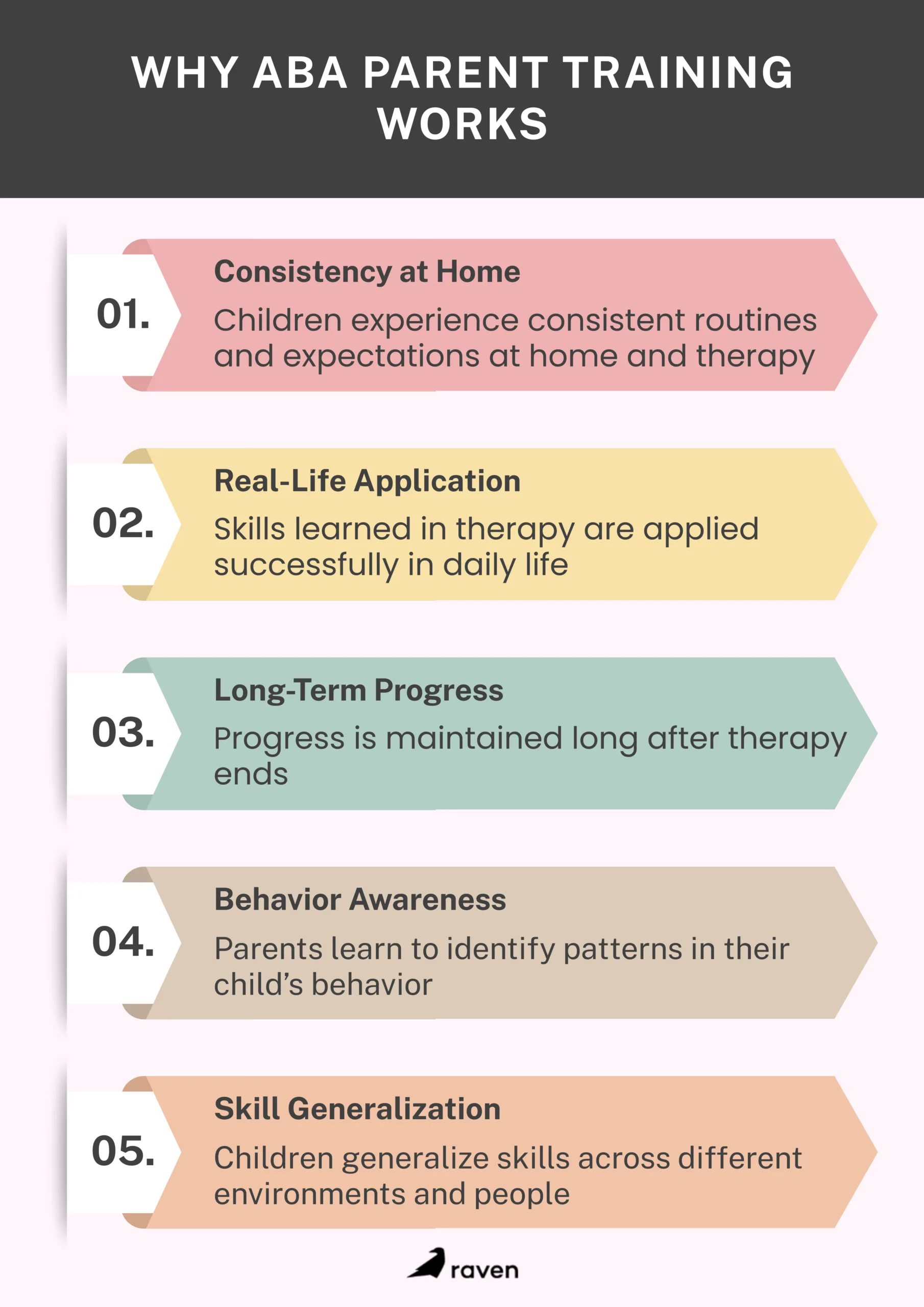
Parent training ensures that the progress made during therapy hours bleeds into real life.
- Consistency is Key: Children with autism often thrive on predictability. If the clinic uses a specific visual schedule or a token economy to reward positive behavior, but home life is unstructured and reactive, the child receives mixed signals.
- Skill Maintenance: Therapy eventually ends. Parent training equips you with the strategies to maintain those hard-won skills for years after discharge.
- Reducing Stress: Understanding behavior functionally rather than emotionally, significantly lowers household stress levels. It moves you from reacting to behaviors to managing them proactively.
Goals, Strategies, and the “ABC” of Life
Many parents fear that training will be a lecture series where they are judged for their parenting style. In a quality ABA program, this couldn’t be further from the truth. Structured parent training is practical, data-driven, and highly individualized.
The ABC Model
One of the first things you will tackle is the “ABC” contingency. This is the heartbeat of behavior analysis.
- Antecedent: What happened immediately before the behavior? (e.g., You said “time for bed.”)
- Behavior: What exactly did the child do? (e.g., Threw the iPad.)
- Consequence: What happened immediately after? (e.g., You negotiated for 5 more minutes to stop the crying.)
In training, you learn to spot these patterns. You might realize, “Oh, every time I give a warning about bed, he throws the iPad because it successfully buys him more time.” Once you see the pattern, you can change it.
Goal Alignment
Your Board Certified Behavior Analyst (BCBA) will sit down with you to identify socially significant goals. These aren’t just academic goals; they are survival goals for your family.
- Do you need to be able to go to a restaurant without a meltdown?
- Do you need your child to sleep in their own bed?
- Do you need them to tolerate brushing their teeth?
These specific pain points become the curriculum for your training sessions.
For clinic owners, this goal-setting conversation is also a powerful retention tool. When parents see that the program is directly addressing the chaos in their daily life, not just running drills on a table, their buy-in skyrockets. Train your BCBAs to open every parent training relationship with this needs-based conversation.
Concrete Strategies
You will move beyond theory into actionable techniques such as:
- Reinforcement: Learning the difference between a “bribe” (given to stop a bad behavior) and “reinforcement” (given to increase a good behavior).
- Task Analysis: Breaking down complex chores like showering into tiny, teachable steps so you don’t have to nag.
- Extinction: Learning how to safely ignore attention-seeking behaviors until they fade away, rather than accidentally feeding them.
A Collaborative Process- Empowerment, Not instruction
The best parent training feels like a partnership, not a classroom. You are the expert on your child; the BCBA is the expert on behavior. When these two expertise areas combine, magic happens.
This collaboration is designed to empower you. There is a specific kind of helplessness that comes from not knowing how to help your distressed child. Parent training replaces that helplessness with competence.
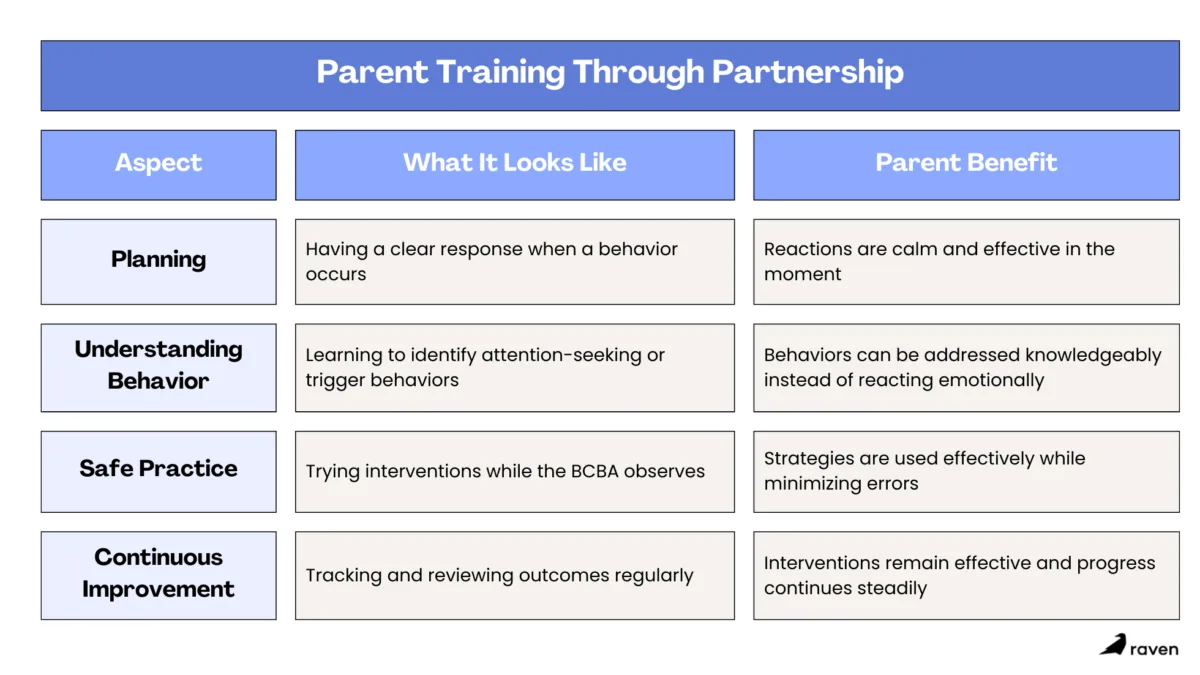
When a behavior occurs, you won’t freeze. You will have a plan. You will know, “Okay, this is an attention behavior. I know exactly what to do.”
Key aspects of this partnership include:
- Feedback Loops: You try a strategy at home and report back. If it didn’t work, the BCBA doesn’t blame you; they tweak the plan.
- Modeling: The clinician will often model the interaction with your child while you watch, then let you try while they provide supportive feedback.
- Data Collection: You might be asked to take simple data (like tally marks on a sticky note) to track if a new intervention is working.
A note on staff training: The quality of your parent training program is only as strong as the BCBAs and RBTs delivering it. New clinic owners should invest in training their staff on how to coach adults, not just how to work with children. This is a distinct skill set, and one worth building into your onboarding and supervision protocols.
How to Build a Strong Parent Training Program at Your Clinic
If you’re in the early stages of building out your clinical services, here are some practical steps to ensure parent training is embedded, not bolted on:
- Standardize your intake conversation. Every family should hear about parent training at the very first touchpoint, before authorization, before the initial assessment. Set the expectation that it’s part of the program, not an add-on.
- Use consistent materials. Whether it’s a parent handbook, a shared visual schedule template, or a simple data sheet families take home, consistency in tools reinforces consistency in approach.
- Track participation, not just delivery. Documenting that a parent training session occurred is the minimum. High-performing clinics also track caregiver comprehension, implementation fidelity at home, and goal progress, data your BCBAs can use to adjust the plan.
- Address barriers proactively. Single parents, language barriers, work schedules, and caregiver burnout are all real obstacles to engagement. Build flexibility into your model, telehealth parent sessions, translated materials, or evening scheduling, so participation doesn’t quietly drop off.
- Measure outcomes and share them. If you can demonstrate to a referring pediatrician or school district that families from your clinic are implementing strategies at home and seeing results, that’s a differentiator that no marketing campaign can replicate.
Conclusion
ABA Parent Training is about building a sustainable ecosystem for a child’s growth. It shifts the dynamic from “therapy is something that happens to my child” to “growth is something we do together.”
For the families you serve, this means more generalization, less regression, and stronger outcomes after discharge. For your clinic, it means families who understand and value the work, and are more likely to stay, refer others, and speak well of your program.
Parent training isn’t a checkbox. It’s one of the highest-leverage investments your clinical team can make: for the child, for the family, and for the long-term reputation of your clinic.
Sources: