
Published on
When a child begins ABA therapy, parents, caregivers, and therapists all share the same big question: “Is this therapy actually working?” In ABA, we do not just guess the answer to that question or rely on our gut feelings; we prove it.
Tracking a client’s improvement is the fundamental basis of Applied Behavior Analysis. By tracking, analyzing, and sharing data, therapists can see exactly how a child is growing, adapting, and learning over time.
This clear, steady focus on data removes the guesswork entirely from ABA therapy. It ensures that every single minute spent in a session is actually helping the child reach their full potential, while giving parents peace of mind that their time and effort are paying off.
Why Measuring Progress Is Essential in ABA?
In many types of treatments, progress can feel like a guessing game based on feelings or general observations. ABA is entirely different. It relies on hard numbers and clear facts to guide every single decision made by the clinical team.
If a child is working on a new skill, measuring progress tells the therapist exactly when that skill is mastered and when it is time to move on to a harder challenge.
Without proper measurement, a therapist might think a challenging behavior is getting better just because they had one “good day.” Continuous data collection shows the real, long-term trends. If the numbers show that a specific teaching method is not working, the therapist can quickly change the plan.
This saves valuable time and prevents the child from getting frustrated. Furthermore, clear data builds a bridge of trust between the clinical team and the family, proving with visual facts that the therapy is truly making a difference in their child’s daily life.
Key Metrics Used in ABA Therapy
To figure out if a child is making progress, behavior analysts look at a few specific areas of growth. They do not just track general “good behavior”; they look at very specific, measurable goals that are tailored to the individual child.
Here are the most common metrics used to track a client’s success:
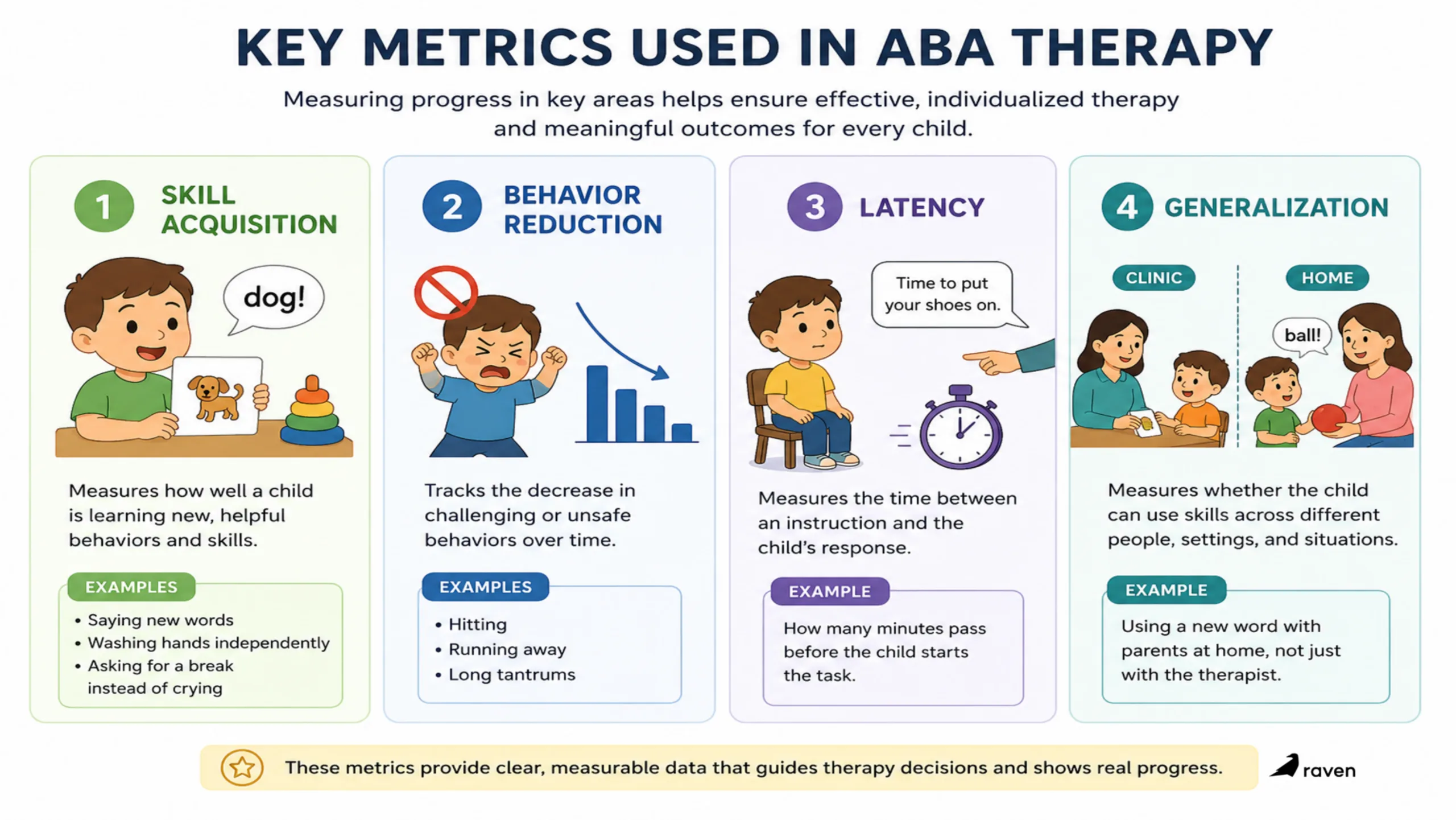
Skill Acquisition
This measures how well a child is learning new, helpful behaviors. It could be tracking how many new words they learn to say, how well they can wash their hands independently, or if they can ask for a break instead of crying.
Behavior Reduction
This tracks the decrease in challenging or unsafe behaviors, like hitting, running away, or long tantrums. The goal is to see these numbers slowly drop as the child learns better, safer ways to communicate their needs.
Latency
This measures the amount of time it takes for a child to respond after they are given an instruction. For instance, if a parent says, “Time to put your shoes on,” latency tracking measures how many minutes pass before the child actually starts the task.
Generalization
This is perhaps the most important metric. It measures whether the child can use their new skills in the real world, not just in the clinic. If a child only uses a new word with their therapist but never with their parents at home, the skill has not fully generalized yet.
Data Collection Methods Explained
So, how do therapists actually get all these numbers? They use very specific data collection methods during their sessions. Choosing the right method depends entirely on the type of behavior they are looking at and the environment they are in.
Here is a breakdown of the most common ways therapists track data:
Frequency Recording
This is as simple as it sounds. The therapist counts exactly how many times a behavior happens during a session. This method is perfect for actions that have a very clear beginning and end, like throwing a toy, raising a hand, or asking a question.
Duration Recording
Sometimes, how long a behavior lasts is much more important than how often it happens. Duration recording tracks the total time from start to finish. For example, a child might only have one tantrum a day, but if it lasts for forty minutes, that is what the therapist needs to measure and work on reducing.
Interval Recording
If a behavior happens too often to count each occurrence (like constant tapping or vocal echoing), therapists use interval recording by dividing the session into short time blocks, such as one-minute intervals. They then mark “yes” or “no” to show whether the behavior occurred during each block. This method gives a clear overall picture of behavior patterns without needing to track every single instance.
Communicating Client Progress to Parents
Gathering all this data is useless if it is not shared clearly with the child’s family. A major part of an ABA therapist’s job is translating these charts and numbers into everyday language that parents can easily understand and appreciate.
When communicating progress, professionals should avoid heavy clinical jargon. Instead of saying “the intervention decreased the frequency of the target behavior,” they should say, “We noticed he is hitting much less this week when asked to clean up.”
Regular meetings should be set up to show parents the visual graphs of their child’s progress. This open, honest communication empowers parents, allowing them to celebrate the small victories and use the exact same successful strategies at home.
Conclusion
Measuring progress in ABA therapy is what makes the science so incredibly effective. By relying on concrete metrics like skill growth and behavior reduction, and using clear data collection methods like frequency and duration tracking, therapists can build a highly personalized roadmap for every child.
When this data is shared openly and simply with parents, it creates a powerful team focused on one shared goal: helping the child navigate their world with more confidence, independence, and joy.
Sources:
nurturingnests.com/aba-data-collection/
bluejayaba.com/blog/how-to-talk-to-parents-in-aba
blossomabatherapy.com/blog/how-to-talk-to-parents-in-aba
crossrivertherapy.com/articles/understanding-interval-recording-in-aba-data-collection
scubed.io/blog/aba-data-collection-methods-explained-frequency-duration-and-interval-recording
trueprogresstherapy.com/blog/address-parent-concerns-aba-services/