ABA programs work best when professionals from different fields team up. In a multidisciplinary ABA team, Board Certified Behavior Analysts (BCBAs) work alongside speech therapists, occupational therapists (OTs), psychologists, educators, and parents.
This collaborative model covers all areas of a child’s development, such as communication, motor skills, social-emotional skills, behavior, and more, so nothing is missed. By aligning their expertise, the team creates holistic treatment plans and coordinated care that lead to better outcomes for clients. In this article, you will explore the benefits of multidisciplinary collaboration in ABA.
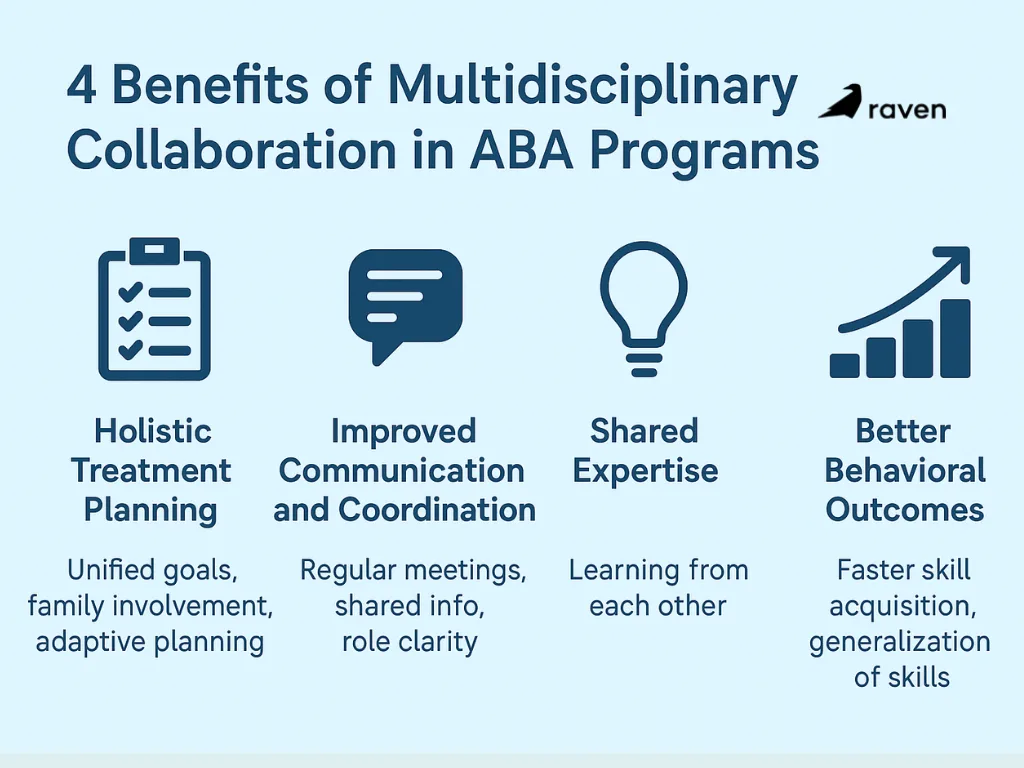
1. Holistic Treatment Planning
When a team collaborates, treatment planning becomes integrated. All professionals align their interventions so the child hears the same messages everywhere. For example, if an OT recommends a quiet corner to reduce sensory overload, the BCBA can incorporate that into behavior goals so the child stays calmer and can learn better. By sharing information, the team avoids mixed messages (for instance, one therapist telling a child to use one technique and another suggesting a different one).
Key elements of holistic planning include:
Unified Goals: The team meets regularly to agree on priorities, for example, to improve requesting or manage frustration. Clear contracts or role agreements spell out who does what, preventing overlapping or conflicting strategies.
Family Involvement: Families join team discussions and practice plans at home. When parents know the therapy targets and methods, they reinforce them throughout the day. This consistent home–school–clinic approach is family-centered and reduces confusion.
Adaptive Planning: As the child grows, the team adjusts goals together. For example, a teenager’s plan might shift from basic communication to social skills for friendships, and the team all move forward on that new target.
Children receiving a combined program of ABA, speech, OT, etc., often make larger gains than those in isolated services. It is found that kids in integrated therapy achieve communication and social milestones more quickly than children receiving each therapy separately. This means a child may learn to speak their first words and use them socially faster when SLP goals and ABA techniques reinforce each other.
By coordinating, therapists avoid giving children too many different instructions. For example, visual schedules or reward systems can be shared across sessions. In short, holistic, team-based planning guarantees that no area is ignored.
2. Improved Communication and Coordination
Successful teams communicate clearly and frequently. Open dialogue and regular check-ins are key:
Regular Meetings: Teams often schedule weekly or monthly meetings. In these sessions, therapists share progress data and discuss challenges in real time. This keeps everyone informed. For example, if an ABA session shows a new difficulty, the SLP or OT can quickly adapt their sessions.
Shared Information: Many teams use shared notes, progress trackers, or apps so everyone sees the latest data. This transparency means a teacher or therapist can pick up on another’s strategies. Digital tools or written logs help make this process seamless.
Role Clarity: From the start, defining each person’s role (often in writing) prevents confusion. When everyone knows who will target what skill, their efforts reinforce rather than contradict each other.
Parent Communication: Keeping parents in the loop is part of team communication. Clear consent and information-sharing policies protect privacy and trust, but within those guidelines, families are treated as team members. Parents who understand the plan can ensure home practices match therapy.
Good communication directly improves outcomes. When an ABA therapist and an SLP, for example, use the same cues and reinforcements, skills learned in speech sessions are reinforced in ABA and vice versa. This consistency accelerates learning and makes behaviors stick. It also means therapies complement one another rather than clashing.
3. Shared Expertise
Pooling expertise means each professional can learn from the others and incorporate new ideas:
For instance, an OT might train the BCBA in a deep-pressure strategy that calms the child, allowing ABA learning to happen more smoothly.
Conversely, a BCBA might teach an SLP how to break language goals into small teachable steps.
Psychologists and medical professionals can alert the team to co-occurring issues (like anxiety or sleep problems) that influence behavior, leading to a more informed ABA plan.
By working together, the team creates rich, multi-layered interventions. For example, if a child is learning to request help verbally, the SLP might use picture cards while the BCBA teaches the behavior of raising a hand.
The child then hears the same goal from two directions. This collaborative learning also keeps the program fresh and personalized, rather than formulaic.
4. Better Behavioral Outcomes
All these collaborative efforts translate into better results for the child:
Faster Skill Acquisition: Children often reach milestones sooner. Integrated therapy means practice is reinforced in all settings.
Generalization of Skills: When every team member teaches the same behaviors, children apply skills in new situations more easily. For example, a child learns to ask for a break with the ABA therapist, and the teacher and parents use the same words and signals, so the child uses the skill everywhere. This broad use of strategies comes from consistent teamwork.
Reduced Conflicts: With a coordinated plan, caregivers don’t get conflicting instructions. Families report less stress when all providers speak the same language in treatment. Having one unified plan means no therapist is working at cross-purposes.
Holistic Well-being: By addressing medical, sensory, social, and emotional factors along with behavior, the team treats the whole child. The end result is often a higher quality of life and better adaptive functioning.
Key Roles on an ABA Team
Each specialist brings unique skills to the team, ensuring every aspect of development is addressed:
Behavior Analysts (BCBAs)
They design and oversee the ABA program. BCBAs create individualized behavior intervention plans that teach social, communication, academic, and daily living skills. They use data-driven methods to encourage positive behaviors and reduce challenging ones
Speech-Language Pathologists (SLPs)
SLPs focus on communication and language. They work on speech sounds, vocabulary, and social communication, and may introduce tools like picture cards or speech devices. By improving functional communication, SLPs help children express needs and interact more successfully.
Occupational Therapists (OTs)
OTs address sensory processing, fine motor skills, and daily living tasks. They help children manage sensory sensitivities (for example, being bothered by noise or touch) and teach skills like dressing, feeding, or handwriting. Strong sensory regulation and motor skills support better learning during ABA sessions.
Psychologists
Psychologists work on emotional and behavioral health. They assess issues like anxiety or attention that may affect learning. By teaching coping strategies and social skills, psychologists support the child’s mental well-being, which in turn makes ABA progress smoother.
Educators and Parents
Teachers and special educators implement strategies in the classroom, aligning academic goals with therapy goals. Parents and caregivers are trained to reinforce techniques at home. This family involvement makes sure skills generalize to daily life and keeps everyone working towards the same targets.
Together, these professionals cover all developmental domains. The combined insights of BCBAs, SLPs, OTs, and others mean that therapy is truly well-rounded and person-centered.
Conclusion
Multidisciplinary collaboration is a cornerstone of effective ABA therapy. By bringing together BCBAs, speech and language therapists, OTs, psychologists, educators, and families, ABA programs ensure that no part of a child’s development is overlooked. Clear communication, shared goals, and mutual support mean therapy is consistent everywhere the child goes. This team approach produces holistic, person-centered care that research consistently links with better and faster learning.
Sources
The Role of Multidisciplinary Teams in Autism Support Programs
The Benefits of Multidisciplinary Collaboration in ABA Programs
The Benefits of Multidisciplinary Collaboration in ABA Programs
Multidisciplinary Teaming: Enhancing Collaboration through Increased Understanding