
Last updated on

Opening an Applied Behavior Analysis (ABA) practice is incredibly rewarding, but the sheer volume of administrative work can hit you like a ton of bricks. During your first twelve months, you are not just a clinician; you are a hiring manager, a billing specialist, and a compliance officer. Trying to juggle these roles using paper files and basic spreadsheets literally burns you out.
To survive and thrive, you need a tech stack that does the heavy lifting for you. From clinical data to revenue cycles, here is a detailed breakdown of the essential tools your new ABA clinic needs to operate efficiently.
Why Do the Right Tools Matter in Your First Year?
Let’s be honest: the first year of any healthcare startup is chaotic. However, in the ABA industry, that chaos is magnified by strict insurance regulations and intensive clinical guidelines. Relying on outdated systems or fragmented software leads to denied claims, lost data, and frustrated staff.
Implementing the right digital tools from day one establishes a culture of compliance and efficiency. According to the U.S. Department of Health & Human Services (HHS), maintaining strict digital security for Protected Health Information (PHI) is non-negotiable.
Using disjointed apps that are not inherently HIPAA-compliant puts your entire business at risk. By investing in dedicated, industry-specific tools, you protect your patients’ privacy, ensure your staff gets paid on time, and free up your leadership team to focus on actual patient care.
1. Practice Management Software
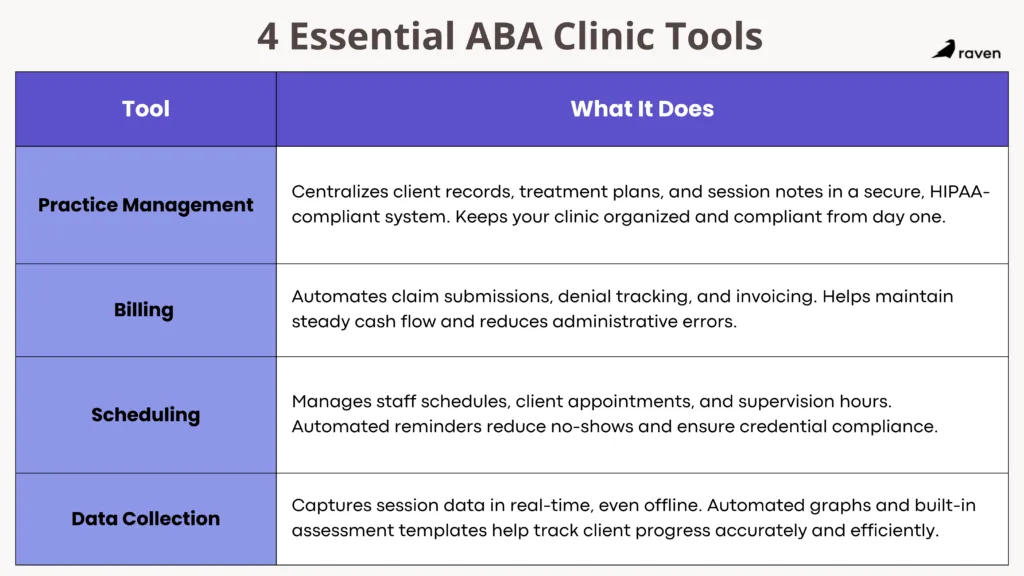
A good practice management software is the central nervous system of your clinic. Instead of paying for five different cheap subscriptions, you need a robust Electronic Medical Record (EMR) system that keeps everything under one roof. Here, the specific feature set matters the most. When selecting a PM system, ensure it includes:
- Strict HIPAA Compliance offering end-to-end encryption for all patient files, session notes, and internal communications.
- Integrated Client Portals to have a secure way for parents to sign intake documents, view their child’s schedule, and read session notes without relying on unsecured emails.
- Secure Document Storage such as cloud-based storage for diagnostic reports, IEPs, and standardized assessments that your clinicians can access from anywhere.
2. Data Collection and Progress Tracking Tools
Gone are the days of hauling around heavy clipboards and spending hours calculating percentages by hand. Accurate, real-time data collection is the absolute core of ABA therapy. The Behavior Analyst Certification Board (BACB) mandates detailed documentation, and modern data collection software ensures that your clinicians stay compliant while saving time.
Your data collection tool needs to be highly responsive and customizable. Look for these core capabilities:
- Offline Functionality: Wi-Fi drops happen constantly, especially during in-home sessions. Your software must allow Registered Behavior Technicians (RBTs) to collect data offline and automatically sync it once they reconnect.
- Automated Graphing: The system should instantly convert raw trial-by-trial data into visual phase-change graphs, allowing Board Certified Behavior Analysts (BCBAs) to make rapid clinical decisions.
- Curriculum Integration: The best tools offer built-in templates for common assessments like the VB-MAPP, ABLLS-R, or PEAK, eliminating the need to build programs completely from scratch.
3. Scheduling and Staff Management Systems
Scheduling in an ABA clinic is notoriously difficult. A single client might have three different RBTs and a supervising BCBA, all working varying hours across different locations.
A manual calendar simply will not cut it. You need a dynamic scheduling tool designed specifically for the quirks of behavioral health. A solid scheduling system should offer:
- Credential Tracking: The software should alert you 30 days before a staff member’s CPR certification, state license, or RBT credential expires, preventing lapsed qualifications.
- Supervision Tracking: It must track the mandatory 5% supervision hours required for RBTs, ensuring your BCBAs are meeting their clinical oversight quotas.
- Automated Reminders: SMS and email reminders sent automatically to parents 24 hours before a session to drastically reduce costly no-shows and last-minute cancellations.
4. Billing and Revenue Cycle Tools
You can provide the best clinical care in the world, but if your billing system is broken, your clinic will close. The revenue cycle in ABA is incredibly complex, involving multiple payer rules, changing authorization codes, and frequent claim denials.
According to guidelines from the Centers for Medicare & Medicaid Services (CMS), submitting clean claims is the only way to guarantee steady reimbursement. To keep your cash flow healthy, your billing tool must feature:
- Claim Scrubbing: The system should automatically scan claims for missing modifiers, incorrect CPT codes, or expired authorizations before submitting them to the clearinghouse.
- Denial Management: If a claim is rejected, the software should clearly flag the specific error code, allowing your billing team to correct and resubmit it within 24 hours.
- Authorization Tracking: A dashboard that tracks exactly how many approved hours a client has left, preventing your staff from accidentally providing unbillable, unauthorized therapy.
Run Your ABA Clinic Smarter with Raven Health
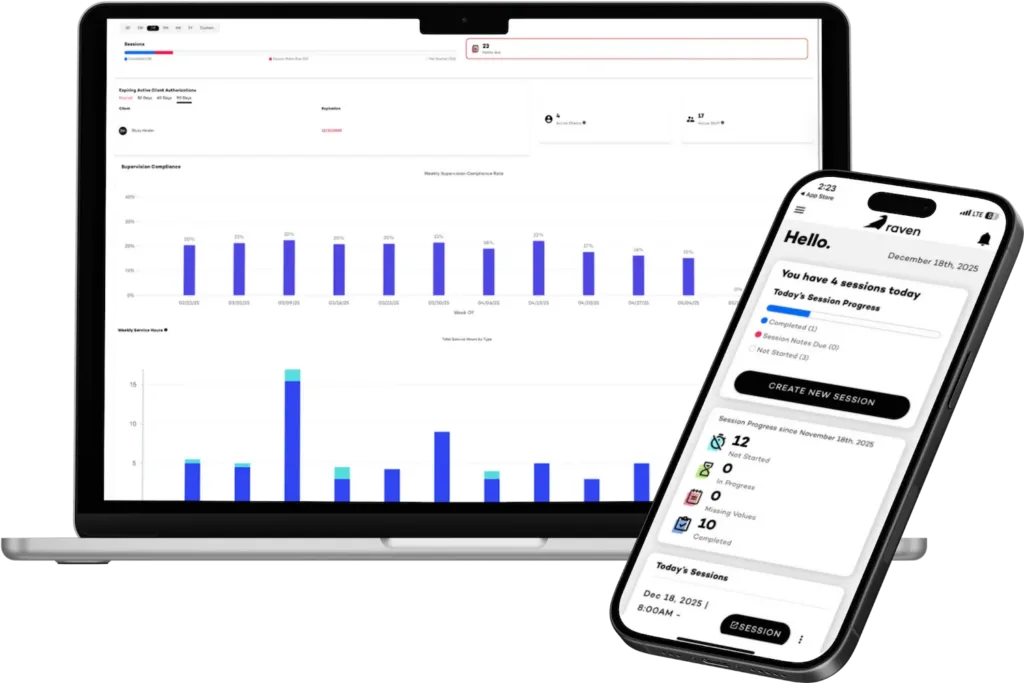
Raven Health is an all‑in‑one ABA practice management platform built specifically for therapy providers, especially startups and early‑year clinics. Instead of cobbling together multiple systems, Raven gives you a single, secure platform to support your clinic’s administrative and clinical needs.
What Raven Health provides includes:
- Practice Management & Centralized Records: A unified system that consolidates client data, treatment plans, session notes, and compliance documentation all accessible from one secure dashboard.
- Data Collection & Progress Tracking: Built‑in ABA data capture tools let clinicians record session notes and collect real‑time progress data, even offline, with customizable reporting and progress visualization.
- Scheduling & Staff Coordination: Smart appointment and calendar tools help you book sessions, manage staff calendars, automate reminders, and coordinate complex schedules easily.
- Billing & Revenue Cycle Management: Integrated claims tools (including self‑billing or fully managed billing services) automate invoicing and insurance submissions, reduce denials, and help you get paid faster.
With Raven Health, your clinic gets HIPAA‑aligned security, mobile‑friendly access, and workflows designed for ABA providers all in one platform so you can spend more time caring for clients and less time on administrative overhead.
Conclusion
Starting an ABA clinic is a huge milestone, but the daily administrative tasks can quickly take over if you aren’t prepared. Setting up the right software for your data, schedules, and billing from day one is the best way to protect your new business.
These tools handle the stressful background work, keep you compliant with strict insurance rules, and keep your cash flow steady. Ultimately, investing in the right tech means spending less time fighting with spreadsheets and more time delivering the life-changing care you initially set out to provide for your clients.