
Published on
Applied Behavior Analysis (ABA) relies completely on accurate data. Tracking a child’s progress step-by-step is how clinicians know if a teaching plan is actually working. But how that data gets recorded is shifting rapidly across the industry.
While some clinics still rely heavily on clipboards and pens, many are moving to tablets and specialized software. Here is a closer look at the good and the bad of both paper and digital data collection in everyday practice.
How ABA Practices Still Using Paper Data Collection Compare
Clinics that still use paper often have large filing cabinets full of thick binders. During a session, clinicians typically carry clipboards and write down tallies, checkmarks, or quick notes by hand while trying to manage the child.
At the end of the day, or even the end of the week, a supervisor has to gather all of these loose sheets. They then sit at a computer and manually type the raw numbers into a spreadsheet to create a visual graph.
This older method takes a massive amount of manual effort and physical storage space compared to modern clinics that simply sync live data directly to a secure cloud server.
Pros and Cons of Paper-Based ABA Data Collection
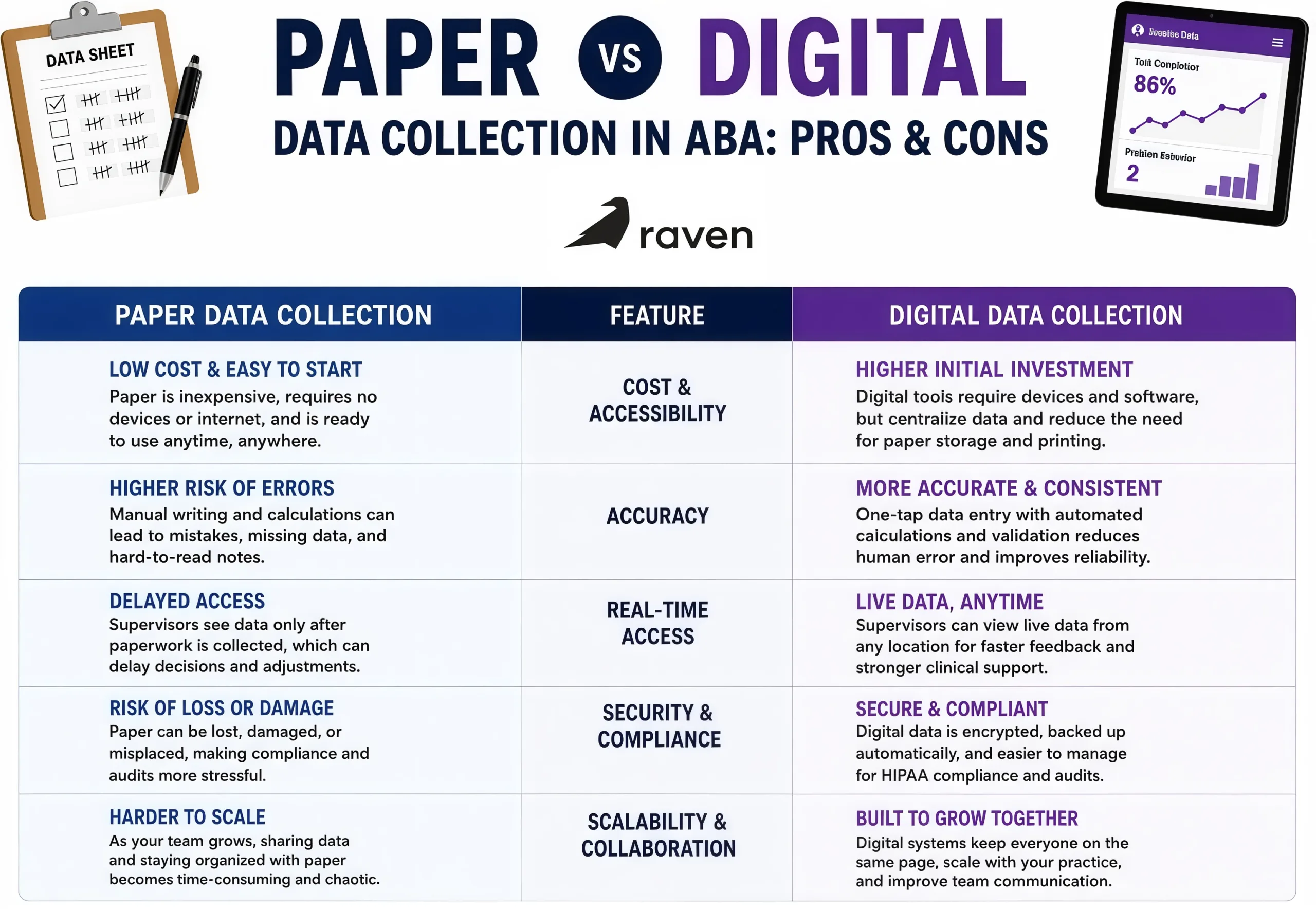
Paper has been the gold standard in the behavioral health field for decades, and some veteran therapists still strongly prefer it. However, the physical and manual nature of using paper brings its very clear downsides that can hurt a growing business.
Where Paper Works Well
Paper is incredibly cheap, and it never runs out of battery. You do not have to worry about a tablet dying or the clinic’s Wi-Fi going down in the middle of a tough behavior spike. It is also highly flexible.
If a therapist needs to quickly draw a diagram of a room layout or write a messy, detailed note in the margins, a pen and paper make that instantly possible without navigating through complex software menus.
Where Paper Creates Risk and Rework
The biggest problem with paper is the high chance of human error. Loose notes get lost in transit, water spills on important data sheets, or handwriting is simply impossible for the supervisor to read.
Furthermore, supervisors cannot see the data until the physical paper is handed to them days later. This means a child might be struggling with a skill for a whole week before the supervisor realizes the teaching plan needs to be adjusted.
Also, calculating percentages and graphing everything by hand wastes hours of unpaid staff time and can leave a clinic vulnerable during insurance audits.
Pros and Cons of Digital ABA Data Collection
Digital data collection uses dedicated apps on phones or tablets to track behaviors the exact second they happen. It is fast becoming the standard for modern, efficient clinics, but it does require a shift in how daily operations run.
Speed, Accuracy, and Compliance Benefits
The absolute biggest win for digital tools is speed. When a clinician taps a button to record a behavior, the software does the heavy lifting instantly.
- It builds visual graphs automatically, saving supervisors hours of manual typing.
- Supervisors can log in from anywhere, whether at home or in another clinic, and see live updates during an active session.
- Digital records are backed up securely on encrypted servers. This makes it much easier to stay compliant with health privacy laws like HIPAA compared to accidentally leaving a patient binder in the back seat of a car.
Common Objections and How to Address Them
Some clinic owners worry that bringing tablets into the therapy room will distract the children or that older staff members will struggle to learn the new software. To fix this, clinics can use heavy-duty screen protectors and rugged cases to keep devices safe from drops or throws.
They can also provide paid, hands-on training days for staff so they feel completely confident before using the app with a real client.
The upfront cost of buying iPads can feel scary, but the sheer amount of time saved on graphing and fixing errors usually pays for the devices very quickly.
Which is Right for Your Practice Size and Setup?
If you run a tiny, independent clinic with just one or two learners, keeping things on paper might still be manageable. But once a practice starts to grow, paper quickly becomes a logistical nightmare.
If you have multiple clinicians working in different homes, several learners, and supervisors who work remotely, digital software becomes almost mandatory.
It keeps everyone on the exact same page, stops data from getting lost, and prevents billing delays because the notes are always ready and accurate.
What to Look for in a Digital Data Collection Tool?
Not all ABA software is built the same. When picking a digital tool for your team, you want an interface that is extremely easy for a clinician to use with just one hand while playing with a child.
It absolutely needs to work offline in case the Wi-Fi drops, automatically syncing the data later when the connection comes back.
Finally, it should connect directly to your billing system so that daily session notes easily turn into clean, error-free insurance claims without double data entry.
Conclusion
Choosing how to collect everyday data is a huge decision for the health of an ABA practice. While paper is familiar and reliable in a power outage, it often slows down clinical progress by trapping important numbers on a clipboard.
Moving to digital data collection takes a little bit of upfront effort to build new habits, but it ultimately frees up your clinicians. They spend less time dealing with paper and tedious admin work, and more time actually helping their learners succeed.
Source:
https://nurturingnests.com/aba-data-collection/
https://aimhigheraba.com/the-importance-of-data-collection-in-aba-therapy/#:~:text=In Applied Behavior Analysis (ABA,adjust%20interventions%20to%20maximize%20effectiveness.&text=ABA%20therapy%20is%20most%20effective,adjustments%20to%20the%20intervention%20strategies
https://www.praxisnotes.com/resources/paper-vs-digital-aba-documentation
https://www.rethinkbehavioralhealth.com/resources/free-aba-data-sheets/