
Self-stimulatory behavior also known as ‘stimming’ is one of the most discussed and misunderstood aspects of autism. It may resemble flapping the hands, rocking, repetition of sounds, or observation of the movement of things. However, in case of an autistic person, stimming is not random or meaningless. It has practical applications related to the regulation of sensory, expression of emotions and self-comforting. It is important to understand the reasons behind stimming to be able to react to it in a respectful way as opposed to trying to stop the behavior. In this article, you will find out what is stimming, why it occurs and how to respond in a supportive manner to it.
What Is Stimming?
Stimming involves constant movements, sounds, or contacts with objects that assist a person to control his or her inner life. Although stimming is closely related to autism, it is not limited only to autistic individuals.
Many neurotypical people stim in minor forms, including tapping a foot, twirling hair or pacing during thought process. Stimming in autism can be more common, more prominent or more intense because of variations in sensory processing and emotional regulation.
Why Stimming Is Common in Autism
The brains of the autistic people do not process the information in the same way. The sounds, lights, textures, and the social needs may be overwhelming or even under-promising. Stimming assists in generating equilibrium.
1. Sensory Regulation
The brain of the autistic functions in a different way with regard to sensory input. There are those who are hypersensitive (over-responsive) to lights, sounds and textures and those who are hyposensitive (under-responsive).
Dampening Overwhelm: Stimming can filter when the world gets too loud or chaotic. Breathing in through a repetitive movement, such as rocking, will enable the individual to suppress the overabundance of external stimuli and reassert control.
Waking Up the Senses: On the other hand, when one feels under-stimulated or numb, then he/she can stimulate to create sensory feedback. Banging against a sofa can make them feel that they are present in their bodies or screaming can make them feel that they are present.
2. Emotional Expression
To most autistic individuals, feelings are experienced to the maximum, but may not be easily explained. Stimming bridges this gap.
Joy and Excitement: A typical example here is happy flapping, in which a child may flap his/her hands in an excited manner. It is physical expression of unadulterated happiness.
Anxiety and Frustration: Rapid and less predictable stimming may indicate the increased stress or the failure to express a particular requirement.
3. Self-Soothing and Comfort
Predictability is calming. The repetitive quality of stimming acts as a good anchor in a sometimes unpredictable and confusing world. The repetition gets the tension off and forms a kind of feedback loop of safety as a child sucking their thumb to go to sleep.
It has been found that, in cases where it is not accompanied by a reduction in its functionality, the suppression of stimming may actually result in higher levels of stress and anxiety.
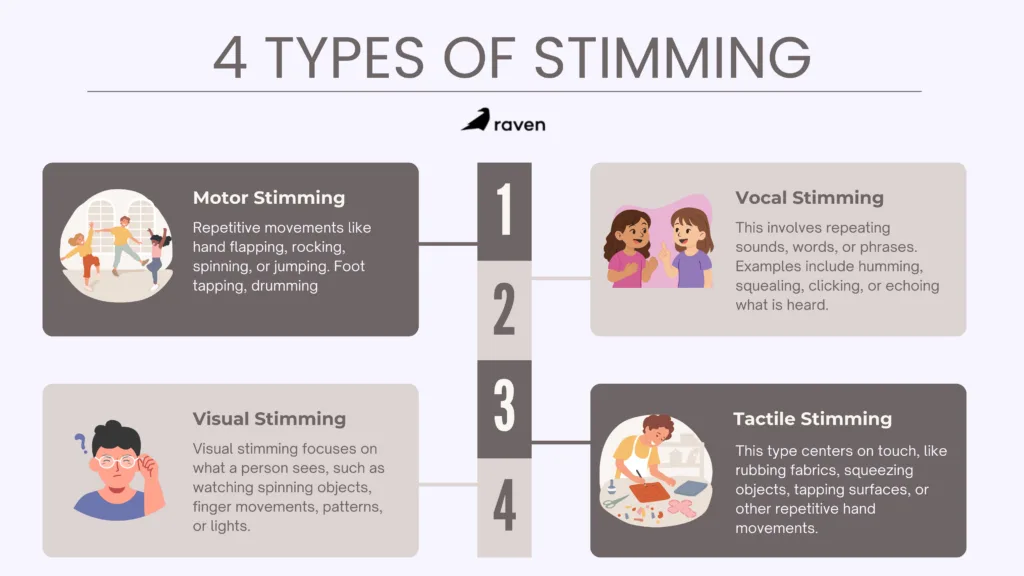
Different Types of Stimming
Stimming can take many forms. The type may assist caregivers and professionals in their response.
1. Motor Stimming
This is body movements and represents one of the most observable types. Examples include: • Hand flapping • Rocking back and forth • Jumping or spinning • Finger flicking
Motor stimming also tends to use unnecessary energy or overcome intense emotions.
2. Vocal Stimming
Vocal stimming consists of repetitions of words or sounds. Examples include: • Humming • Recitation of phrases or scripts. • Making clicking or squealing noises.
Such a form of stimming may be used to help in controlling of emotion or auditory sensory requirements.
3. Visual Stimming
The visual stimming is the repetitive or focused way of seeing things. Examples include: • Watching spinning objects • Finger movement before the eyes. • Paying attention to patterns or lights.
Visual stimuli can assist in controlling visual stimulation or create a feeling of predictability.
4. Tactile Stimming
This is the one that deals with touch and physical sensation. Examples include: • Rubbing fabrics or textures • Squeezing objects • Repeatedly touching surfaces.
Tactile stimming usually assists people in stabilizing themselves in the surrounding.
When Stimming Need Not Be Discontinued
Many forms of stimming are harmless and should not be discouraged. If the behavior:
Does not cause injury
Does not significantly disrupt learning or daily life
Helps the individual stay calm or focused
Then stimming is serving a positive purpose. Trying to stop these behaviors simply because they look unusual can lead to increased distress and reduced self-regulation.
Autistic adults consistently report that being forced to suppress stimming made childhood environments more stressful, not more functional.
When Stimming May Interfere with Daily Functioning
In some cases, stimming may require support if it: • Brings about physical injuries (e.g., head banging) • Eliminates engagement in learning or social life. • Signals extreme distress
It is not aimed at stopping stimming but to know what need it is satisfying.
How Caregivers and Professionals Can Respond Supportively
Successful reactions are more based on learning and knowledge and not punishment.
Start with Observation
Ask: • Before the stimming what takes place? • Does it get higher in stress, noise or transitions? • Does it assist the person to relax?
Initiate Supportive Alternatives (Where Necessary)
If a stim is unsafe or highly disruptive, consider offering alternatives that meet the same need:
Fidget tools for tactile input
Movement breaks for motor stimming
Noise-canceling headphones for auditory overload
Create Sensory-Friendly Environments
Reducing sensory stress can naturally reduce the need for intense stimming. Such as:
Conducting predictable routines
Providing quiet spaces
Ensuring adjustable lighting
Avoid Punishment or Forced Suppression
Punishing stimming does not teach regulation. It teaches masking, which is linked to increased anxiety and burnout in autistic individuals.
Conclusion
Stimming is not the issue that should be resolved. It is a kind of communication and control. When caregivers and professionals start paying attention to autistic persons and shifting their attention to understanding their condition instead of stopping them, autistic individuals are supported in their emotional, social, and developmental needs.
When stimming are respected, but safe and supportive options are provided where necessary, it establishes environments in which autistic individuals can indeed flourish.
Sources:
https://www.autism.org.uk/advice-and-guidance/about-autism/repeated-movements-and-behaviour-stimming
https://www.cdc.gov/autism/signs-symptoms/index.html
https://www.autism.org.uk/advice-and-guidance/about-autism/repeated-movements-and-behaviour-stimming
https://childmind.org/article/autism-and-stimming/
https://www.healthline.com/health/autism/stimming