
Published on
Transitioning from a clinical director or supervising behavior analyst to a business owner is a massive professional leap. You already know how to write an effective behavior intervention plan, but building a sustainable, compliant company requires an entirely different blueprint.
Before you sign a commercial lease or hire your first Registered Behavior Technician (RBT), you must get your operational and financial strategies down on paper. Writing a comprehensive business plan is the most critical step in taking your vision from a concept to a fully functioning clinic.
Here is a detailed breakdown of how to build a practical, effective business plan for your new Applied Behavior Analysis (ABA) practice.
Why Every ABA Clinic Needs a Business Plan?
It is a common misconception that business plans are only necessary if you are pitching to a bank for a massive small business loan. While securing capital is certainly a primary function, a well-structured business plan acts as your operational anchor.
The ABA industry is uniquely complex. Between fluctuating insurance reimbursement rates, high staff turnover, and strict regulatory compliance, flying blind results in rapid burnout and financial failure.
A business plan forces you to stress-test your ideas, anticipate cash flow gaps, and outline your growth strategy before real money is on the line.
According to the U.S. Small Business Administration (SBA), businesses with a formal plan are significantly more likely to secure funding and achieve long-term viability.
Executive Summary: What to Include?
Your executive summary is the first thing investors, partners, or lenders will read. Think of it as the highly condensed elevator pitch for your clinic. Although it appears first in the document, it should actually be the last section you write.
To make this section impactful, include:
- Your Mission and Clinical Philosophy. Are you focusing on assent-based, trauma-informed ABA? Clearly define your clinical values.
- Briefly highlight the experience of the founding Board Certified Behavior Analysts (BCBAs) and operational directors.
- The Problem and Solution: State the current market gap (e.g., a massive shortage of early intervention centers in your specific county) and how your clinic will fill it.
- Financial Ask: If you are seeking funding, explicitly state how much capital you need and exactly what it will be used for (e.g., real estate build-out, payroll runway).
Defining Your Services and Target Market
A common mistake new owners make is trying to be everything to everyone. Your business plan needs to precisely outline the scope of your clinical services.
Service Delivery Model
Will you operate a center-based clinic, provide in-home therapy, or utilize a hybrid model? In-home therapy has lower overhead but higher travel costs and logistical challenges, while a clinic requires significant upfront real estate investment.
Target Demographics
Define the age range and diagnostic criteria you will serve. Will you focus on early intervention for toddlers (ages 2-6), or will you specialize in transition services and vocational training for teenagers and young adults?
Scope of Competence
Ensure your proposed services align strictly with the ethical guidelines regarding boundaries of competence set by the Behavior Analyst Certification Board (BACB).
Market Research and Competitive Analysis
You cannot open a clinic on a hunch; you need hard data. This section proves to stakeholders that a viable market exists for your services.
Demand and Waitlists
Call local diagnostic centers, pediatricians, and existing ABA clinics. If the established clinics in your area have a six-to-twelve-month waitlist, that is concrete proof of high market demand.
Competitor Evaluation
Identify three to five direct competitors in your zip code. What are their strengths and weaknesses? Perhaps the largest clinic in town has great facilities but terrible parent reviews regarding staff communication. That weakness becomes your primary marketing advantage.
The Staffing Market
The biggest bottleneck in ABA is not finding clients; it is finding staff. Research the local RBT and BCBA talent pool. Are you near a university with an ABA master’s program that could serve as a hiring pipeline?
Startup Costs and Financial Projections
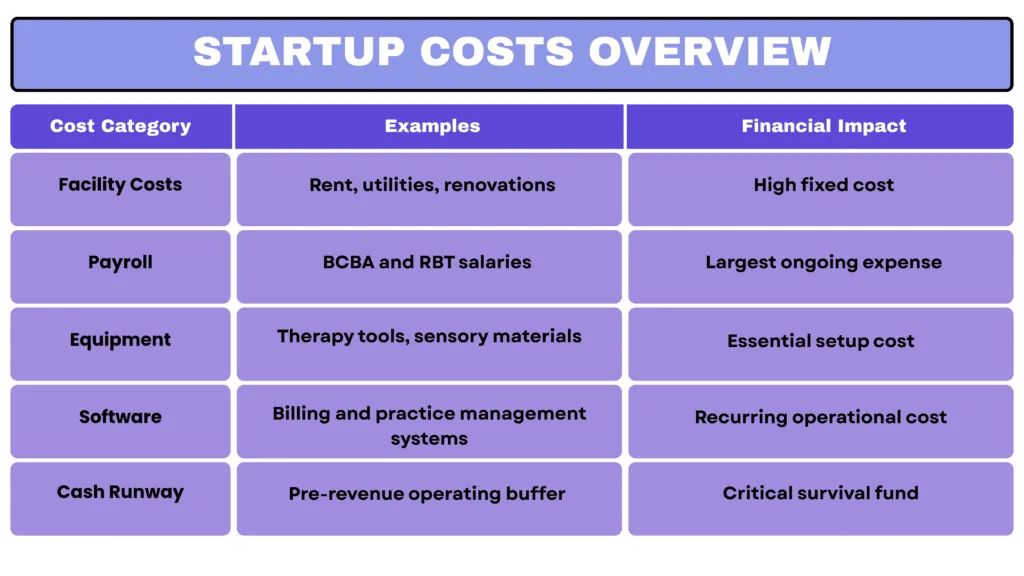
This is the crucial turning point. Because insurance credentialing can take anywhere from 90 to 120 days, your financial projections must account for months of zero revenue while your doors are technically open.
Your financial outline should detail:
- The Operating Runway. You need enough capital to cover rent, utilities, and leadership payroll for at least four to six months before insurance checks start clearing.
- Hard Assets to include the costs of clinical materials, sensory gym equipment, diagnostic testing kits, and office furniture.
- Technology and Software. Factor in the monthly subscription costs for a HIPAA-compliant, ABA-specific practice management software, which is essential for data collection, scheduling, and billing.
Revenue Model and Pricing Strategy
How exactly will your clinic make money? The revenue model for an ABA practice is almost entirely dictated by healthcare funding.
Payer Mix
Clearly define your projected funding sources by breaking down the percentage of your total revenue that will rely on commercial insurance networks, Medicaid, educational contracts, and direct private pay.
Billing Codes
Base your revenue projections on standard ABA CPT codes (such as 97153 for direct RBT therapy and 97155 for BCBA supervision). You need to know the average reimbursement rates for these codes in your specific state to forecast your income accurately.
Credentialing Strategy
Detail your timeline for insurance credentialing, as this process directly dictates when you can actually start billing for your services.
Common Risks for ABA Startups
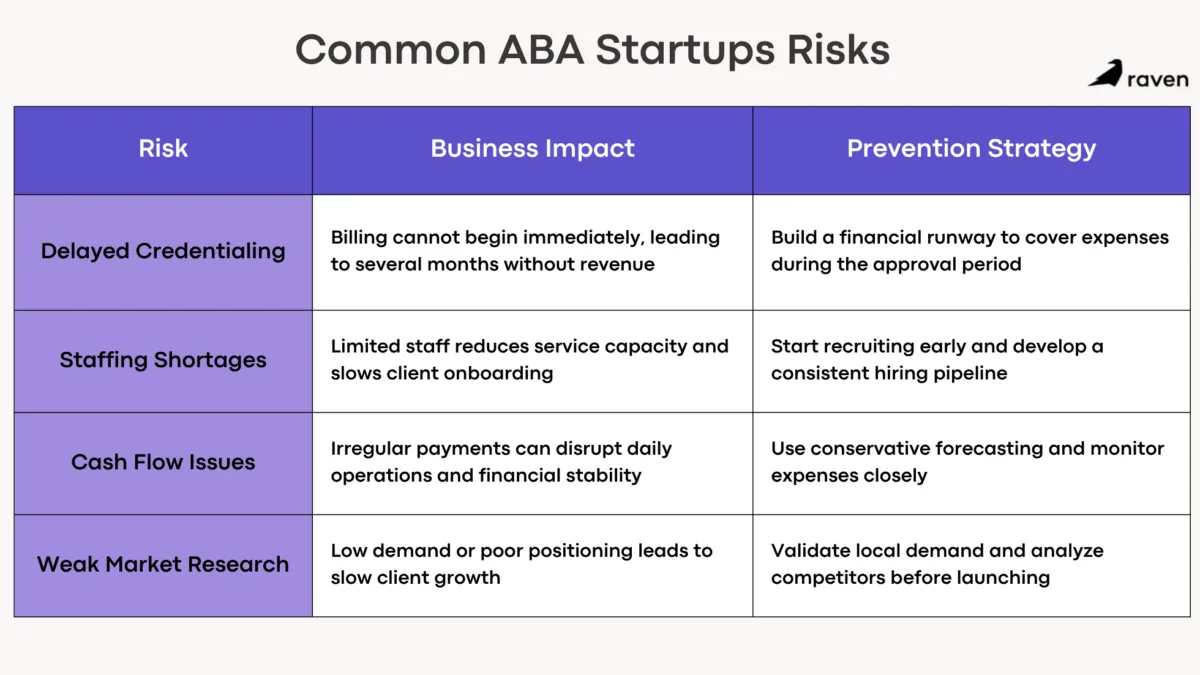
Starting an ABA clinic is exciting, but the early stages can be unpredictable if you’re not prepared for the common roadblocks. Many new clinic owners focus heavily on clinical quality but underestimate the business side, where small missteps can quickly turn into bigger challenges.
One of the biggest hurdles is timing. Delays in credentialing can leave your clinic operating without revenue for months, even after you’ve opened your doors. At the same time, hiring qualified staff isn’t always easy, which can limit how many clients you’re able to serve in the beginning.
Cash flow is another area that often catches new owners off guard. Payments don’t always come in consistently, and without careful planning, it becomes difficult to cover day-to-day expenses. On top of that, skipping proper market research can lead to slow client growth, especially if demand or competition wasn’t fully understood upfront.
The good news is that these risks are predictable. With early planning, realistic financial expectations, and a clear hiring and growth strategy, you can stay ahead of these challenges and build a clinic that runs smoothly from the start.
Conclusion
A comprehensive business plan is far more than a simple formality for securing bank funding; it is the operational compass for your entire ABA clinic. By defining your target market, structuring your clinical services, and realistically forecasting the months-long credentialing runway, you actively protect your practice from the financial turbulence that sinks many new startups.
While drafting financial spreadsheets may not feel as rewarding as running a direct therapy session, a rock-solid business plan ensures your clinic remains financially resilient.
This deliberate preparation guarantees that your doors stay open, allowing your team to focus on what truly matters: delivering life-changing clinical outcomes to the families in your community.