
Published on
Starting a small ABA clinic usually means your heart is set on helping children grow, not on getting confused by complex federal laws. But because your staff handles sensitive details about a child’s behaviors and family life every day, ignoring HIPAA guidelines is a risk that can quickly ruin your business.
Big hospitals are not the only ones who face audits; small practices are equally responsible for keeping patient data completely secure from the start. If the idea of compliance makes you feel overwhelmed, you are certainly not alone.
This guide breaks down the most common privacy mistakes small clinics make and offers a simple checklist to protect your practice and the families you serve.
Why HIPAA Compliance is a Growing Risk for Small ABA Practices?
Small Applied Behavior Analysis (ABA) clinics, or clinics just starting out, often focus deeply on client care, leaving administrative tasks like HIPAA compliance on the back burner. However, this is becoming a massive risk. Because ABA therapy counts as a healthcare service, clinics that bill insurance electronically are considered covered entities under federal law.
If a small practice ignores these rules, they face severe consequences from the Office for Civil Rights (OCR). You are even bound to pay a fine of thousands of dollars per violation. Beyond the financial hit, a data breach ruins the trust families place in your clinic.
Parents share highly sensitive details about their child’s behaviors and diagnoses, and losing that data can permanently damage a clinic’s reputation. As digital tools become more common in homes and clinics, the chances of an accidental data leak grow every single day.
The 7 HIPAA Requirements ABA Practices Most Commonly Miss
Even when small clinics try to follow the rules, they often overlook specific details during busy workdays. Here are seven common gaps that happen in the field:
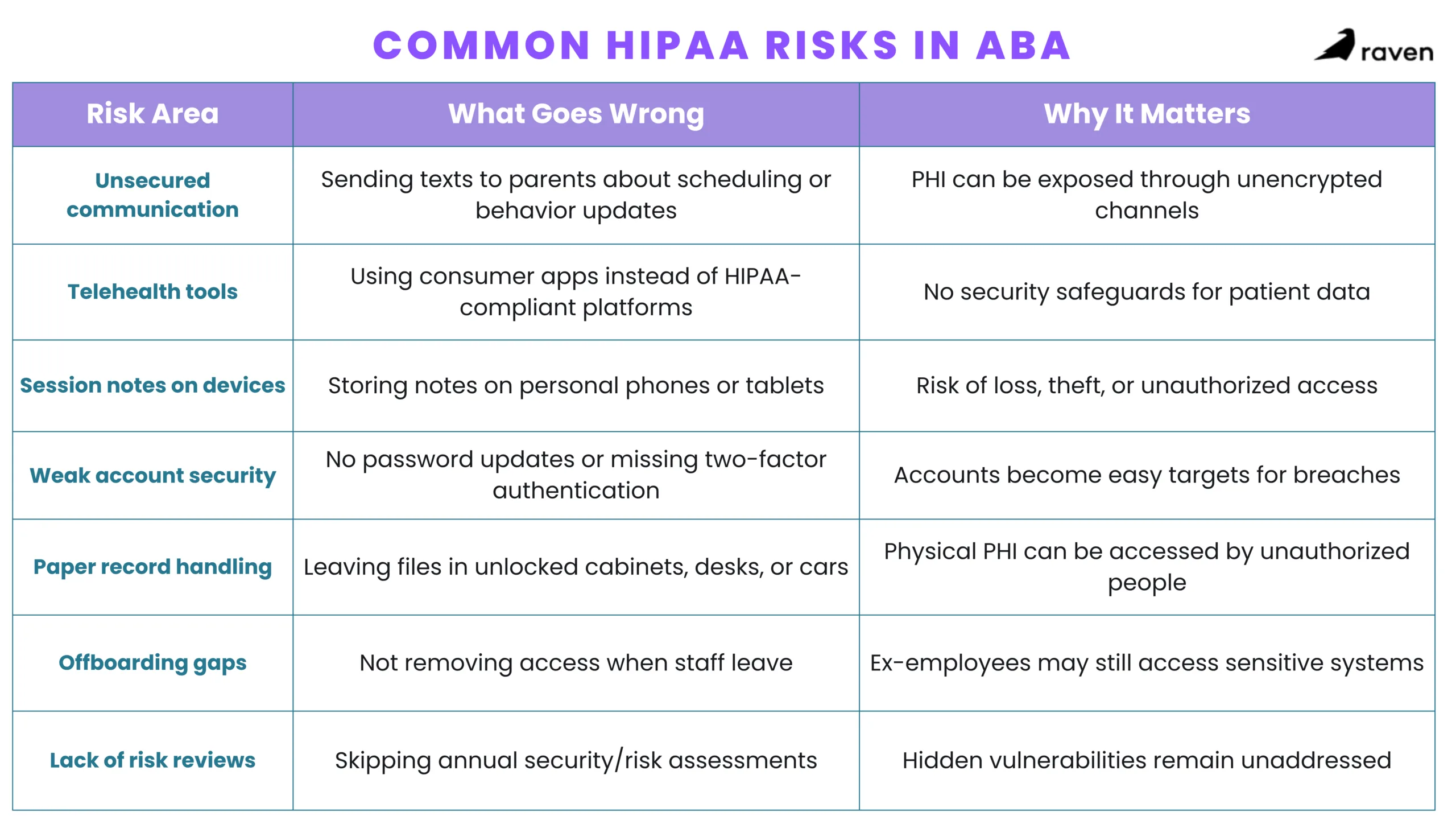
- Sending unsecured texts to parents about scheduling changes or daily behaviors.
- Using consumer-grade video tools for telehealth instead of secure, approved platforms.
- Keeping session notes on unencrypted personal mobile phones or tablets.
- Failing to update user passwords or enable two-factor authentication for staff accounts.
- Keeping paper records in unlocked cabinets, on desks, or inside cars.
- Not removing software access immediately when a behavior technician quits or is fired.
- Missing annual risk assessments to spot new security holes in the clinic.
Patient Data Storage and Access Controls
Keeping data safe means locking it down both physically and digitally. When it comes to digital records, clinics must use role-based access. This means a billing specialist should not have access to clinical session notes if they only need to see billing codes. Limiting who sees what is a core rule that stops data from being viewed by the wrong eyes.
For data storage, encryption is a must. Files should be protected with AES-256 encryption when they are resting on a server, and they must be secured during transfer over the internet.
Also, if staff members use tablets in the field or in a client’s home, those devices must have strong passcodes and the ability to be wiped remotely if they get lost or stolen.
Business Associate Agreements (BAAs)
A BAA is a legally binding contract between your clinic and any outside company that handles your patient data. Many small ABA practices make the huge mistake of signing up for cheap email systems, cloud storage, or scheduling apps without checking if the vendor will actually sign a BAA.
If you use a software company to store Protected Health Information (PHI) and you do not have a BAA on file, you are violating HIPAA rules immediately, even if no one hacks the data. You must get this contract signed and stored safely before putting any client details into a new digital system.
Staff Training and Documentation
Handing a new behavior technician a manual to read on their first day is simply not enough to meet the training requirement. HIPAA mandates that all staff members who touch PHI must receive formal training, and you have to prove it happened to an auditor.
You should clearly document the exact date of the training, the specific topics discussed, and keep signed papers showing that the staff understood the rules. These training records need to be kept safe for at least six years.
Doing this formal training once a year keeps security fresh in everyone’s mind and protects the clinic from massive fines.
Your HIPAA Compliance Checklist
To help you get on the right track without feeling overwhelmed, we have outlined a simple checklist. You can use these practical steps to review your daily operations right now.
- Review all software vendors and make sure you have a physical or digital signed BAA for each one.
- Check that all company laptops and tablets have strong passwords and automatic screen locks enabled.
- Confirm that paper files are locked away in cabinets and never left out in open waiting areas.
- Make sure your team only uses secure, encrypted messaging apps to talk about client progress.
- Schedule your yearly risk assessment and mandatory staff training sessions well in advance.
How Your ABA Software should Support Compliance Automatically?
The easiest way to stay compliant is to pick practice management software that does the heavy lifting for you. Good software operates quietly in the background to keep data completely safe without slowing down your therapists during a session.
Your platform should automatically log out users after a few minutes of no activity so an open screen is not left unattended. It should also create an instant audit trail, tracking exactly who looked at a file, what time they opened it, and what changes they made.
When the software handles all the complex encryption and logging, your team can spend less time worrying about rules.
Conclusion
Managing HIPAA compliance might feel like a heavy chore for a small ABA practice, but it is deeply necessary for protecting your clients and your business. By understanding the most common mistakes, setting strict data rules, and choosing the right software, you can build a highly secure environment.
It takes a little extra effort upfront, but doing it right gives families peace of mind and keeps your clinic safe from legal trouble.
Sources
https://www.praxisnotes.com/resources/aba-hipaa-compliance-faqs
https://ravenhealth.com/blog/hipaa-features-for-aba-practices/
https://behavioristbookclub.com/ceu/faq/addressing-hipaa-vulnerabilities/