

Running an ABA practice takes more than strong clinical care. Behind every well-run organization is an operational workflow that ties together scheduling, documentation, billing, and financial reporting. When these pieces don't talk to each other, small inefficiencies compound fast, showing up as delayed payments, administrative burnout, and slower growth.
This is especially true for practices in their first two or three years. A new clinic often starts with a patchwork: a scheduling tool here, a spreadsheet for authorizations there, billing handled through a separate system, documentation stored somewhere else entirely. Each tool might work fine on its own. Together, they create friction that's hard to see until it shows up in denied claims or a missed payroll deadline.
This article looks at where that friction actually comes from, what it costs a growing practice, and what a more connected setup looks like.
What Counts as a "Disconnected System"
A disconnected system is exactly what it sounds like: tools or processes that don't automatically communicate with one another.
In short, it’s any setup where tools or processes don't automatically share information. In ABA specifically, that usually looks like one platform for scheduling, another for clinical documentation, a spreadsheet tracking authorization units, and standalone billing software that nobody fully trusts.
None of these tools are bad on their own. The problem is what happens in between them: someone has to manually carry information from one system to the next, and that's where errors creep in.
1. Administrative Work Starts to Snowball
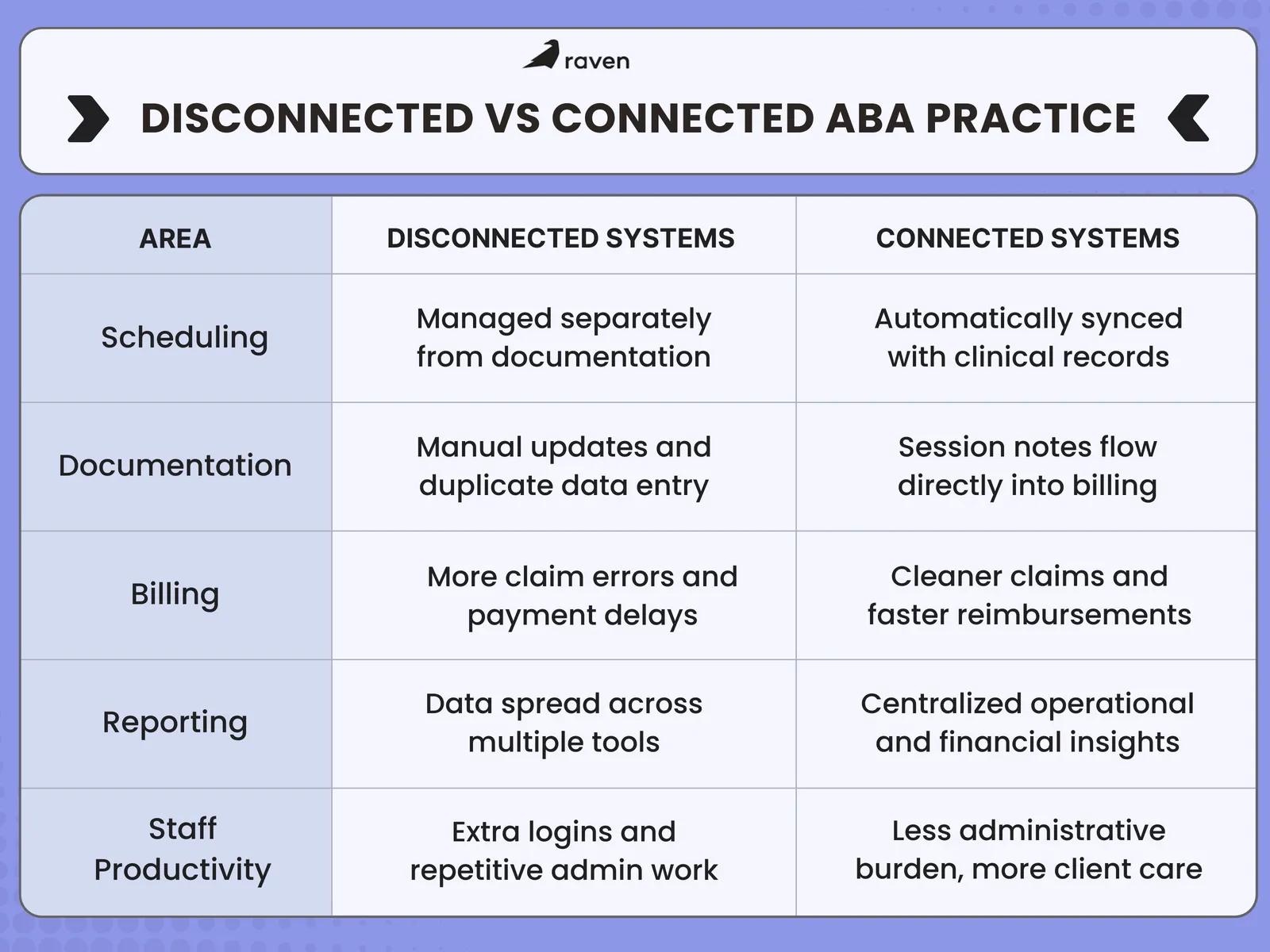
Admin teams end up re-entering learner information, manually checking authorization units against what was actually billed, updating schedules in more than one place, and pulling utilization reports from two or three different tools before a leadership meeting. None of this is a single time-consuming task. It's dozens of small ones that add up to hours every week, usually absorbed by the people who can least afford to lose the time.
2. Billing Delays Become More Common
ABA billing is unforgiving about mismatches. If a session note doesn't align with the authorized units, or if scheduling shows a session that documentation never confirms, that claim is at risk of denial. Payers in this space already have some of the more detailed documentation requirements in healthcare, and disconnected systems make it easy to miss something small that causes a real delay in payment. Practices that keep documentation, authorizations, and billing in sync tend to see fewer denials and faster reimbursement cycles.
3. Leadership Loses Operational Visibility
When utilization, cancellations, payer mix, and revenue trends live in different places, answering a basic question, like which payers are slowest to reimburse or which BCBAs are running under capacity, takes far longer than it should. For a growing practice trying to decide whether it can afford to hire another RBT or open a second location, that kind of delay in getting a straight answer is expensive in its own right.
4. Financial Performance Is Harder to Understand
Operational efficiency is only half the picture. A practice can have smooth scheduling and clean documentation and still be unclear on its actual margins once payroll, payer mix, and collection timelines are factored in. ABA revenue doesn't behave like revenue in most other businesses: units billed instead of flat invoices, session-based payroll, and reimbursement timelines that vary widely by payer. General bookkeeping tools built for retail or professional services often miss that nuance, which is part of why so many growing practices end up managing financial reporting by feel rather than with real numbers.
5. Staff Burnout Increases
Every extra login and manual workaround adds friction to someone's day. For BCBAs and RBTs already managing a full caseload, added administrative steps are among the most common reasons people burn out or leave. Reducing the number of systems staff have to touch is one of the more overlooked ways to improve retention.
What Does a Connected ABA Practice Look Like?
A connected workflow links scheduling, authorization tracking, documentation, billing, and reporting so that information moves automatically rather than being re-entered by hand. This is the gap Raven Health's practice management and RCM tools are built to close: authorizations, session notes, and billing stay tied together from the start, so claims go out clean, and leadership can see utilization and revenue in one place rather than piecing it together after the fact.
Operational data can answer questions like how many sessions were cancelled this month or which payers are slow to reimburse. Financial data answers a different set of questions: what's the actual margin after payroll, how does cash flow look three months out, and where is the practice over- or under-staffed relative to billable hours? Both matter, and they tend to require different tools. Some practices handle the second set with in-house finance help; others bring in an ABA-focused partner for it. Either way, the two data sets are more useful together than apart.
Questions Every ABA Organization Should Ask
How many systems do staff log into each day?
How much manual data entry happens after every session?
Can scheduling, documentation, and billing communicate automatically?
How quickly can leadership access meaningful business metrics?
Are financial reports helping guide strategic decisions?
Building a More Efficient ABA Practice
Practices don't usually fix this by adding more software. They fix it by making sure the systems they already depend on- scheduling, documentation, billing, and reporting- actually work as one connected process instead of five separate ones.
For clinics that are early in this process, it's worth taking stock of where the manual handoffs actually are before choosing new tools. That's usually where the real cost is hiding.
Conclusion
As ABA practices grow, disconnected systems become more than an operational inconvenience. They create unnecessary administrative work, increase the risk of billing issues, and make it harder for leadership to understand how the business is performing.
A connected workflow helps bring scheduling, documentation, billing, and reporting together so information flows more efficiently across the practice. By reducing manual processes and improving visibility, clinics can spend less time managing systems and more time focusing on quality care and sustainable growth.