Tracking behavior accurately is the foundation of Applied Behavior Analysis (ABA), but not every behavior can be easily counted with a simple tally mark. When a behavior happens too quickly, too frequently, or without a clear start and end point, ABA practitioners use specific discontinuous measurement methods to capture data.
Partial interval recording is one of the most widely used methods because it offers a practical, efficient way to track behaviors that would otherwise be nearly impossible to measure continuously in a busy environment.
Understanding exactly how this method works, when it is appropriate, and how it compares to other options is essential for creating accurate behavior intervention plans.
What Is Partial Interval Recording?
Partial interval recording is a discontinuous data collection method that breaks a larger observation period down into smaller, equal blocks of time, known as intervals. Instead of tracking exactly how many times a behavior happens or exactly how long it lasts, the observer records whether the target behavior occurred at any point during each specific interval.
If the behavior happens even once, whether it lasts for a single second or the entire duration of the block, the interval is marked as an occurrence. If the interval passes and the behavior never happens at all, it is marked as a non-occurrence.
This method provides an estimate of how often a behavior is happening over a session, reported as a percentage of total intervals, without requiring the therapist to catch every single instance.
How Does Partial Interval Recording Work?
To use partial interval recording effectively, practitioners must follow a rigid setup to ensure the data is reliable across different days and different observers.
The process starts with a crystal-clear operational definition of the target behavior. Everyone taking data must know exactly what counts as an occurrence and what does not.
Once the behavior is defined, the practitioner sets a total observation window, such as a 20-minute classroom period or a 15-minute free play session. This window is then sliced into smaller, equal intervals.
The length of the interval is usually determined by how frequently the behavior typically occurs. For high-rate behaviors, a practitioner might use a short 10-second interval. For behaviors that happen less often, a 2-minute or 5-minute interval might be more appropriate.
During the session, the observer watches the learner. As soon as the behavior happens within an active interval, the observer marks a "+" on their data sheet and stops tracking for that specific block.
They do not need to keep watching for that behavior until the timer resets for the next interval. At the end of the session, the observer counts the total number of "+" intervals, divides it by the total number of intervals in the session, and multiplies by 100 to get a final percentage.
Partial Interval Recording Example
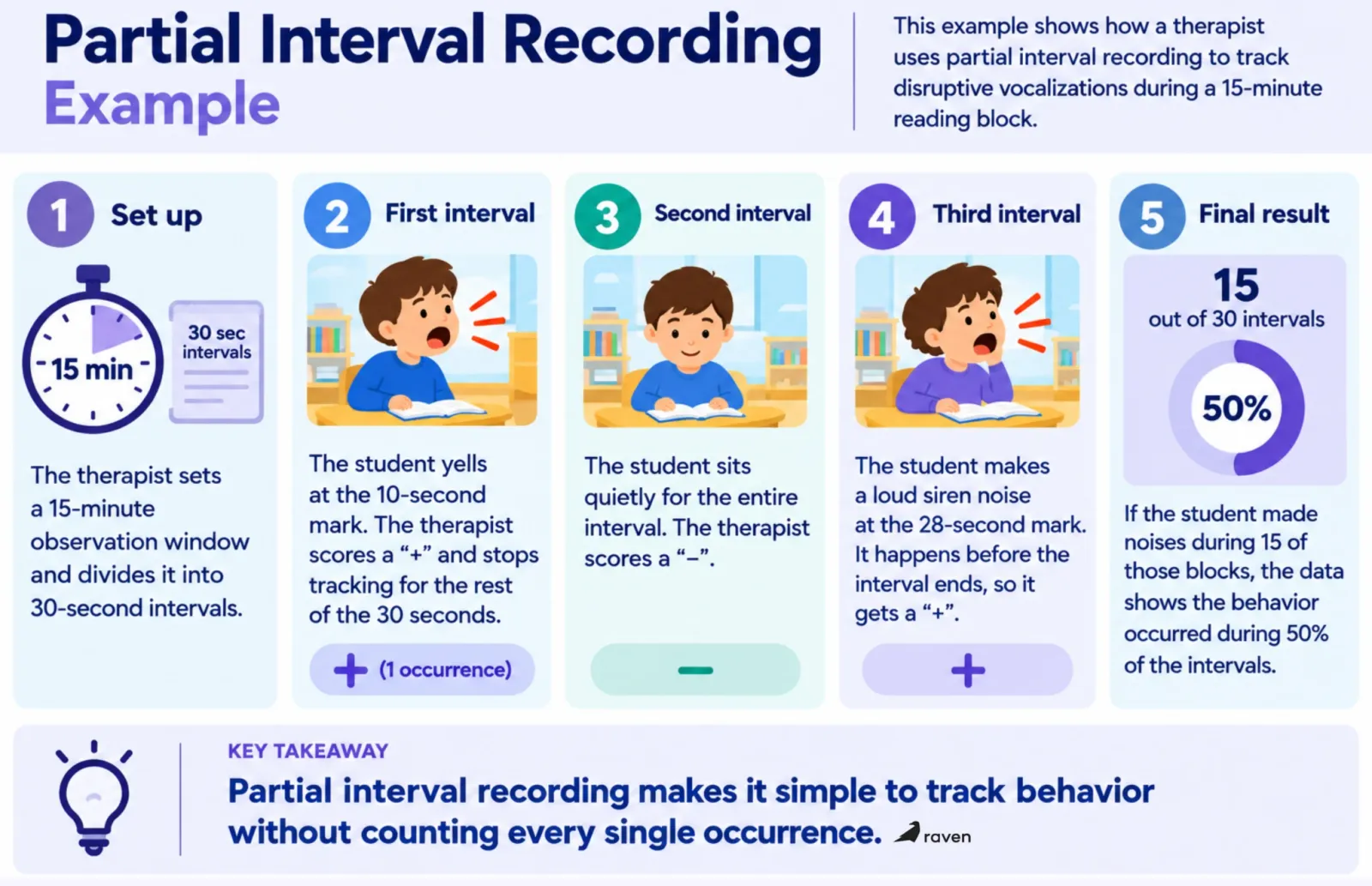
Imagine an ABA therapist is working in a busy kindergarten classroom and needs to track how often a student engages in disruptive vocalizations, such as yelling or making loud siren noises during a 15-minute reading block. Counting every single noise would be exhausting and likely inaccurate, so the therapist uses partial interval recording.
The therapist sets their total observation window for 15 minutes and divides it into 30-second intervals. They start their timer. During the very first 30-second block, the student yells out at the 10-second mark.
The therapist immediately scores that interval with a "+" and stops tracking the vocalizations for the remaining 20 seconds of that block. Even if the student yells three more times before the timer hits 30 seconds, it only counts as one occurrence for that specific interval.
During the second 30-second interval, the student sits quietly the entire time. The therapist scores a "-". In the third interval, the student makes a loud siren noise right at the 28-second mark. Because it happened before the interval ended, it gets a "+".
At the end of the 15 minutes, the therapist has 30 total intervals. If the student made noises during 15 of those blocks, the data would show that the behavior occurred during 50% of the intervals.
Partial Interval vs. Whole Interval Recording
In the ABA field, it is crucial to understand the difference between partial and whole interval recording, because choosing the wrong method will drastically change your data and potentially ruin a treatment plan.
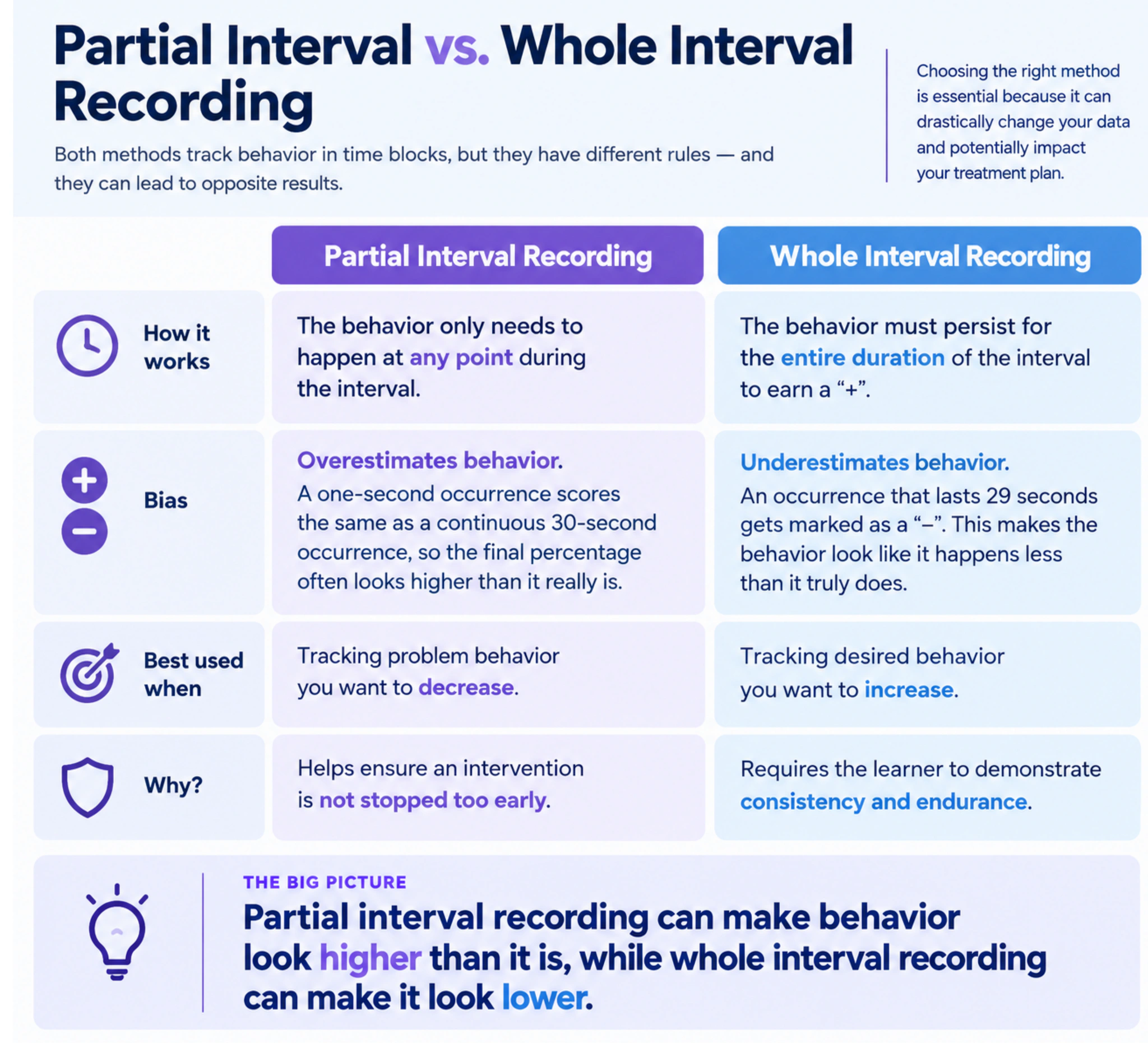
While partial interval recording only requires the behavior to happen at any point during the time block, whole interval recording demands that the behavior persists for the entire duration of the interval to earn a "+".
Because of these distinct rules, the two methods produce opposite biases:
Partial interval recording systematically overestimates behavior. Because a one-second occurrence scores the exact same as a continuous 30-second occurrence, the final percentage often makes the behavior look like it is happening more frequently than it actually is.
Whole interval recording systematically underestimates behavior. Because a behavior must last the entire 30 seconds to score, an occurrence that lasts 29 seconds gets marked as a "-". This makes the behavior look like it happens less than it truly does.
Practitioners use partial interval recording when their goal is to decrease a problem behavior, as the overestimation ensures they do not prematurely stop an intervention.
Conversely, they use whole-interval recording when the clinical goal is to increase a desired behavior, as underestimation forces the learner to build endurance and consistency to show progress on the graph.
Advantages and Limitations of Partial Interval Recording
Like any measurement tool, this method has distinct pros and cons that dictate when it should be pulled out of a clinician's toolkit. The biggest advantage is that it is incredibly practical and efficient for observers who have other responsibilities, like teachers or group therapists.
Because they only have to catch a behavior once per interval to score it, they do not have to maintain unbroken, constant eye contact with the learner for the entire session.
Additionally, this method is highly versatile. It provides a reliable estimate for both the frequency and the duration of a behavior using a single, simple data sheet, making it a great middle-ground metric when continuous data collection is impossible.
However, the limitations are significant. The most glaring flaw is the built-in overestimation artifact. If a child engages in a severe behavior for two seconds during a one-minute interval, the data makes it look like the behavior occupied the entire block.
If the interval lengths are set too long like a 10-minute block, the data becomes completely useless, failing to show actual clinical progress even if the behavior is drastically reducing in real-time. It is also a poor choice for measuring behaviors that are extremely low in frequency, as those are better tracked with a simple frequency tally.
When Should ABA Practitioners Use Partial Interval Recording?
Practitioners specifically select partial interval recording when they are targeting high-rate behaviors that happen so fast they cannot be accurately counted.
Behaviors like rapid hand-flapping, fast vocal stereotypy, or rapid finger-tapping are excellent candidates for this method because trying to tally each individual flap or tap would result in massive human error.
It is also the go-to method for behaviors that do not have a clear, discrete beginning and end. If a child engages in a continuous tantrum where crying blends into whining and then back into crying, it is difficult to say where one instance ended and another began.
Partial interval recording bypasses this problem entirely by just asking the simple question: did it happen at any point during this block?
Ultimately, ABA professionals use this method exclusively for behavior reduction programs. Because it intentionally overestimates the occurrence of a behavior, it provides a highly conservative measure of success.
If the data chart shows a problem behavior is dropping using partial interval recording, the BCBA can be absolutely certain that the intervention is genuinely working and the behavior is truly fading away.
How to Track Partial Interval Data?
To track this data accurately, preparation and consistency are key. Trying to guess interval times by glancing at a wall clock will instantly ruin the integrity of the data. Practitioners must use strict timing tools and organized documentation.
Here are the standard steps for tracking partial interval data in a live session:
Use interval timers: The observer should use a digital timer that automatically beeps or vibrates at the end of each interval (e.g., every 30 seconds). This allows the therapist to focus on the child rather than staring at a stopwatch.
Format the data sheet: Whether using a physical paper grid or a digital tablet, the data sheet must clearly list the interval blocks in sequence with simple "+ / -" checkboxes.
Score immediately: To prevent memory errors, the observer must mark the "+" the exact second the behavior is observed. If the timer goes off and the behavior did not happen, the "-" must be recorded immediately before the next interval begins.
Graph the results: At the end of the session, the total percentage of occurrence is calculated and plotted on a line graph. This visual representation allows the clinical supervisor to spot trends over time and make data-driven decisions about the treatment plan.
Conclusion
Selecting the right measurement system is just as important as selecting the right intervention. Partial interval recording provides an elegant, efficient solution for capturing chaotic, high-frequency behaviors that standard counting cannot handle.
By dividing a session into manageable time blocks, practitioners can reliably track problem behaviors without ignoring their other clinical duties. While it requires an understanding of its built-in overestimation bias, when used correctly for behavior reduction goals, partial interval recording delivers the solid, actionable data needed to change lives.
Sources:
https://www.theralytics.net/blogs/partial-interval-recording-in-aba
https://abastudyguide.com/glossary/partial-interval-recording/
https://www.artemisaba.com/blog/discontinuous-measurement-aba