When a child throws a toy, screams during a lesson, or runs out of a room, it is easy to assume they are just acting out. However, in the world of behavior analysis, these actions are almost always a plea for help. If an individual lacks the words or skills to say exactly what they want, they will use whatever behavior gets the job done the fastest.
Functional Communication Training (FCT) is a respectful intervention that addresses this problem. Instead of simply punishing a bad habit, therapists teach the individual a much easier and safer way to ask for what they need.
What Is Functional Communication Training?
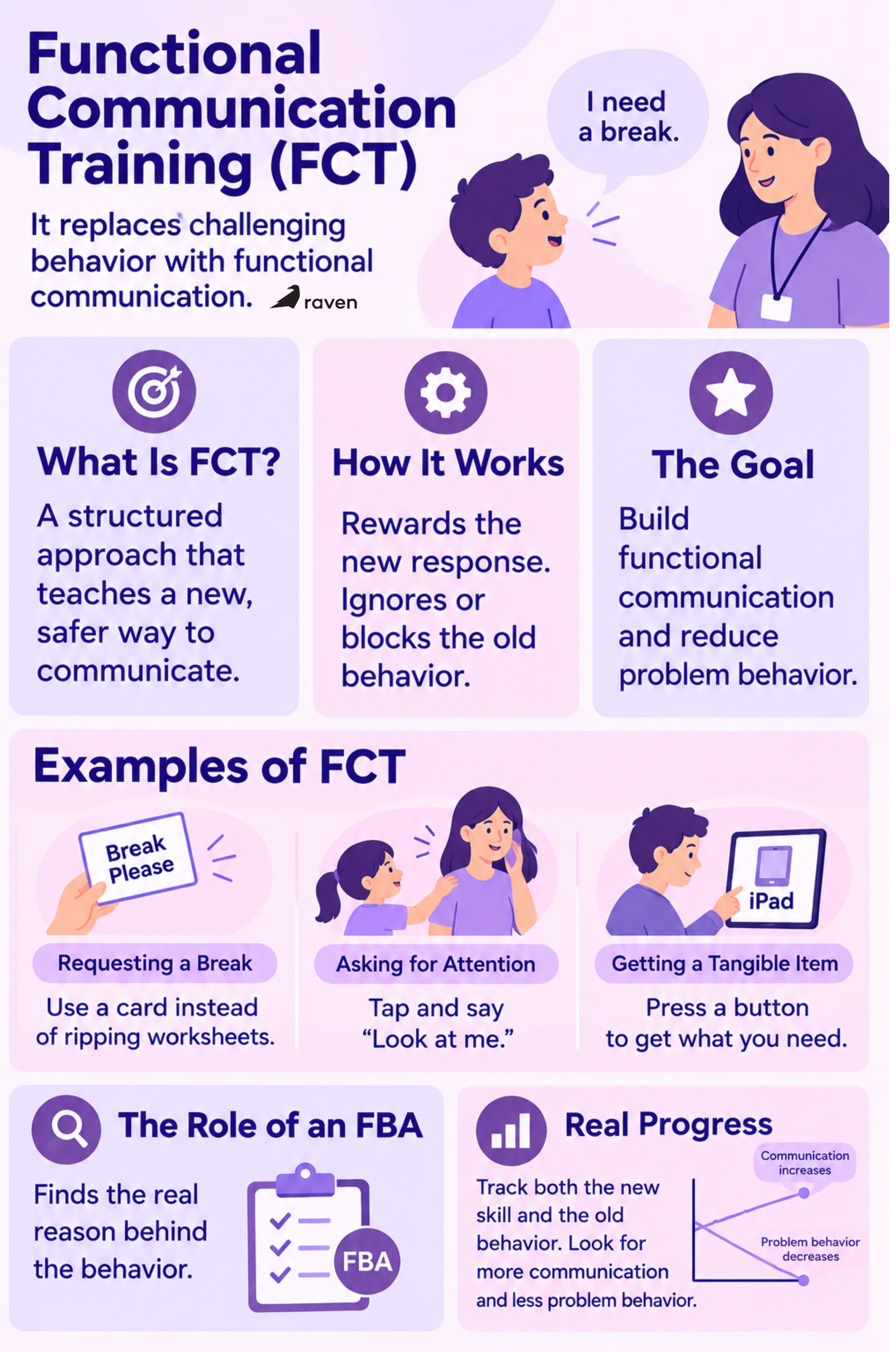
Functional Communication Training is an evidence-based behavioral intervention that replaces challenging actions with socially acceptable communication. The key word here is "functional." Therapists are not just teaching a child to repeat random vocabulary words; they are teaching communication that serves an immediate, real-life purpose.
This approach was first introduced to the clinical world in 1985 and has since become one of the most reliable tools in Applied Behavior Analysis (ABA). It operates under the belief that problem behaviors like aggression or self-injury are just misguided attempts to communicate.
By giving the learner a functional voice, the dangerous behaviors naturally fade away because they are no longer needed to get their point across.
How Does Functional Communication Training Work?
FCT relies on the scientific principle of differential reinforcement. This means the therapist actively rewards the new, appropriate communication while entirely ignoring or safely blocking the old, problematic behavior.
First, the clinical team figures out exactly what the child is trying to achieve with their behavior. Next, they pick an easier, more appropriate way for the child to ask for that exact same thing. Whenever the child uses the new communication tool, the therapist immediately honors the request.
Over time, the child's brain makes a new connection: asking nicely works instantly, while throwing a tantrum gets them nowhere.
Examples of Functional Communication Training
To understand how FCT works in a real room, you have to look at the daily struggles a child faces.
Requesting a Break
A student frequently rips up their math worksheets to get sent to the principal's office, which allows them to escape the hard work. Using FCT, the teacher prompts the student to hand over a small "Break Please" card. When the student uses the card, they get a two-minute break immediately. Ripping the paper no longer results in escaping the room.
Asking for Attention
A toddler hits their sibling every time their mother is on the phone because it guarantees the mother will hang up and scold them. Through FCT, the therapist teaches the child to tap the mother's arm and say "Look at me." The mother is coached to hang up and provide massive attention when the child taps, but to withhold attention if the child hits.
Getting a Tangible Item
A non-verbal teenager bites their own hand when they want access to an iPad that is placed out of reach. The clinician teaches the teen to use a tablet to press an "iPad" button. When the button is pressed, the device is handed over instantly.
The Role of Functional Behavior Assessment in FCT
You cannot start Functional Communication Training without doing some detective work first. This critical first step is called a Functional Behavior Assessment (FBA). An FBA helps the behavior analyst pinpoint the exact reason, or "function," behind the challenging action.
In ABA, behaviors generally serve one of four main functions: getting attention, escaping a demand, accessing a tangible item, or fulfilling a sensory need. If you do not figure out the correct function, your FCT plan will completely fail.
For example, if a child is screaming to escape a loud room, but you teach them to ask for a piece of candy instead, the screaming will not stop because the actual need was never met. The replacement behavior must directly match the original function discovered during the FBA.
Types of Communication Responses Used in FCT
Not every child communicates by speaking out loud. FCT is highly adaptable and respects the individual learner's current physical and cognitive abilities. Therapists select a communication method that takes less physical and mental effort for the child to perform than the problem behavior.
Vocal Speech: Teaching a child to use single words or short phrases to ask for what they want.
Sign Language: A great alternative for individuals who have the fine motor skills to use their hands but struggle with verbal speech.
Picture Exchange Communication System (PECS): The learner hands a physical picture of the item they want to a caregiver in exchange for the actual item.
Augmentative and Alternative Communication (AAC): Using high-tech devices, like tablets with speech-generating software, where the child presses a button and the device speaks for them.
Common Challenges with Functional Communication Training
Even though FCT is highly effective, practitioners and parents often run into a few common roadblocks during the initial teaching phase.
The biggest mistake is waiting until the child is already having a meltdown to teach the new skill. When a child is highly stressed and escalated, their brain cannot process new information. Therapists must set up contrived, calm practice sessions to teach the skill in a low-pressure environment before a real crisis happens.
Another major issue is inconsistency across different environments. If a therapist honors a picture card at the clinic, but a parent at home ignores the picture card and gives in to a tantrum instead, the child will revert right back to the problem behavior. Everyone interacting with the child must respond to the new communication tool in the exact same way for the training to stick.
How to Measure Progress in FCT?
Because ABA is a science based entirely on objective data, practitioners do not just guess if a child is getting better at communicating; they track it meticulously. Therapists record the exact frequency of both the new communication skill and the old problem behavior during every single session.
Ideally, the data graph should show two crossing lines: the challenging behavior steadily dropping toward zero, and the new communication skill sharply rising. To keep track of this intense daily data collection and manage the operational side of a clinic smoothly, many ABA practices rely on robust practice management and financial software like Flychain.
Utilizing strong digital systems ensures that clinic owners and BCBAs spend less time worrying about billing and paperwork, allowing them to focus fully on analyzing the clinical data and adjusting the FCT plan as the child grows more independent.
Conclusion
Behavior is just communication in disguise. When we look at a challenging behavior as a missing skill rather than a disciplinary issue, we completely change how we help individuals with developmental delays.
Functional Communication Training empowers learners by giving them a clear, functional voice. By taking the time to uncover the true reason behind a behavior through an FBA, and consistently rewarding an easier alternative, therapists and caregivers can reduce daily stress and open the door to a much more connected, fulfilling life.
Sources:
https://www.alumacare.com/blog/what-is-functional-communication-training-in-aba
https://www.ambitionsaba.com/resources/the-role-of-functional-communication-training-in-aba-programs
https://empoweraba.com/what-is-functional-communication-training-fct-in-aba/