
Data collection is the core of Applied Behavior Analysis (ABA). Without accurate numbers, therapists cannot objectively tell if a behavioral intervention is actually helping a client. While some behaviors are quick and easy to count, others are better understood by measuring exactly how much time they take up.
This is where duration data collection becomes an essential tool for behavior analysts. By capturing the exact length of a behavior, practitioners gain a much clearer picture of a client's daily challenges and successes.
What Is Duration in ABA?
In ABA, duration is a type of continuous measurement that records the exact length of time a specific behavior lasts, from the moment it begins to the moment it ends.
As a continuous measurement system, it requires the observer to capture every single instance of the behavior during the session to get a complete, unbroken picture of the session. Instead of asking "How many times did this happen?" duration answers the question "How long did it last?"
This measurement is highly effective for behaviors that occur for extended periods, such as crying, reading, or independently playing with a toy.
How Is Duration Measured in ABA?
Measuring duration requires the right tools and a clear, organized plan to ensure the data is reliable across different days and different therapists.
Define the Behavior
The most important step is creating a strict, measurable operational definition. Everyone on the clinical team must agree on what exact action starts the timer and what exact action stops it.
Choose a Tool
Therapists typically use a digital stopwatch, a smartphone timer app, or specialized ABA data collection software that automatically syncs the recorded times directly to a client's graph.
Record the Time
The observer starts the timer the exact second the defined behavior begins and stops it the second the behavior ends.
Select a Format
Practitioners can track "total duration" by combining the time of all episodes in a session, or "duration per occurrence" to see how long each individual episode lasted on its own.
Duration Measurement Examples
Practical examples help clarify exactly how this data looks when applied in a real-world clinic, home, or school setting.
Tantrums: A therapist measures an emotional outburst and records that the episode lasted for exactly 12 minutes.
On-Task Behavior: A teacher tracks a student during a quiet reading block and notes that the student stayed completely focused on their assignment for 20 continuous minutes.
Social Engagement: A practitioner uses a timer to see that a child spent 6 minutes playing independently or engaging appropriately with their peers at recess.
Stereotypic Behavior: A clinician tracks that a learner engaged in repetitive physical motions, such as hand-flapping, for a total of 30 minutes over the course of the therapy session.
How to Calculate Duration in ABA
At the end of an observation period, the raw timer data must be calculated into usable metrics so the supervising behavior analyst can make treatment decisions.
Total Duration
Simply add up the time from every episode that occurred during the observation period. If a child cried for 3 minutes, 5 minutes, and 2 minutes throughout the day, the total duration is exactly 10 minutes.
Average Duration
Take the total duration and divide it by the total number of episodes. Using the previous example, 10 total minutes divided by 3 separate episodes equals an average duration of roughly 3.33 minutes per episode.
Percentage of Session Time
Divide the total duration by the total length of the observation session, then multiply by 100. This is especially useful if therapy sessions vary in length from day to day, as it provides a fair, standardized comparison to see if the behavior is actually improving.
When Should You Use Duration Measurement?
You should use this method whenever the length of the behavior has a bigger impact on the client's safety or quality of life than the sheer number of times it happens.
For instance, a single tantrum that lasts 45 minutes is usually much more concerning and disruptive to a family than three separate tantrums that only last one minute each. It is also the ideal choice for measuring behaviors that have a clear start and end point.
Practitioners rely heavily on this method when they want to track behavioral endurance, such as slowly increasing how long a child can safely sit at the dinner table or engage in independent play.
Duration vs. Frequency in ABA
These are the two most common continuous measurement methods used in the field, but they track entirely different dimensions of human behavior.
Duration focuses exclusively on time. It captures the elapsed time of the behavior but does not inherently tell you how many times it happened unless you actively record each occurrence separately.
Frequency focuses exclusively on counting. It measures how many times a behavior happens, but completely ignores how long those behaviors lasted.
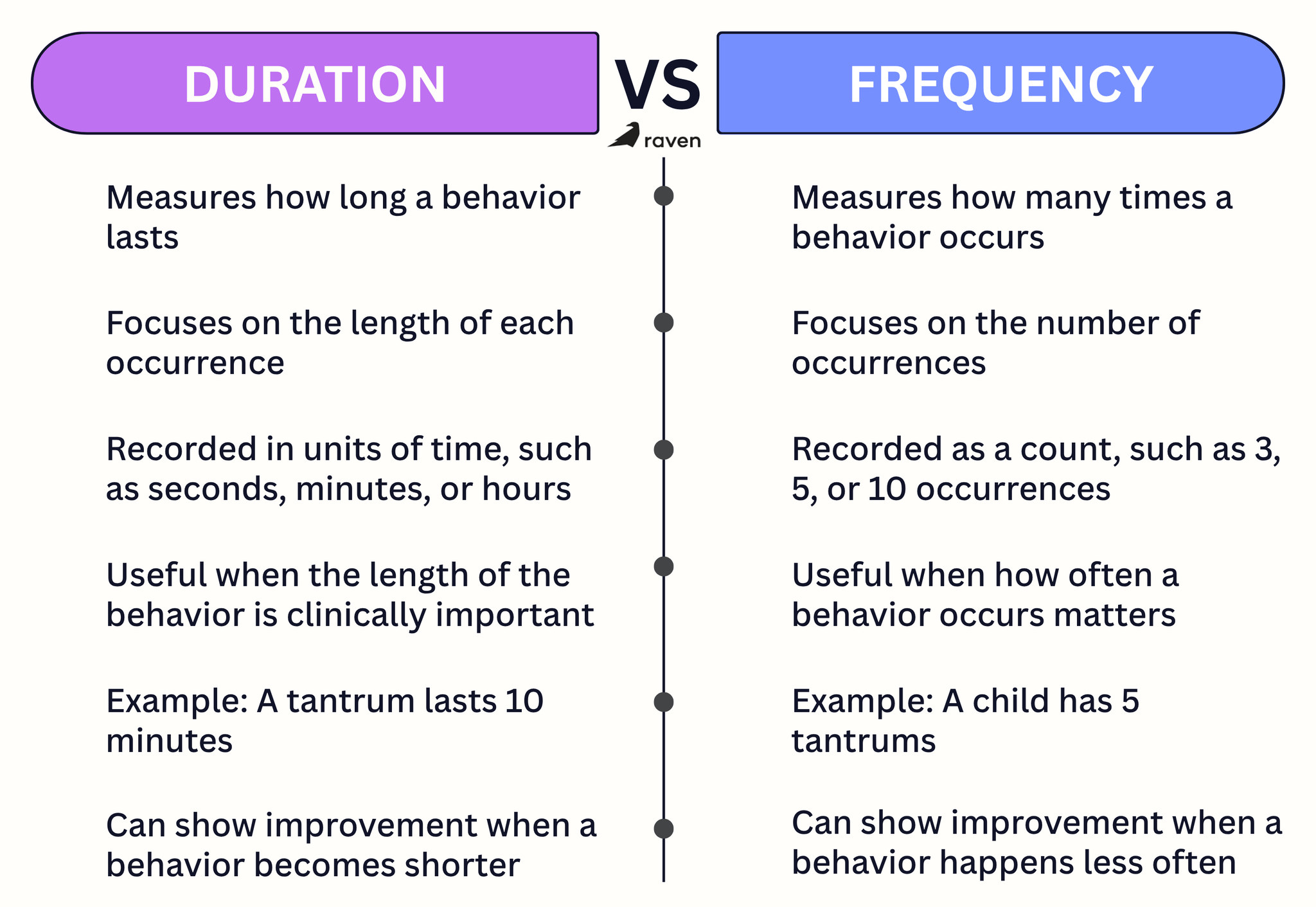
If a practitioner only uses frequency, they might see that a child had five tantrums on Monday and five tantrums on Friday, assuming no progress was made.
However, if they used duration, they might see that Monday's tantrums lasted 30 minutes, while Friday's tantrums only lasted 5 minutes. Often, the best clinical approach is to collect both metrics at the same time to get a more accurate picture of the behavior.
Common Mistakes When Measuring Duration
Even highly experienced therapists can make tracking errors that accidentally ruin the integrity of the clinical data.
Vague Definitions
If a behavior is not defined clearly, two different therapists will start and stop their timers at completely different moments. For example, if a definition does not clearly state whether a tantrum ends when the crying stops or when the child stands up, the data will be unreliable. Running regular interobserver agreement (IOA) checks, where two observers time the same behavior and compare results, is the easiest way to catch this.
Data Collection Fatigue
Because duration requires continuous, unbroken focus on the learner, a therapist might easily miss an episode if the observation period is too long or they become distracted by other students in the room. When continuous recording isn’t realistic, research on discontinuous methods can help teams choose a sampling approach that still produces useful data.
Confusing It with Latency
Duration measures the total length of the actual behavior, while latency measures the time it takes for a behavior to start after an instruction is given. Mixing these two measurements up will completely skew the graph and the resulting treatment plan.
Conclusion
Accurately measuring behavior is the only way to know if an individual is genuinely making progress in therapy. Duration provides a powerful, time-based lens for behavior analysts to see exactly how much of a session is being consumed by challenging behaviors or, conversely, how much time is being gained in positive, independent activities.
By defining behaviors clearly, choosing the right calculation methods, and avoiding common tracking mistakes, practitioners can build effective, data-driven interventions that truly improve a learner's everyday life.
Sources:
https://www.connectncareaba.com/blog/understanding-duration-in-aba/
https://www.passagehealth.com/blog/duration-aba
https://www.artemisaba.com/blog/duration-aba