When teaching new skills using Applied Behavior Analysis (ABA), learners will inevitably make mistakes. An error can be picking the wrong picture card, saying the incorrect word, or simply sitting in silence and not responding to a question at all.
In everyday life, people often react to mistakes by saying "no," getting frustrated, or just giving the person the right answer and moving on. In ABA therapy, however, practitioners use a structured, systematic approach called error correction.
The goal of error correction is not to punish the learner. It is to guide them to the correct answer without accidentally reinforcing the wrong response.
When it is done well, error correction reduces frustration, keeps the learner from practicing incorrect responses, and helps them acquire new skills faster. A 2019 review in the Journal of Applied Behavior Analysis describes error correction as a remedial strategy used after an incorrect response to make a correct response more likely in the future.
Common Error Correction Procedures in ABA
There is no single, universal way to correct an error. Practitioners choose a strategy based on what the learner is working on and how they respond to feedback.
Modeling and Demonstration
This is one of the simplest methods. The therapist shows the child exactly what to do. If the therapist asks the child to clap their hands and the child touches their head instead, the therapist claps their own hands to model the correct response.
Re-Prompting (Increasing Assistance)
If a child makes a mistake, the therapist immediately steps in with a more supportive prompt. For example, if pointing to the correct object (a gestural prompt) didn't work, the therapist might gently guide the child's hand to touch the object (a physical prompt).
The 4-Step Procedure (Model, Prompt, Switch, Repeat)
This is a highly structured routine. First, the therapist models the correct answer right after the error (Model). The child then gives the correct response with that help (Prompt). Next, the therapist presents one or two easy, mastered tasks like touching their nose or giving a high-five (Switch, sometimes called a distractor trial). Finally, the original instruction is presented again so the child can answer independently, and a correct response is reinforced (Repeat).
Transfer Trials
After helping a child get the right answer with a prompt, the therapist immediately presents the same instruction again, this time without the prompt. This transfer trial shifts control from the therapist's prompt to the instruction itself, so the child learns to respond independently.
Error Correction Examples in ABA
To see how these procedures work in practice, here are two everyday clinical examples covering different types of skills.
Example 1: Labeling an Object (Expressive Language)
The therapist holds up a picture of a cat and asks, "What is this?" The child looks at it and says, "Dog." The therapist immediately says, "Cat. What is this?" The child repeats, "Cat."
To make sure the child actually learned the response, the therapist might present a quick distractor task like "Touch your nose." After the child touches their nose, the therapist holds up the picture of the cat again and asks, "What is this?" The child says, "Cat," and the therapist gives them a high-five and verbal praise.
Example 2: Following Instructions (Receptive Language)
The therapist places a red block and a blue block on the table. They say, "Give me the blue block." The child reaches for the red block. Before the child can grab it, the therapist gently blocks their hand and physically guides their hand to pick up the blue block.
Then, the therapist rearranges the blocks on the table and asks again, "Give me the blue block," giving the child a chance to complete the task independently.
How to Implement Error Correction
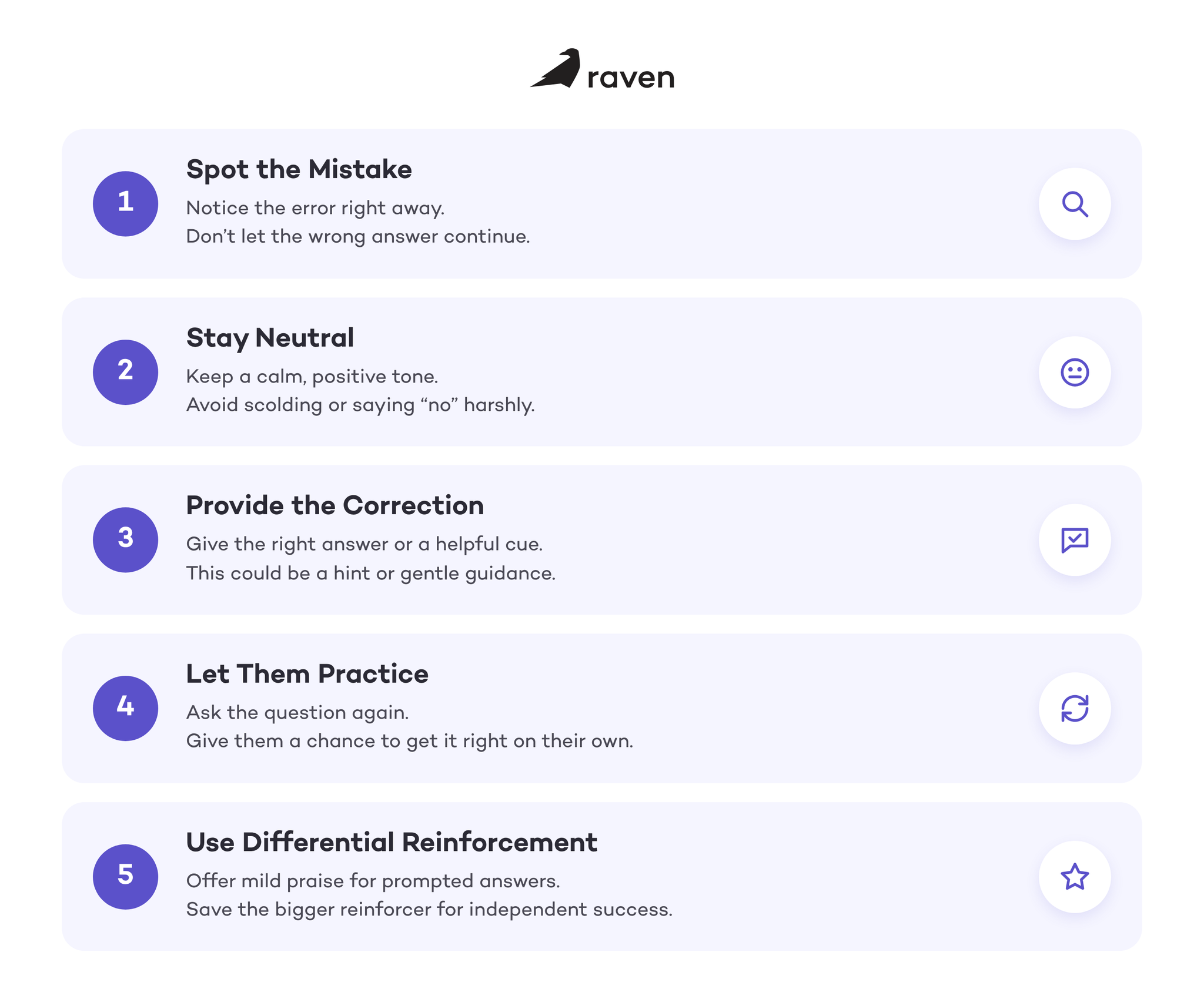
Implementing these procedures takes patience, consistency, and a calm approach. Following a clear sequence helps the child learn without feeling discouraged.
Identify the Mistake Immediately
As soon as the child gives the wrong answer or hesitates too long, step in. Letting them repeat the incorrect response over and over only strengthens it.
Stay Neutral
Do not scold, sigh, or say "no" in a harsh tone, and avoid making a big deal out of the mistake. Simply pause the activity or gently clear the teaching materials.
Provide the Correction
Give the child the exact prompt they need to succeed in that moment. That might mean saying the correct word for them or guiding their hand.
Create an Opportunity to Practice
Do not just give them the answer and move on to a new activity. You must ask the question or present the instruction again so they can practice getting it right on their own.
Use Differential Reinforcement
This step matters most. When the child gets the answer right with your help, give mild praise. When they get it right on their own during the practice trial, deliver a bigger reinforcer, like access to a favorite toy or enthusiastic praise.
Error Correction vs Prompting in ABA
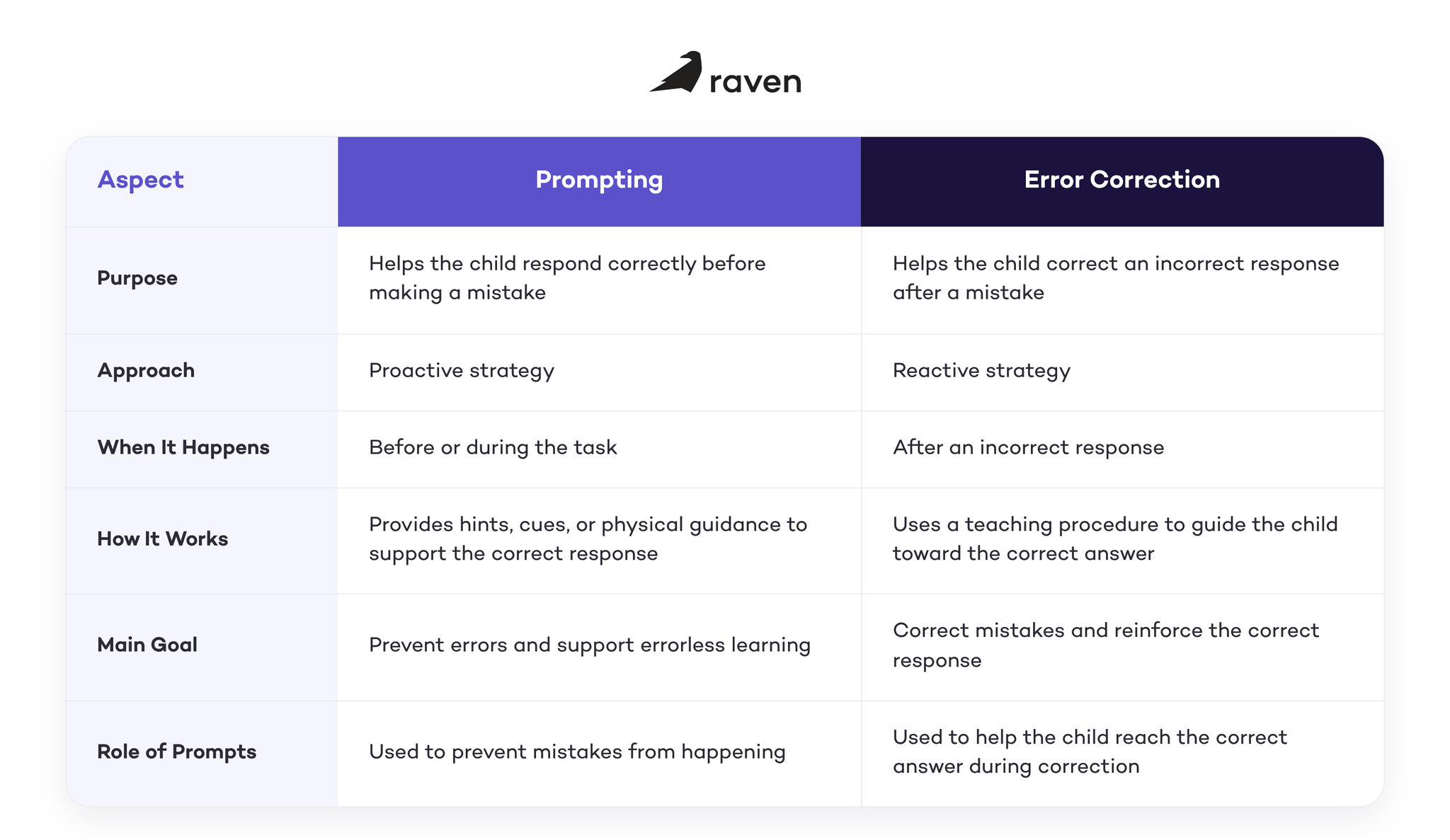
While they sound similar and are often used together, prompting and error correction play different roles in a teaching session.
Prompting is a proactive strategy. It involves giving the child a hint or physical guidance before or during the task so they do not make a mistake in the first place. This is the foundation of errorless learning, a teaching approach that tries to prevent errors so the learner stays confident.
Error correction, on the other hand, is a reactive strategy. It is the specific protocol you follow after a mistake has already happened. Both approaches work. A randomized clinical trial with 28 learners with autism found that errorless learning and error correction were both effective and efficient for teaching tacts (labeling).
However, you will almost always use prompts as a tool within your error correction procedure to help the child find the right answer. In short: prompts are used to prevent errors, but they are also used to fix them once they happen.
Common Mistakes to Avoid with Error Correction
Even experienced practitioners and well-meaning parents can slip up when correcting mistakes, which can slow down learning.
Accidentally Rewarding the Error
If a child makes a mistake because they want your attention, and you respond with a long, emotional lecture about why they are wrong, you may be reinforcing the error. Keep corrections brief, boring, and emotionally neutral.
Giving the Biggest Reward for a Prompted Answer
If a child gets the best reinforcer (like a favorite snack or tablet time) after you basically did the task for them, they have little reason to try it independently next time. Save the best reinforcers for independent responses.
Being Inconsistent
If a Registered Behavior Technician (RBT) uses a structured 4-step correction, but a parent ignores the mistake and gives the child the toy anyway, the child gets mixed messages. Everyone working with the learner should use the same strategy.
Skipping the Transfer Trial
If you only show the child the correct answer but never ask them to respond again on their own, they are less likely to retain the skill. They need to practice without your help.
How to Choose an Error Correction Procedure
Selecting the right strategy depends on the individual learner and the complexity of the task.
If a child gets frustrated easily and tends to shut down or cry after a mistake, an intensive 4-step procedure might be too much. For these learners, a simple model-and-move-on approach, combined with errorless teaching to prevent mistakes in the first place, may work better.
You also have to consider what you are teaching. A complex chain of physical behaviors, like learning how to tie shoelaces or wash hands, might require hands-on physical guidance to correct.
Conversely, a simple vocal mistake, like saying the wrong number, might only need a quick verbal model. Practitioners should review session data regularly to see whether the chosen correction method is helping the learner acquire the skill, and adjust if progress stalls. ABA data collection software makes those trends easier to spot across sessions.
Conclusion
Error correction turns challenging moments into valuable learning opportunities.
By keeping reactions neutral, providing immediate guidance, and saving the biggest reinforcers for independent success, practitioners build a supportive environment where mistakes are a natural step toward new skills.
Consistency across the whole care team helps the learner build long-term confidence and independence without unnecessary frustration. To see how Raven Health helps teams track learner progress and keep everyone on the same page, schedule a demo.
Sources:
https://heartlinksaba.com/what-is-error-correction-in-aba-therapy/
https://www.crossrivertherapy.com/articles/the-role-of-error-correction-in-aba-teaching
https://www.magnetaba.com/blog/what-is-error-correction-in-aba
https://www.astroaba.com/blog/what-is-error-correction-in-aba-therapy