Stepping out of the clinical role to open your own Applied Behavior Analysis (ABA) practice is a thrilling milestone. You likely have a vision for the perfect sensory gym, a dedicated team of technicians, and a community of families waiting for your services.
Opening a clinic means dealing with state rules, business forms, and strict insurance guidelines. If you miss even one small step, you could face big fines or have trouble getting paid by insurance right from the start.
To keep your business safe and help you launch with confidence, here is a clear guide to the legal and licensing steps you need to take before opening your doors. To help you protect your investment and launch with confidence, here is the ultimate guide for you to explore in this article.
Why Licensing Matters for ABA Clinics?
You might wonder why you need so much paperwork if you already hold a national certification. The reality is that legal licensing is what separates a legitimate, fundable healthcare facility from a risky liability.
Proper licensing is not just a regulatory hoop to jump through; it is the fundamental key to your revenue cycle. Commercial insurance companies and state Medicaid programs will refuse to credential your clinic if your business licensing is incomplete.
Furthermore, having your legal work in a row establishes immediate trust with the families you serve, proving that your facility meets state-mandated health and safety standards.
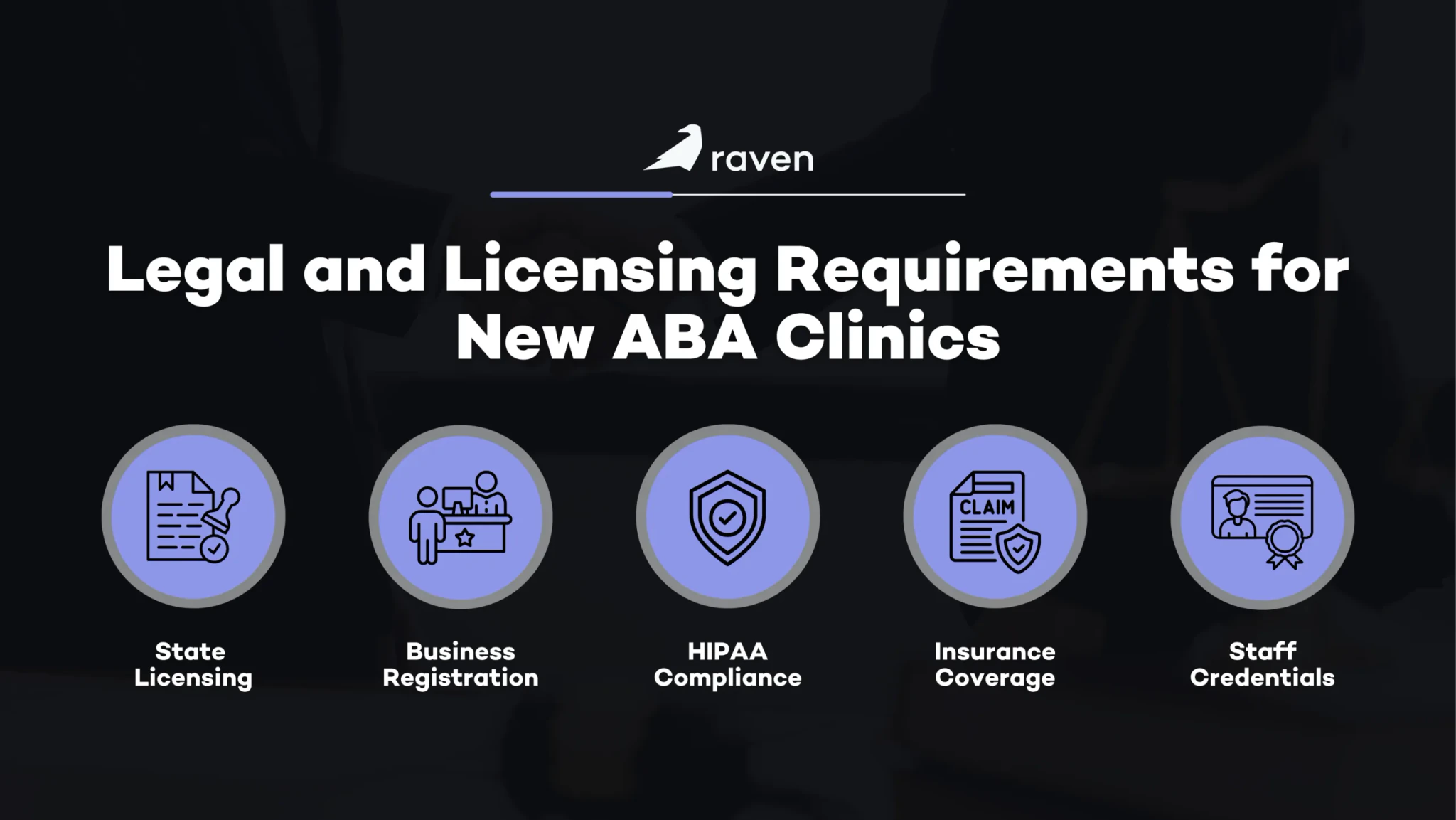
State Licensing Requirements Overview
There is no universal, federally mandated license to open an ABA clinic. Instead, the rules change drastically the moment you cross state lines.
While the Behavior Analyst Certification Board (BACB) governs the professional certification of practitioners nationally, the state governs your business. Many states now require a specific licensure for behavior analysts (LBA) to practice legally.

Additionally, your physical clinic may need a healthcare facility license or an early childhood center license, depending on the age group you treat and the specific services you deliver.
You must contact your state’s Department of Health or designated regulatory board to understand the exact facility licenses required for your zip code.
Business Registration and Legal Structure
Before you can apply for any clinical licenses or sign a commercial lease, you have to establish your practice as a legal entity.
Do not operate as a sole proprietorship. Because healthcare carries inherent risks, you need to protect your personal assets by forming a Limited Liability Company (LLC) or an S-Corporation.
Once you file your articles of organization with your state, you must immediately apply for an Employer Identification Number (EIN) through the IRS. Your EIN acts as your business’s social security number and is strictly required to open a business bank account, process payroll, and apply for group National Provider Identifier (NPI) numbers.
Insurance Requirements for ABA Practices
Accidents happen, especially in active clinical environments with children. Operating an uninsured clinic is a massive financial gamble.

To safeguard your practice, you must secure several distinct policies:
Professional Liability (Malpractice)
This covers your BCBAs and Registered Behavior Technicians (RBTs) if a family claims that a treatment plan caused harm or failed to meet the standard of care.
General Liability Insurance
This is the standard “slip and fall” insurance. It covers physical injuries that happen on your property, such as a parent tripping in the waiting room.
Workers’ Compensation
If an RBT is injured on the job (for example, by an aggressive client), this insurance covers their medical bills and lost wages. Most states legally require this the moment you hire your first employee.
HIPAA Compliance and Patient Privacy
Protecting Protected Health Information (PHI) is a federal mandate. The U.S. Department of Health and Human Services (HHS) heavily penalizes clinics that mishandle patient data.
HIPAA compliance goes far beyond keeping files in a locked cabinet. Your entire digital infrastructure must be secure.
You are legally required to sign a Business Associate Agreement (BAA) with any third-party software vendor you use, including your practice management system, email provider, and payroll service. If a vendor refuses to sign a BAA, you cannot legally use them to store or transmit client data.
Staff Certification and Credential Requirements
Your clinic is only as compliant as the people working inside it. Every single BCBA and RBT on your payroll must have active, verified credentials before they bill a single hour of therapy.
You must secure a Type 2 (Organizational) NPI number for your clinic, while ensuring every individual provider holds an active Type 1 (Individual) NPI.
Furthermore, insurance credentialing is tied directly to staff certifications. If an RBT lets their certification lapse but continues to run sessions, billing for those hours constitutes insurance fraud, which can result in devastating legal consequences for your new clinic.
Common Legal Mistakes New Clinics Make
Many new owners try to cut corners to save money, only to find themselves in deep legal trouble months later. Avoid these common pitfalls:
Misclassifying Employees
Attempting to classify RBTs as independent contractors (1099) rather than employees (W-2) to save on taxes. Because BCBAs dictate exactly how, when, and where RBTs work, labour laws almost universally classify them as employees.
Jumping the Gun on Billing
Providing services before your insurance credentialing contracts are fully executed. You cannot legally retro-bill for dates of service before your official network’s effective date.
Skipping Background Checks
Failing to run comprehensive, state-mandated criminal background checks on staff who work directly with vulnerable populations.
Conclusion
Starting your own ABA clinic is an incredible achievement, but ignoring the legal and administrative side can quickly turn that dream into a stressful situation. By taking the time to secure the right state licenses, set up proper insurance, and follow privacy rules from day one, you are protecting everything you’ve worked so hard to build. It might seem like a lot of paperwork up front.
However, getting it right the first time means you can stop worrying about compliance and focus on what really matters: providing amazing, life-changing care to the families in your community.