Being an Applied Behavior Analysis (ABA) therapist means you have to spend hours on your feet, running teaching trials, managing intense behaviors, and keeping children engaged in their learning environment. Then, just when you think your day is finally over, you have to sit down and face the reality of writing session notes.
Paperwork is often the number one reason behavior technicians and analysts burn out and leave the field entirely.
While clinical documentation is absolutely necessary to track a child's progress and make sure insurance companies actually pay the clinic for the session, writing these notes from scratch every single day takes way too much time.
The good news is that writing notes does not have to be a painful, drawn-out process. By changing a few daily habits and leaning on modern software, you can drastically cut down on your documentation time without sacrificing the quality of your clinical records.
Generate ABA Session Notes with AI
The biggest leap you can make to speed up your daily paperwork is to completely change how the note is actually written. For years, therapists just stared at a blank screen and tried to remember everything that happened during a two-hour session.
Artificial intelligence is now stepping in to do the heavy lifting. AI note generators are designed to take the raw data you collect during a session and instantly turn it into a readable, professional narrative.
A standout platform in this space is Raven Health. We have built AI-powered session note generation specifically for the ABA industry. Instead of typing out long paragraphs about how many times a child asked for a toy, the Raven Health AI looks at the data buttons you tapped during the session.
It then automatically drafts a highly detailed, HIPAA-compliant session summary in a matter of seconds. The system understands the specific clinical language of ABA, so it knows how to write about prompt levels, behavioral interventions, and skill acquisition correctly.
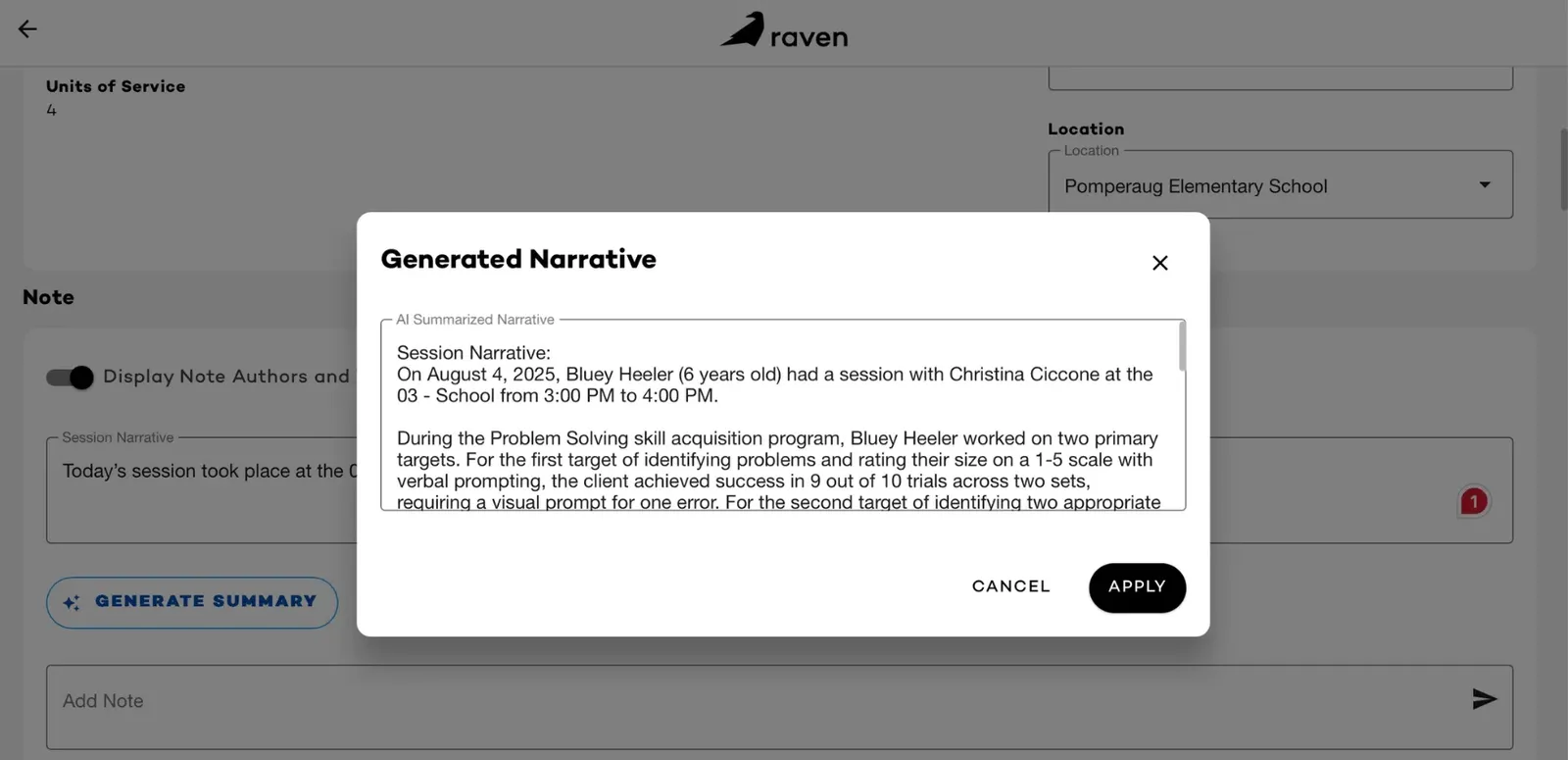
Using an AI tool like Raven Health completely removes the stress of staring at a blank page. Your job shifts from being a writer to simply being an editor.
You spend a few minutes reading over the draft the AI created to make sure it matches your memory of the session.
You tweak a sentence or two if you need to add a specific clinical insight.
You sign the note and you are done.
This technology alone can save therapists hours of unpaid administrative work every single week, allowing them to focus entirely on their clients.
Use Structured Templates
If you are not quite ready to jump into artificial intelligence, or if your clinic requires you to use their older software, the next best thing is to use heavily structured templates.
Trying to write a free-flowing story about a therapy session is a massive waste of time. It usually leads to rambling, vague language, and missing details that insurance companies will reject.
A good template breaks the session note down into very clear, bite-sized sections. Many clinics use the SOAP format (Subjective, Objective, Assessment, Plan) or the DAP format (Data, Assessment, Plan).
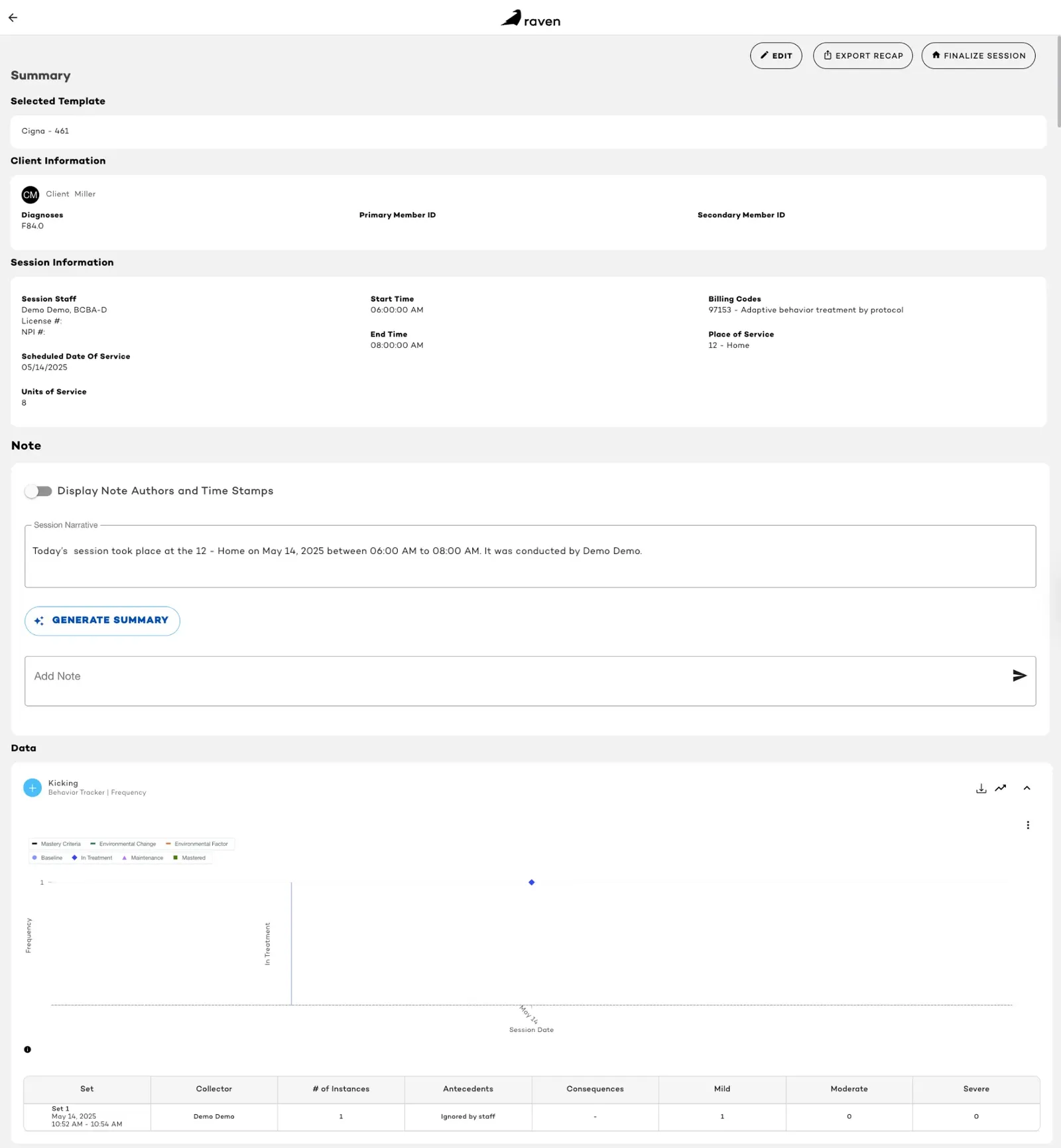
These templates force you to stay focused on what actually matters clinically. You do not need to write about what the child ate for a snack unless it directly relates to a feeding goal or a behavior spike.
Templates also protect you from making silly mistakes that ruin insurance claims.
A strong template will have mandatory fields for the start time, end time, location of the session, and who was present in the room.
By structuring the note with specific boxes for "Behaviors Targeted" and "Interventions Used," you never have to guess what you are supposed to write about next.
The structure keeps your brain on track and helps you finish the document much faster.
Document During Sessions When Appropriate
The most time-consuming aspect of writing notes is simply trying to recall what occurred. If you wait until 6:00 PM to write a note for a session that ended at 10:00 AM, your brain is going to struggle to recall specific prompt levels or the exact duration of a tantrum.
This leads to sitting at the computer and staring blankly at the wall. The easiest way to fix this is to practice concurrent documentation, which means writing parts of your note while the session is actually happening.
Now, this does not mean you should ignore the child and stare at your tablet for the whole appointment. However, there are natural breaks built into every ABA session.
When the child is taking a five-minute reinforcement break to watch a video or play independently with a toy, you can use two of those minutes to quickly type out your objective data.
Another great strategy is to allocate the last ten to fifteen minutes of the session for wrap-up.
While the child is transitioning to a low-demand activity or doing a final clean-up routine, you can jot down your clinical insights and plan for the next session.
Getting the bulk of the notes done before you even walk out the door means you leave work at work.
It also ensures that the data you are recording is highly accurate because the event just happened three minutes ago.
Standardize Common Responses
If you look closely at your past session notes, you will probably realize that you type the exact same phrases over and over again. Behaviors might change, but the clinical interventions we use are often very similar across different clients.
Typing out "implemented a token economy system to reinforce positive behavior and utilized planned ignoring for attention-seeking vocalizations" takes a lot of keystrokes.
To speed things up, you need to standardize your common responses. Sit down and look at a month's worth of your old notes.
Find the phrases and interventions you use the most. Once you have a list, build those directly into your software as checkboxes or drop-down menus.
If your software does not allow that, keep a simple text document on your computer desktop with these phrases so you can just copy and paste them into your daily notes.
This strategy is not about being lazy; it is about working smart.
Using standardized phrases ensures that your language is always objective and professional.
It stops you from accidentally using vague, emotional words like "he had a bad day," which auditors hate to see.
You can always use checkboxes for the standard interventions and just leave one small text box underneath to type a quick, custom sentence about how the child specifically reacted that day.
Automate Administrative Tasks
Session notes are not just clinical diaries; they are the legal documents that trigger the billing process. A massive amount of time is wasted when therapists have to manually type out administrative details that the computer already knows.
If you are typing the client's date of birth, their insurance ID, your own credentials, and the exact address of the clinic into every single note, you are wasting valuable time.
Modern practice management software connects the daily schedule directly to the clinical note. When you click on the appointment in your calendar to start writing, the software should automatically pull all of that boring administrative data into the note for you.
This level of automation also helps speed up the backend of the business.
When administrative tasks are automated, the moment you sign the note, the software instantly generates a clean insurance claim.
It cross-checks the time on your note with the time scheduled on the calendar to make sure they match perfectly, preventing annoying billing errors.
When the software handles the background details, the therapist only has to worry about the actual therapy, cutting the overall documentation time in half.
Conclusion
Spending less time on ABA session notes completely comes down to building better daily habits and trusting modern technology to help you out.
Whether you choose to invest in a smart AI generation tool like Raven Health, build strict custom templates, or just get better at typing your notes while the session is actually happening, every little change adds up.
Your goal should be to capture the clinical reality of the session accurately without writing a novel every afternoon. When you are not constantly stressed out about a massive pile of unfinished paperwork, you have much more energy to bring to your therapy sessions, which ultimately leads to much better outcomes for the kids you are trying to help.
Sources:
https://ensorahealth.com/blog/how-to-write-good-aba-session-notes-examples-and-tips/
https://ravenhealth.com/key-features-ai-capabilities/
https://www.rethinkbehavioralhealth.com/our-solutions/session-note-ai/
https://www.passagehealth.com/blog/aba-session-notes-examples
https://www.heidihealth.com/en-au/blog/aba-session-notes-template
https://heyberries.com/blog/articles/aba-session-notes-examples
https://www.artemisaba.com/blog/aba-session-notes
https://psychcentral.com/pro/7-tips-for-shortening-your-therapy-notes