
Teaching a learner a new, complex skill can often feel overwhelming for both the therapist and the learner. When a learner with autism is asked to perform a big task, like brushing their teeth or making a sandwich, the number of steps involved can cause frustration and behavioral meltdowns.
Applied Behavior Analysis (ABA) solves this problem by breaking these massive tasks down into very small, easily digestible steps. This method is called task analysis.
By looking closely at every single physical movement required to complete a job, therapists can build a highly structured roadmap for learning.
This article explores how task analysis works, how to write one correctly, the different ways to teach it, and how modern software is making the data tracking process much easier.
What Is Task Analysis in ABA Therapy?
In the world of Applied Behavior Analysis, task analysis is the strict process of breaking a complex, multi-step skill down into a sequence of much smaller, highly teachable components.
Instead of looking at washing hands as one single action, a task analysis views it as a long chain of very specific behaviors that must happen in an exact order.
The primary goal of a task analysis is to reduce the cognitive load on the learner. When a child is presented with a great demand, they often do not know where to start, which leads to task avoidance.
By shrinking the demand down to just the very first, tiny step like turning on the cold water, the child can experience immediate success and access reinforcement much faster.
A well-constructed task analysis serves as the foundation for creating a behavior chain. It provides the therapist with a clear checklist of exactly what needs to be taught and in what specific order.
Furthermore, it allows the clinical team to pinpoint exactly where a child is getting stuck. If a child can successfully grab the toothbrush and put paste on it but always fails to actually brush their back teeth, the task analysis clearly highlights that exact missing link so the therapist can provide targeted help.
How to Write an Effective Task Analysis?
Writing a task analysis might sound simple, but it requires a very high level of observation. If you skip a step that seems obvious to you, the entire teaching chain will break for the learner.
The very first rule of writing a task analysis is that you must physically perform the task yourself before you write it down. As you do the task, write down every single physical movement you make.
Here is the step-by-step process for creating a strong task analysis:
1. Identify the Target Skill Clearly
Define exactly what the finished product looks like so there is no confusion about when the task is officially complete.
2. Assess the Learner's Baseline
You must know what prerequisite skills the child already has. If they cannot grip a zipper, they cannot learn to zip a jacket, no matter how good your task analysis is.
3. Determine the Step Size
If a child learns very quickly, your steps can be larger. If the child has severe learning delays, you might need to break "turning on the water" into three separate steps: reach for handle, grasp handle, turn handle.
4. Test the Sequence
Hand your written list to a coworker and ask them to follow it exactly like a robot. If they get stuck or do something out of order, your written steps are not clear enough and may need to be rewritten.
Types of Task Analysis
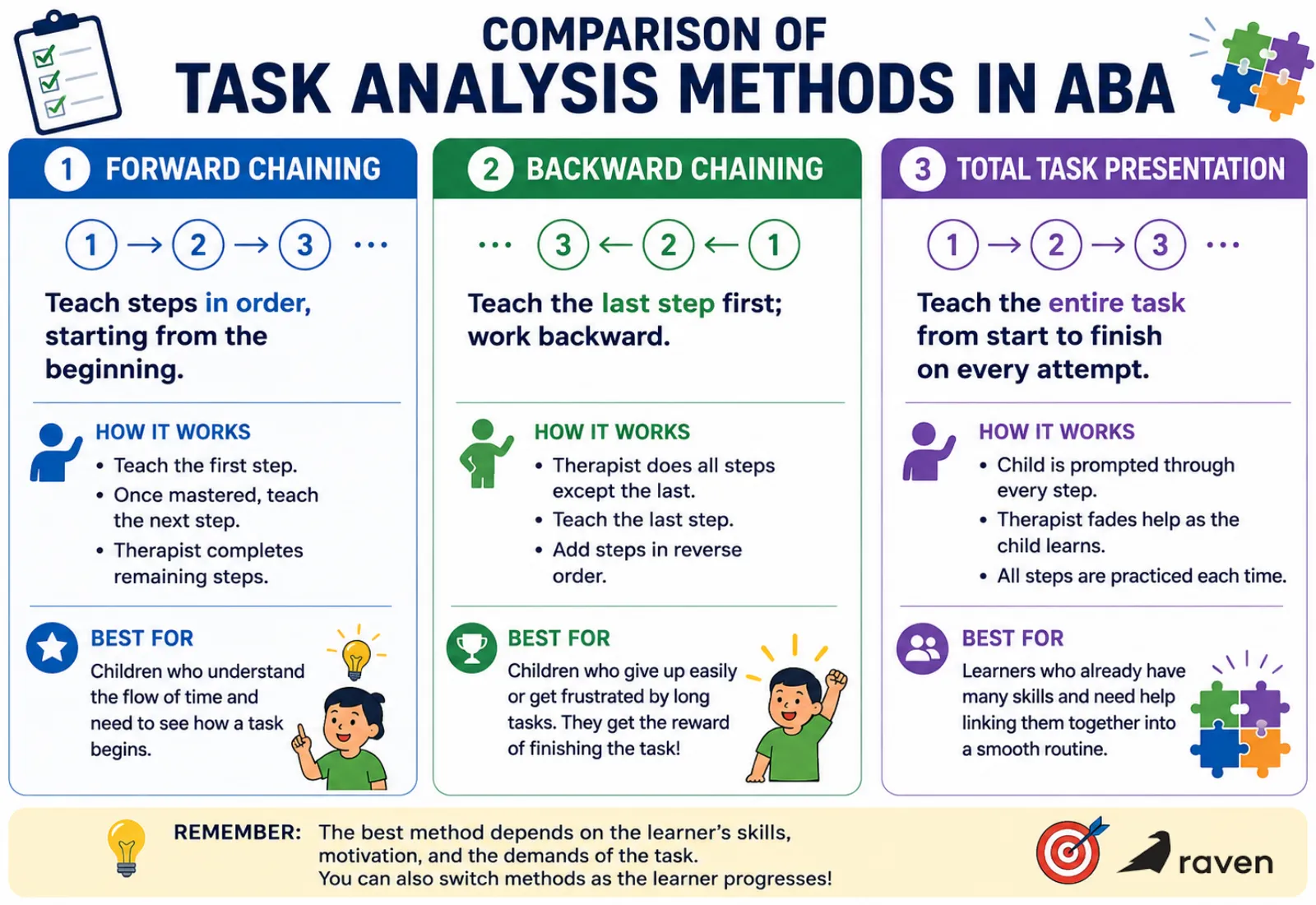
Once you have your perfect list of steps, you have to decide exactly how you are going to teach it to the child. In ABA, there are three primary methods used to teach a behavior chain, and selecting the right one depends entirely on the child's specific learning style and frustration tolerance.
Forward Chaining
Forward chaining is exactly what it sounds like: teaching the steps in chronological order. The therapist heavily prompts the child to complete step one.
Once the child masters step one independently, the therapist moves on to teaching step two. The therapist usually finishes the rest of the steps for the child so the task gets completed quickly.
This method is excellent for children who understand the logical flow of time and need to see how a task begins.
Backward Chaining
Backward chaining flips the process upside down. The therapist does all the hard work at the beginning and physically guides the child through almost the entire task.
The therapist only stops to teach the very last step. For example, if the task is making a bed, the therapist does everything except pulling the final pillow into place, which they teach the child to do.
Backward chaining is incredibly powerful because the child gets to experience the natural reward of finishing the task immediately.
It is highly recommended for children who give up easily or get frustrated by long, demanding tasks.
Total Task Presentation
Total task presentation involves teaching the entire chain from start to finish on every single attempt.
The child is prompted through every single step, and the therapist fades their physical help as the child starts to learn the movements.
This method works best for learners who already have a lot of prerequisite skills and just need help linking them all together into a smooth routine.
How to Collect and Record Task Analysis Data
Data collection is the backbone of ABA therapy. Without accurate data, a supervisor cannot tell if the task analysis is actually working or if the child is just memorizing prompts. Recording data for a long behavior chain can be messy because you are tracking multiple steps at once.
The most common way to track a task analysis is by recording the prompt level required for each individual step. Instead of a simple "yes" or "no," the therapist marks exactly how much help the child needed.
Here is the standard prompt hierarchy usually recorded on a data sheet:
Independent (I): The child did the step with zero help.
Verbal (V): The therapist had to tell the child what to do next.
Gestural (G): The therapist had to point at the correct object.
Model (M): The therapist had to show the child the physical movement first.
Physical (P): The therapist had to put their hands on the child to guide their movement.
By tracking these specific letters for every step, a supervisor can look at a chart and clearly see if the learner is slowly becoming more independent or if they are becoming dependent on heavy physical prompts.
Common Mistakes in Task Analysis and How to Avoid Them
Even experienced Board Certified Behavior Analysts (BCBAs) can make errors when designing a task analysis. When a program fails, it is rarely the child's fault; it usually means the teaching steps are broken or confusing.
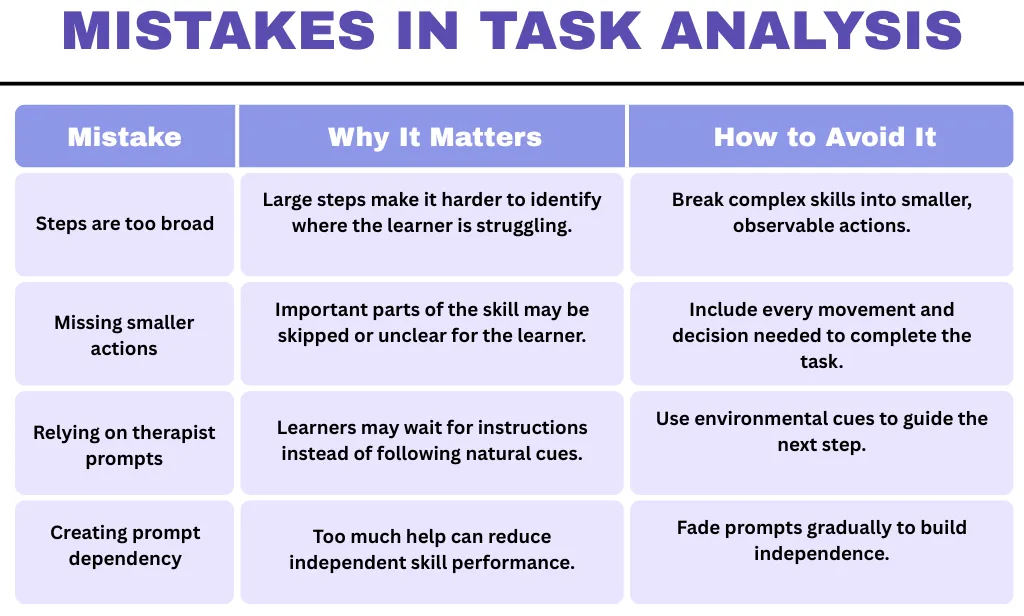
The most frequent mistake is making the steps way too large. Writing "put on pants" as a single step is a massive failure. Putting on pants involves balancing on one leg, aiming a foot, pulling fabric over a heel, and managing a button.
If the steps are too big, the data will just look like a string of failures. Always err on the side of making the steps tinier than you think they need to be.
Another huge error is forgetting to teach the natural cue to start the next step. A child should not be waiting for the therapist to say "good job, now do the next part." The natural completion of step one should be the trigger for step two.
For example, the feeling of the water becoming warm should be the natural cue to put hands under the faucet, not a verbal command from an adult. If you over-prompt with your voice, you create prompt dependency.
How Digital Tools Simplify Task Analysis Tracking
In the past, tracking a twenty-step task analysis meant carrying around a heavy clipboard covered in messy paper grids.
Therapists spent more time staring at their paperwork trying to find the right box to check than actually watching the child.
Thankfully, digital ABA data collection software has completely changed how task analysis is recorded in modern clinics.
Software platforms like Raven Health allow supervisors to build massive, multi-step behavior chains directly into a mobile app.
The therapist simply opens the app on a tablet and sees a clean, scrolling list of the exact steps.
They just tap a button to record the prompt level, and the software instantly graphs the data in the background.
Live graphing allows BCBAs to remotely monitor sessions and immediately identify any steps causing a bottleneck in the child's learning.
Furthermore, advanced digital tools can automatically move a child to the next phase of learning. If a child masters step one of a forward chain, the software can automatically unlock step two for the next session without the supervisor having to manually change the programming.
This automation saves an incredible amount of administrative time and ensures the child is always being challenged at the correct difficulty level.
Conclusion
Task analysis is one of the most powerful teaching tools available in ABA therapy. It takes the overwhelming stress out of learning daily living skills by shrinking giant tasks into tiny, manageable victories.
By taking the time to write highly detailed steps, choosing the correct chaining method, and carefully tracking prompt levels, therapists can teach children incredible independence. Avoiding common traps like making steps too large ensures that the learner stays motivated and successful.
While tracking these long chains used to be an administrative nightmare, modern digital data collection tools have made the process seamless, allowing the clinical team to focus entirely on celebrating the child's hard-earned progress.
Sources:
https://masteraba.academy/post/behavior-chains-using-task-analysis-for-chaining
https://iidc.indiana.edu/irca/articles/applied-behavior-analysis.html
https://www.abacenters.com/task-analysis-in-aba-therapy/
https://autismhub.education.qld.gov.au/resources/functional-behaviour-assessment-tool/task-analysis
https://vcuautismcenter.org/resources/factsheets/content.cfm/2446
https://brightbridgeaba.com/blog/types-of-chaining-in-aba-backward-forward-total-task-chains
https://moveupaba.com/blog/three-types-of-chaining-in-aba/
https://www.inclusiveaba.com/blog/what-are-the-three-types-of-chaining-in-aba
https://tallyflex.com/blog/task-analysis-data-collection-guide