
by Raven Health | May 1, 2026 | Blogs

Starting a new Applied Behavior Analysis (ABA) clinic is an exciting journey, but it comes with real financial stress. You can have a waiting list full of clients and still struggle to pay your therapists if your money is tied up in the billing process.
Cash flow is simply the money moving in and out of your business. If more money is going out than coming in, your doors will close, no matter how great your therapy is. In this article, you will explore cash flow tips for your new ABA clinic to keep your finances healthy.
Why Cash Flow Matters for ABA Clinics
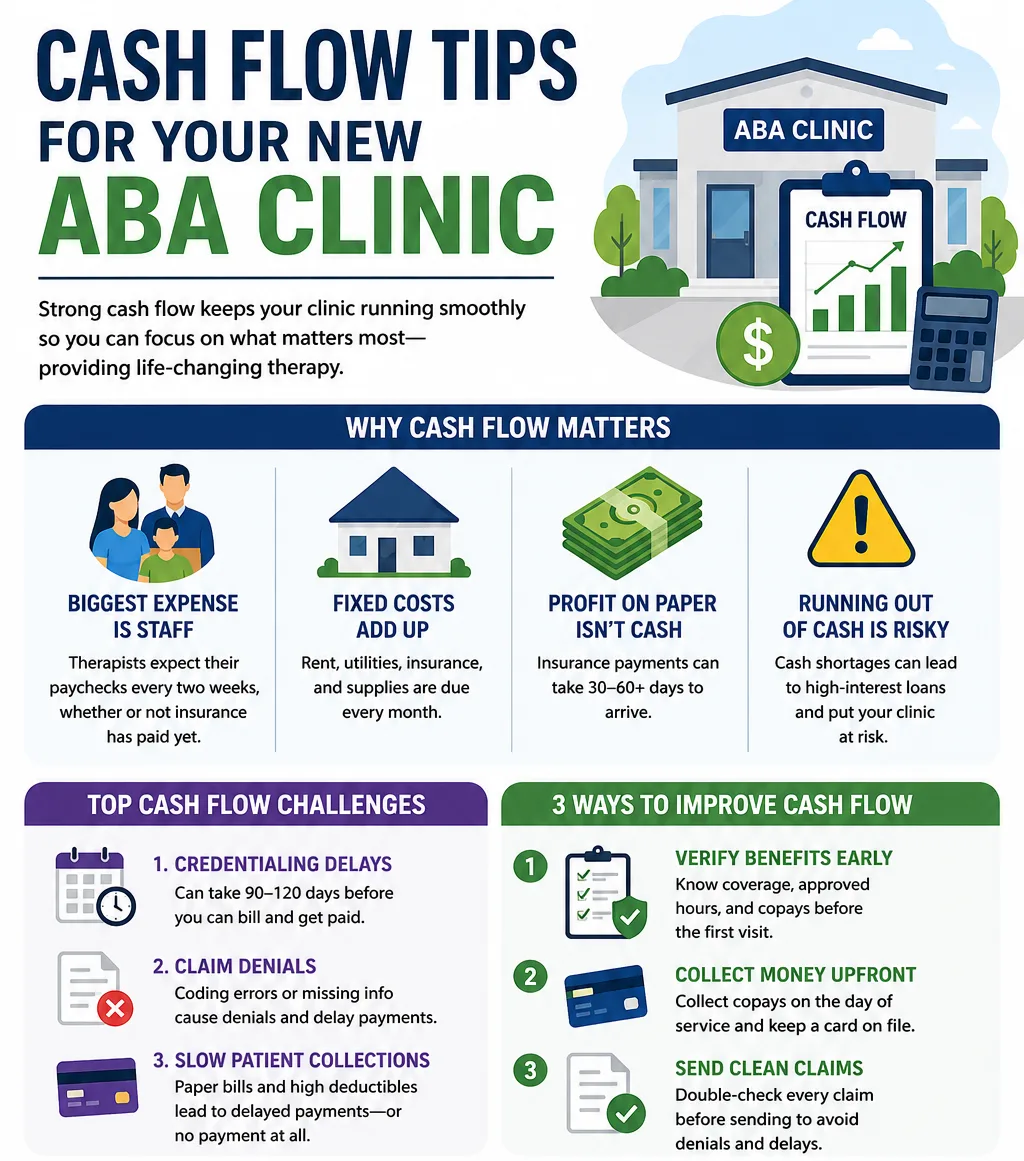
ABA therapy is a highly service-based business. Your absolute biggest expense is your staff. Board Certified Behavior Analysts (BCBAs) and Registered Behavior Technicians (RBTs) expect their paychecks every two weeks, regardless of whether an insurance company has actually paid them yet.
Besides payroll, you’ll likely have fixed monthly costs like clinic rent, lights, liability insurance, and therapy supplies. Cash flow matters because profit on a piece of paper does not pay the bills; actual cash in your bank account does.
You might bill $50,000 in a month, but if insurance takes 45 days to send the check, you have zero cash to pay your rent today. If you run out of cash while waiting for insurance payouts, you might be forced to take out high-interest loans just to keep the lights on.
Common Cash Flow Challenges in New Clinics
New medical practices face a unique set of hurdles when trying to keep their bank accounts healthy. Understanding these roadblocks is the first step to fixing them.
1. Credentialing Delays
Before you can bill an insurance company, your clinic and your individual therapists must be credentialed. This slow process can take anywhere from 90 to 120 days. If you start seeing patients before this is fully done, you will wait months to get paid.
2. Claim Denials
ABA billing codes are very strict. A simple mistake, like using the wrong time modifier or billing for hours that were not approved, will cause the insurance company to deny the claim. Denials instantly stop your cash flow and require hours of phone calls to fix.
3. Slow Patient Collections
Families often have copays or high deductibles. If you send a paper bill in the mail weeks after a therapy session, it usually takes months to collect that money, if you get it at all.
Ways to Manage and Improve Cash Flow
To protect your clinic’s financial health, you need to set up strict rules from day one. Do not treat billing as something you only think about at the end of the month.
1. Verify Benefits Early
Before a child even walks in for their first assessment, call their insurance company. Know exactly what their plan covers, how many hours are allowed, and what their copay will be. Surprises lead to unpaid bills.
2. Collect Money Upfront
Stop sending paper bills. Have families keep a credit card on file and collect their copays on the exact day of the service. This guarantees you get the patient’s portion of the payment immediately.
3. Send Clean Claims
Make sure your billing team double-checks every single claim before sending it. Fixing a typo before it goes to the insurance company takes five minutes. Fixing a denial takes weeks of waiting.
Tools to Help Track and Manage Cash Flow
You cannot manage what you do not track. Relying on basic spreadsheets will cause you to lose track of claims and lose money. You need technology built specifically for medical billing.
Practice Management (PM) Software
Use an ABA-specific system. These tools track appointments, therapist hours, billing, and more, all in one place. Most importantly, they can warn you if an insurance authorization is about to expire, stopping you from providing free, unbillable therapy.
Clearinghouses
A clearinghouse acts as a digital middleman between your clinic and the insurance company. It scrubs your claims for coding errors before they are submitted, reducing your denial rate and speeding up your payments.
Conclusion
Managing cash flow is not the most fun part of running an ABA clinic, but it is the most vital. By understanding common billing traps, collecting copays upfront, and investing in the right tracking software, you can avoid the panic of missing a payroll run.
When your money is managed well, you remove the stress of keeping the doors open. This allows you to focus all your energy on what truly matters: providing life-changing therapy to the children and families who need you most.
Sources:
https://www.mgma.com/financial-management-2
https://www.mgma.com/online-courses/cash-flow-accounts-payable-and-payroll-management-certificate
https://practolytics.com/blog/impact-of-poor-credentialing-on-provider-revenue/
https://medicalnewsbulletin.com/how-credentialing-impacts-your-cash-flow/
https://ensorahealth.com/blog/aba-billing-cheat-sheet-best-practices-2/
https://www.portiapro.com/blog/aba-billing/
https://swiftcarebilling.com/professional-aba-billing-services-improve-cash-flow/

by Raven Health | Apr 24, 2026 | Blogs

When a child gets an autism diagnosis, parents quickly start looking for the best support. Applied Behavior Analysis therapy is the most recommended treatment, but it is also a big financial commitment. Many families worry about how they will afford the hours of therapy their child needs to succeed.
Understanding the costs, what insurance covers, and how clinics charge can help you plan your finances and get the right care for your child without panicking. In this article, you will explore the complete breakdown of how much ABA therapy costs.
What Factors Influence the Cost of ABA Therapy?
Not every ABA program costs the same amount. The price changes based on a few clear factors that clinics use to set their rates.
1. Therapist Experience and Credentials
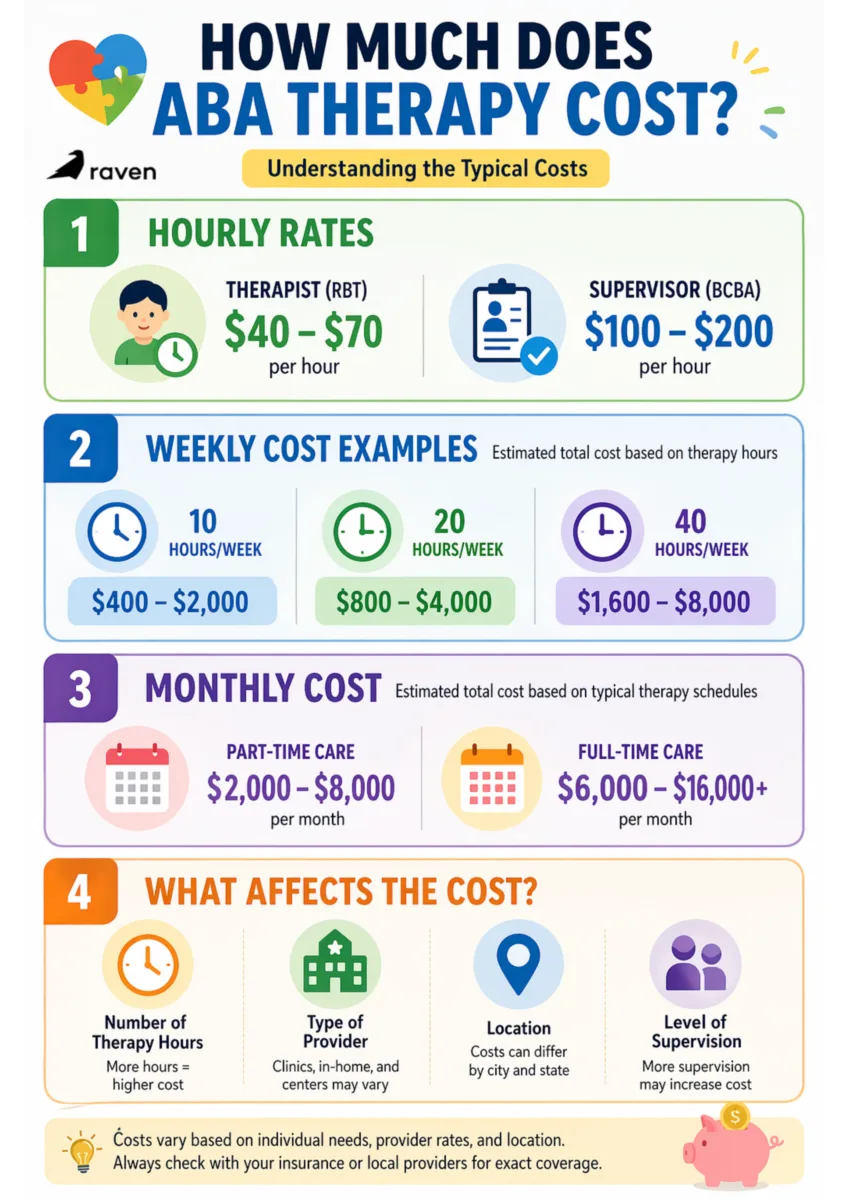
Who is working with your child changes the price. A Board Certified Behavior Analyst (BCBA) has a master’s degree and charges more for their time. A Registered Behavior Technician (RBT) works directly with the child under the BCBA’s watch and costs less.
2. Where Therapy Happens
Going to a clinic or center usually costs more than at-home therapy. Clinics have to pay for rent, electricity, and expensive learning toys. Home-based therapy skips these extra bills, though therapists do have to charge for travel time.
3. Where You Live
Just like rent and groceries cost more in big cities, ABA therapy does too. Clinics in busy urban areas have higher costs to stay open, which means higher hourly rates for families.
Average Cost of ABA Therapy Services
If you are paying out of your own pocket, the total bill can look very high. Most children need between 10 and 40 hours of therapy every single week for it to work well.
Hourly Rates: The average cost for one hour of direct ABA therapy is between $120 and $150. If a highly experienced BCBA is doing the session, it can jump to $200 an hour.
- Weekly Costs: For a child getting 20 hours of therapy a week, the cost is roughly $2,400 to $4,500.
- Annual Costs: If a child does intensive therapy year-round without insurance, the total yearly cost can range anywhere from $62,400 to over $249,600.
- Upfront Fees: Before starting, clinics charge for an initial assessment to create a customized treatment plan. This usually costs a flat fee of $500 to $2,000.
Insurance Coverage and What It Includes
The good news is that most families never pay those huge out-of-pocket numbers. All 50 states and Washington, D.C., have laws that require health insurance companies to cover ABA therapy for autism.
When you use private health insurance, you usually only have to pay your normal copay or your deductible. Many families only pay between $0 and $50 per session once their deductible is met. However, every state has different rules. Some states have a dollar limit on how much they will pay per year, while others have no limits at all.
Insurance usually covers the first assessment, the hours the RBT spends with your child, and the time the BCBA spends supervising. To get this coverage, the therapy must be marked as “medically necessary” by a doctor, and you usually have to wait a few weeks for the insurance company to approve it before you can start.
Medicaid vs Private Pay Options
When looking at payment options, families mostly choose between using Medicaid or paying privately. Both of these options have different benefits and challenges.
Medicaid Coverage
Medicaid is required by federal law to cover medically necessary ABA therapy for children under 21. For families who qualify, this is the cheapest option. Medicaid usually covers the entire cost of the therapy with zero copays or deductibles.
Even if a family makes too much money for standard Medicaid, children with autism often qualify for state Medicaid waiver programs based on their disability.
Private Pay Flexibility
Private pay means you hand cash directly to the clinic without using insurance. This is very expensive, but it offers total freedom. You do not have to wait for an insurance company to approve the hours, so therapy can start the very next day.
You also get to decide exactly how many hours your child gets without an insurance company saying no. Some families use a mix of both: they use insurance for the basic hours and pay cash for extra weekend sessions or parent training.
Conclusion
Figuring out how to pay for ABA therapy can feel overwhelming at first. The hourly rates look scary, but thanks to strong state laws and Medicaid programs, help is out there. Take the time to call your insurance company and ask exactly what your plan covers.
You can also talk to local clinics about their private pay options or waitlists. Getting the financial part sorted out early lets you focus on what really matters: watching your child learn, grow, and thrive.
Sources:
https://unitedcareaba.com/how-much-does-aba-therapy-cost/
https://www.connectncareaba.com/blog/aba-therapy-cost-in-north-carolina
https://unitedcareaba.com/how-much-does-aba-therapy-cost/
https://abcachieve.com/insurance-vs-private-pay-for-aba/
https://www.appliedbehavioranalysisedu.org/state-by-state-guide-to-autism-insurance-laws/
https://www.magnetaba.com/blog/aba-therapy-costs-and-insurance-coverage
https://www.cubetherapybilling.com/private-pay-vs-insurance-in-aba-which-pays-more-and-works-best
by Raven Health | Apr 21, 2026 | Blogs
Launching a successful ABA practice requires a tremendous amount of effort. You spend months finding the right staff, setting up your space, and meeting with families. But once you start seeing patients, you face a completely different problem: getting paid.
Dealing with health insurance companies is confusing, and it takes up a lot of time. One of the biggest choices you will make as a new clinic owner is how to handle your billing.
Should you hire someone to sit in your office and do the work, or should you pay an outsourced company to handle it for you? Both options have good and bad points when it comes to cost, control, and getting things done fast. Let’s dive into how they compare and what works best, especially for brand-new clinics.
Pros and Cons of In-House Billing
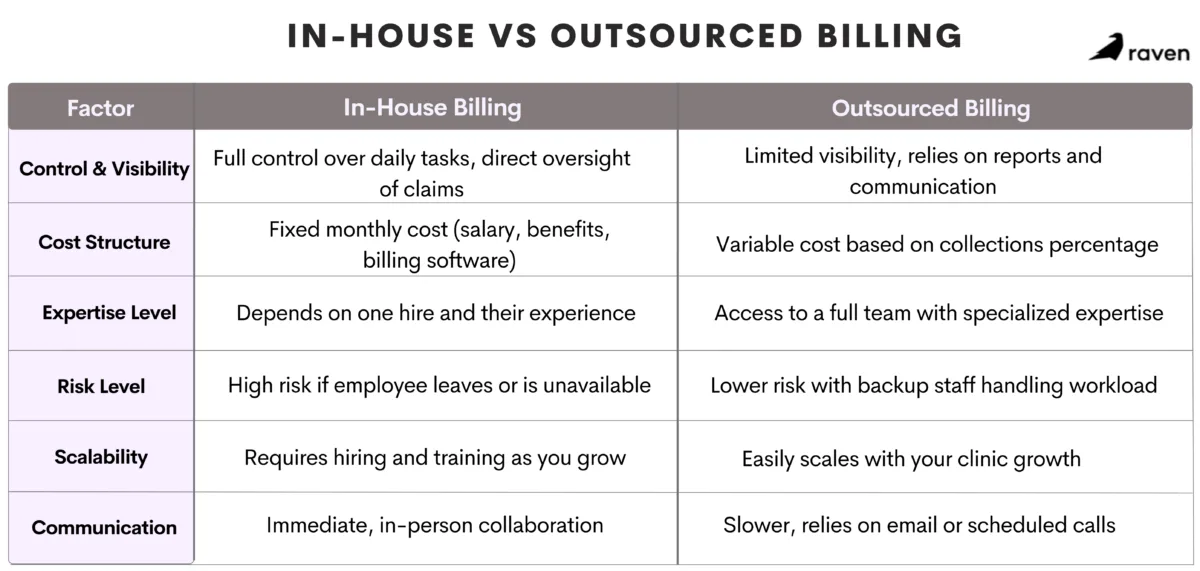
Doing your billing in-house means you hire your own experienced employee to handle all your session claims, payments, and insurance calls right from your ABA clinic.
Pros of In-House Billing
- Total Control: You can walk down the hall and ask your biller a question at any time. You know exactly what they are working on and how many claims they have sent out that day.
- Direct Talk: If an ABA therapist makes a mistake on a session note, your biller can talk to them right away to fix it before sending the claim to the insurance company.
- Full Focus: Your biller works only for you. They are not splitting their time and attention with ten other clinics.
Cons of In-House Billing
- High Start-Up Costs: You have to pay a steady salary, health benefits, and payroll taxes. You also have to purchase billing software and a computer for them to use.
- Staff Risk: If your one biller gets sick, goes on a long vacation, or quits suddenly, your cash flow stops completely until you find and train someone new.
- Training Needs: ABA billing rules change all the time. You have to pay for your staff to keep taking classes so they do not make costly mistakes.
Pros and Cons of Outsourced (Managed) Billing
Outsourcing means you hire a third-party billing company to manage your claims. Your daily session data is sent over, and they do the rest of the work remotely.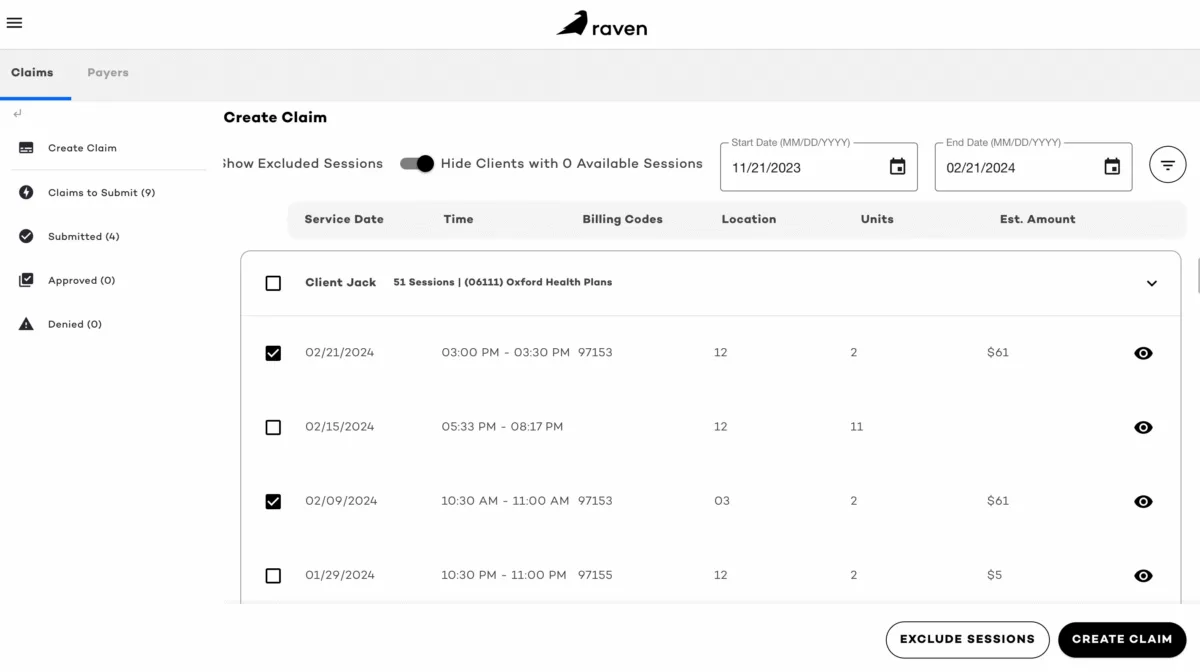
Pros of Outsourced Billing
- Built-in Experts: good billing companies already know ABA codes perfectly and use advanced billing software to streamline claims. They know exactly how to fight insurance denials because they do it all day, every day.
- No Staff Headaches: You do not have to worry about sick days, hiring, or firing. If someone at the billing company calls out sick, another worker simply takes over your account so your claims keep moving.
- Pay for Results: The majority of outside billers charge a small percentage of the money they actually collect. If your clinic does not get paid, the billing company does not get paid.
Cons of Outsourced Billing
- Less Direct Control: You cannot just walk over to their desk. You have to wait for an email reply or hop on a phone call to get updates on your claims.
- Data Sharing Rules: You are handing over sensitive patient information to an outside group. You have to trust and ensure they follow all privacy rules very strictly.
Cost Comparison and ROI Considerations
When you look at the cost, you have to do some basic math to see your return on investment (ROI).
If you hire an in-house biller, you’ll be paying a full-time salary. In many places, an experienced medical biller costs between $45,000 and $60,000 a year. Then you add in the cost of software fees and benefits. That is a high, fixed cost you have to pay every month, even if your clinic is experiencing a slow month with very few clients
If you use an outsourced company to manage your billing, they usually charge between 4% and 8% of the total money they collect for you. If your new clinic is small and only making $10,000 a month at the start, paying 6% is only $600 a month. And as your clinic grows, so does the expertise and capacity your billing partner brings, meaning more claims handled accurately, fewer denials, and faster reimbursements that offset the cost.
Which Option Is Best for New Clinics?
For a brand-new ABA clinic, cash flow is usually very tight. You might only have a few clients in your first few months. Because of this, outsourced billing is almost always the better choice for beginners.
When you outsource, you do not have to commit to a large salary before you even have steady money coming in. You also get instant access to experts who know exactly how to handle tricky ABA insurance codes.
New owners often make a lot of mistakes with insurance rules. Having a team of experts handle this stops early claim denials from freezing your cash flow. Once your clinic is open for a few years and making a steady, high income, you can always change your mind and move your billing in-house.
Conclusion
Deciding how to handle your billing is a major step in running a successful ABA clinic. Having a person in your office gives you great control and easy communication, but it costs a lot of money upfront and carries big risks if that person ever leaves.
Using an outside billing company saves money early on and brings in instant experts. For most new clinics, outsourcing is the safest way to ensure claims are paid fast while keeping costs low.
As your business grows and your income goes up, you can always review your numbers and consider building an in-house team later.
Sources:
cms.gov/medicare/billing
cms.gov/medicare/coding-billing/electronic-billing
hhs.gov/hipaa/for-professionals/covered-entities/sample-business-associate-agreement-provisions/index.html
hfma.org/reference/revenue-cycle-management/
by Raven Health | Apr 20, 2026 | Blogs
Stepping out of the clinical role to open your own Applied Behavior Analysis (ABA) practice is a thrilling milestone. You likely have a vision for the perfect sensory gym, a dedicated team of technicians, and a community of families waiting for your services.
Opening a clinic means dealing with state rules, business forms, and strict insurance guidelines. If you miss even one small step, you could face big fines or have trouble getting paid by insurance right from the start.
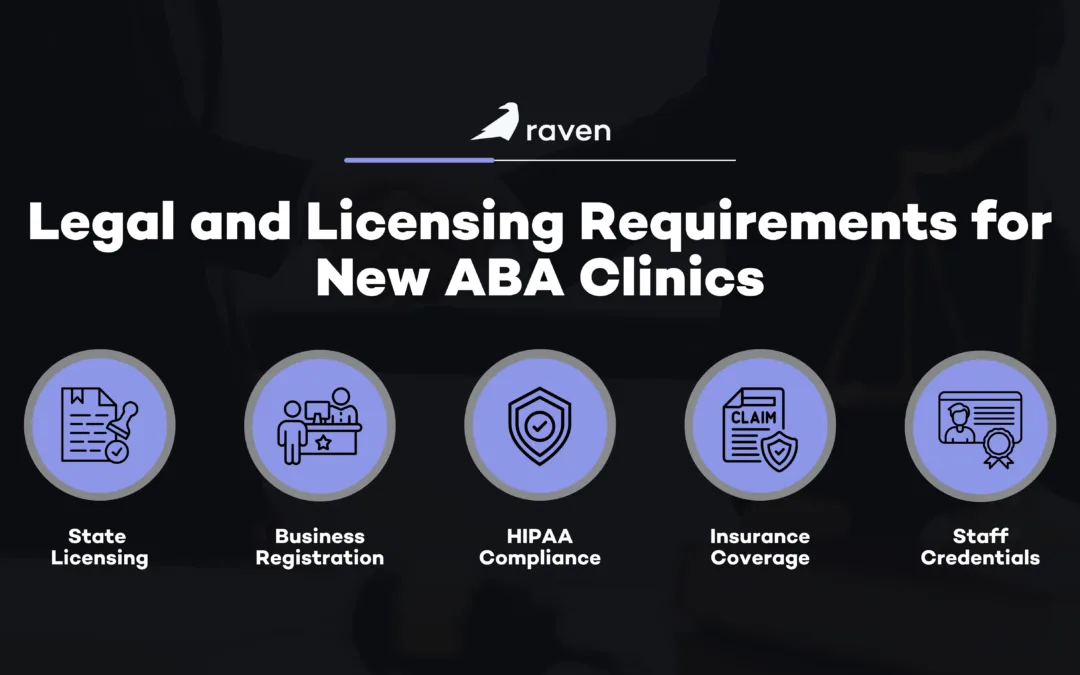
To keep your business safe and help you launch with confidence, here is a clear guide to the legal and licensing steps you need to take before opening your doors. To help you protect your investment and launch with confidence, here is the ultimate guide for you to explore in this article.
Why Licensing Matters for ABA Clinics?
You might wonder why you need so much paperwork if you already hold a national certification. The reality is that legal licensing is what separates a legitimate, fundable healthcare facility from a risky liability.
Proper licensing is not just a regulatory hoop to jump through; it is the fundamental key to your revenue cycle. Commercial insurance companies and state Medicaid programs will refuse to credential your clinic if your business licensing is incomplete.
Furthermore, having your legal work in a row establishes immediate trust with the families you serve, proving that your facility meets state-mandated health and safety standards.
State Licensing Requirements Overview
There is no universal, federally mandated license to open an ABA clinic. Instead, the rules change drastically the moment you cross state lines.
While the Behavior Analyst Certification Board (BACB) governs the professional certification of practitioners nationally, the state governs your business. Many states now require a specific licensure for behavior analysts (LBA) to practice legally.

Additionally, your physical clinic may need a healthcare facility license or an early childhood center license, depending on the age group you treat and the specific services you deliver.
You must contact your state’s Department of Health or designated regulatory board to understand the exact facility licenses required for your zip code.
Business Registration and Legal Structure
Before you can apply for any clinical licenses or sign a commercial lease, you have to establish your practice as a legal entity.
Do not operate as a sole proprietorship. Because healthcare carries inherent risks, you need to protect your personal assets by forming a Limited Liability Company (LLC) or an S-Corporation.
Once you file your articles of organization with your state, you must immediately apply for an Employer Identification Number (EIN) through the IRS. Your EIN acts as your business’s social security number and is strictly required to open a business bank account, process payroll, and apply for group National Provider Identifier (NPI) numbers.
Insurance Requirements for ABA Practices
Accidents happen, especially in active clinical environments with children. Operating an uninsured clinic is a massive financial gamble.

To safeguard your practice, you must secure several distinct policies:
Professional Liability (Malpractice)
This covers your BCBAs and Registered Behavior Technicians (RBTs) if a family claims that a treatment plan caused harm or failed to meet the standard of care.
General Liability Insurance
This is the standard “slip and fall” insurance. It covers physical injuries that happen on your property, such as a parent tripping in the waiting room.
Workers’ Compensation
If an RBT is injured on the job (for example, by an aggressive client), this insurance covers their medical bills and lost wages. Most states legally require this the moment you hire your first employee.
HIPAA Compliance and Patient Privacy
Protecting Protected Health Information (PHI) is a federal mandate. The U.S. Department of Health and Human Services (HHS) heavily penalizes clinics that mishandle patient data.
HIPAA compliance goes far beyond keeping files in a locked cabinet. Your entire digital infrastructure must be secure.
You are legally required to sign a Business Associate Agreement (BAA) with any third-party software vendor you use, including your practice management system, email provider, and payroll service. If a vendor refuses to sign a BAA, you cannot legally use them to store or transmit client data.
Staff Certification and Credential Requirements
Your clinic is only as compliant as the people working inside it. Every single BCBA and RBT on your payroll must have active, verified credentials before they bill a single hour of therapy.
You must secure a Type 2 (Organizational) NPI number for your clinic, while ensuring every individual provider holds an active Type 1 (Individual) NPI.
Furthermore, insurance credentialing is tied directly to staff certifications. If an RBT lets their certification lapse but continues to run sessions, billing for those hours constitutes insurance fraud, which can result in devastating legal consequences for your new clinic.
Common Legal Mistakes New Clinics Make
Many new owners try to cut corners to save money, only to find themselves in deep legal trouble months later. Avoid these common pitfalls:
Misclassifying Employees
Attempting to classify RBTs as independent contractors (1099) rather than employees (W-2) to save on taxes. Because BCBAs dictate exactly how, when, and where RBTs work, labour laws almost universally classify them as employees.
Jumping the Gun on Billing
Providing services before your insurance credentialing contracts are fully executed. You cannot legally retro-bill for dates of service before your official network’s effective date.
Skipping Background Checks
Failing to run comprehensive, state-mandated criminal background checks on staff who work directly with vulnerable populations.
Conclusion
Starting your own ABA clinic is an incredible achievement, but ignoring the legal and administrative side can quickly turn that dream into a stressful situation. By taking the time to secure the right state licenses, set up proper insurance, and follow privacy rules from day one, you are protecting everything you’ve worked so hard to build. It might seem like a lot of paperwork up front.
However, getting it right the first time means you can stop worrying about compliance and focus on what really matters: providing amazing, life-changing care to the families in your community.

by Raven Health | Apr 20, 2026 | Blogs

Have you ever noticed how much easier it is to prevent a mess than it is to clean one up? That simple, practical logic is the entire foundation of antecedent interventions in Applied Behavior Analysis (ABA).
For a long time, the public perception of behavior therapy focused heavily on what happens after a child engages in a challenging behavior; the consequences, the time-outs, or the withholding of attention.
But modern, compassionate ABA flips that script entirely. Instead of waiting for a meltdown to happen and struggling to manage it, we look closely at the environment and ask: How can we set this situation up so the child never feels the need to engage in that behavior in the first place?
The “Before” in the ABCs of Behavior
To understand this strategy, you have to look at the core of behavior analysis: the ABC contingency.
- Antecedent: What happens immediately before the behavior.
- Behavior: What the person actually does.
- Consequence: What happens immediately after the behavior.
An antecedent intervention is a proactive, preventative change we make to the “A” in that equation. It involves altering the environment, the instruction, or the expectation so that the challenging behavior becomes unnecessary.
If a child typically screams when presented with a massive, overwhelming worksheet. Here, the antecedent is the worksheet. If we change how that worksheet is presented, we change the trigger, and we prevent the scream.
Visual Supports: Clarifying the Unpredictable
One of the most common triggers for challenging behavior, especially in autistic learners, is unpredictability. Transitions are notoriously difficult.
Imagine someone walking into your living room, turning off your favorite television show without warning, and dropping a stack of tax forms on your lap. You would likely protest, too.
Visual supports are incredibly powerful antecedent interventions because they remove the element of surprise and give the learner a sense of control and predictability. Processing spoken words can sometimes be overwhelming for a learner, but a picture remains static and reliable.
1. Visual Schedules
Instead of verbally nagging a child to get ready for school, a visual schedule breaks down the morning routine into actionable pictures (toilet, get dressed, eat breakfast, shoes on). It shifts the demand from the parent’s voice to the board.
2. First/Then Boards
This is a brilliant tool for teaching delayed gratification. It visually promises the learner that if they complete a less preferred task (First: Math), they will immediately gain access to a highly preferred activity (Then: iPad).
3. Visual Timers
A visual timer shows time passing as a shrinking red disc. It helps a child physically see how much longer they have to work, or how much time is left in their break, preventing the sudden shock of “time’s up!”
Task Modification: Lowering the Barrier to Entry
Sometimes, the environment isn’t the problem; the task itself is the trigger. If a demand is too hard, too long, or overwhelmingly boring, a learner is highly likely to engage in escape-maintained behaviors, such as swiping materials off the table or running away.
Task modification doesn’t mean we stop teaching or let the child out of doing the work. Instead, it means we adjust the antecedent so the mountain looks a lot more like a molehill.
- Chunking: If reading a whole page causes a meltdown, we fold the paper so only one paragraph is visible at a time. The amount of work hasn’t changed, but the visual overwhelm is gone.
- Behavioral Momentum (High-Probability Sequence): Before asking a child to do something difficult (like writing their name), a therapist will ask them to do three incredibly easy things they already know how to do (e.g., “High five! Clap your hands! Touch your nose!”). This builds a rhythm of success and reinforcement, making them much more likely to comply with the harder task that follows.
- Incorporating Special Interests: If a child hates counting blocks but loves dinosaurs, we swap the blocks for plastic T-Rexes. We modify the materials to capture their natural motivation.
The Power of Choice
Perhaps the simplest and most underutilized antecedent intervention is offering choices. When children feel like they have no control over their day, challenging behavior is often a misguided attempt to regain autonomy.
By building choices into the antecedent, we share control. “It is time to do math. Do you want to use the blue marker or the red marker to write your answers?” Doing math isn’t optional, though the child has input on how it’s done. This simple shift in power dynamics can drastically reduce refusal and opposition.
Conclusion
Antecedent interventions are the ultimate act of respect toward a learner. By utilizing proactive strategies like visual supports, task modifications, and shared control, clinicians and parents can create environments where children feel safe, capable, and understood.
When we stop focusing entirely on how to react to challenging behavior, and start focusing on how to support the learner before the behavior occurs, we pave the way for faster, more meaningful, and far less stressful learning outcomes.
Sources
everway.com/blog/antecedent-interventions/
asatonline.org/for-parents/becoming-a-savvy-consumer/is-there-science-behind-that-antecedent-based-interventions/
conditionmanagement.co.uk/news/the-autistic-brain-and-predictability
autismtoolbox.co.uk/supporting-learners-and-families/effective-partnerships-and-communication/visual-supports/
discoveryaba.com/aba-therapy/aba-therapy-and-antecedent-interventions#:~:text=With tools such as ABC,supportive environment for individuals with
inbloomautism.com/aba-therapy/the-4-functions-of-behavior/#:~:text=2.,difficult%2C boring%2C or overwhelming.**

by Raven Health | Apr 20, 2026 | Blogs

Opening an Applied Behavior Analysis (ABA) practice is incredibly rewarding, but the sheer volume of administrative work can hit you like a ton of bricks. During your first twelve months, you are not just a clinician; you are a hiring manager, a billing specialist, and a compliance officer. Trying to juggle these roles using paper files and basic spreadsheets literally burns you out.
To survive and thrive, you need a tech stack that does the heavy lifting for you. From clinical data to revenue cycles, here is a detailed breakdown of the essential tools your new ABA clinic needs to operate efficiently.
Why Do the Right Tools Matter in Your First Year?
Let’s be honest: the first year of any healthcare startup is chaotic. However, in the ABA industry, that chaos is magnified by strict insurance regulations and intensive clinical guidelines. Relying on outdated systems or fragmented software leads to denied claims, lost data, and frustrated staff.
Implementing the right digital tools from day one establishes a culture of compliance and efficiency. According to the U.S. Department of Health & Human Services (HHS), maintaining strict digital security for Protected Health Information (PHI) is non-negotiable.
Using disjointed apps that are not inherently HIPAA-compliant puts your entire business at risk. By investing in dedicated, industry-specific tools, you protect your patients’ privacy, ensure your staff gets paid on time, and free up your leadership team to focus on actual patient care.
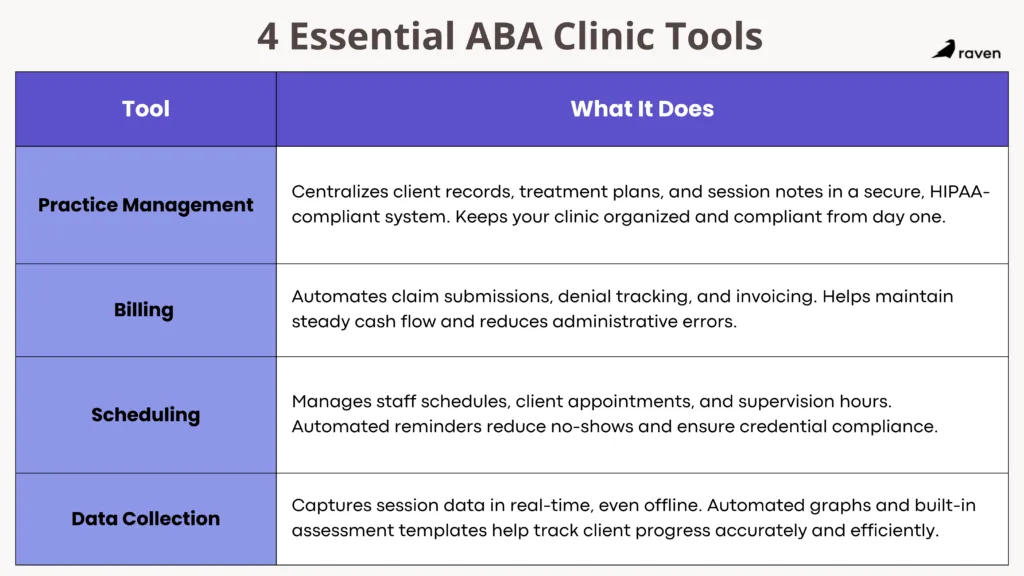
1. Practice Management Software
A good practice management software is the central nervous system of your clinic. Instead of paying for five different cheap subscriptions, you need a robust Electronic Medical Record (EMR) system that keeps everything under one roof. Here, the specific feature set matters the most. When selecting a PM system, ensure it includes:
- Strict HIPAA Compliance offering end-to-end encryption for all patient files, session notes, and internal communications.
- Integrated Client Portals to have a secure way for parents to sign intake documents, view their child’s schedule, and read session notes without relying on unsecured emails.
- Secure Document Storage such as cloud-based storage for diagnostic reports, IEPs, and standardized assessments that your clinicians can access from anywhere.
2. Data Collection and Progress Tracking Tools
Gone are the days of hauling around heavy clipboards and spending hours calculating percentages by hand. Accurate, real-time data collection is the absolute core of ABA therapy. The Behavior Analyst Certification Board (BACB) mandates detailed documentation, and modern data collection software ensures that your clinicians stay compliant while saving time.
Your data collection tool needs to be highly responsive and customizable. Look for these core capabilities:
- Offline Functionality: Wi-Fi drops happen constantly, especially during in-home sessions. Your software must allow Registered Behavior Technicians (RBTs) to collect data offline and automatically sync it once they reconnect.
- Automated Graphing: The system should instantly convert raw trial-by-trial data into visual phase-change graphs, allowing Board Certified Behavior Analysts (BCBAs) to make rapid clinical decisions.
- Curriculum Integration: The best tools offer built-in templates for common assessments like the VB-MAPP, ABLLS-R, or PEAK, eliminating the need to build programs completely from scratch.
3. Scheduling and Staff Management Systems
Scheduling in an ABA clinic is notoriously difficult. A single client might have three different RBTs and a supervising BCBA, all working varying hours across different locations.
A manual calendar simply will not cut it. You need a dynamic scheduling tool designed specifically for the quirks of behavioral health. A solid scheduling system should offer:
- Credential Tracking: The software should alert you 30 days before a staff member’s CPR certification, state license, or RBT credential expires, preventing lapsed qualifications.
- Supervision Tracking: It must track the mandatory 5% supervision hours required for RBTs, ensuring your BCBAs are meeting their clinical oversight quotas.
- Automated Reminders: SMS and email reminders sent automatically to parents 24 hours before a session to drastically reduce costly no-shows and last-minute cancellations.
4. Billing and Revenue Cycle Tools
You can provide the best clinical care in the world, but if your billing system is broken, your clinic will close. The revenue cycle in ABA is incredibly complex, involving multiple payer rules, changing authorization codes, and frequent claim denials.
According to guidelines from the Centers for Medicare & Medicaid Services (CMS), submitting clean claims is the only way to guarantee steady reimbursement. To keep your cash flow healthy, your billing tool must feature:
- Claim Scrubbing: The system should automatically scan claims for missing modifiers, incorrect CPT codes, or expired authorizations before submitting them to the clearinghouse.
- Denial Management: If a claim is rejected, the software should clearly flag the specific error code, allowing your billing team to correct and resubmit it within 24 hours.
- Authorization Tracking: A dashboard that tracks exactly how many approved hours a client has left, preventing your staff from accidentally providing unbillable, unauthorized therapy.
Run Your ABA Clinic Smarter with Raven Health
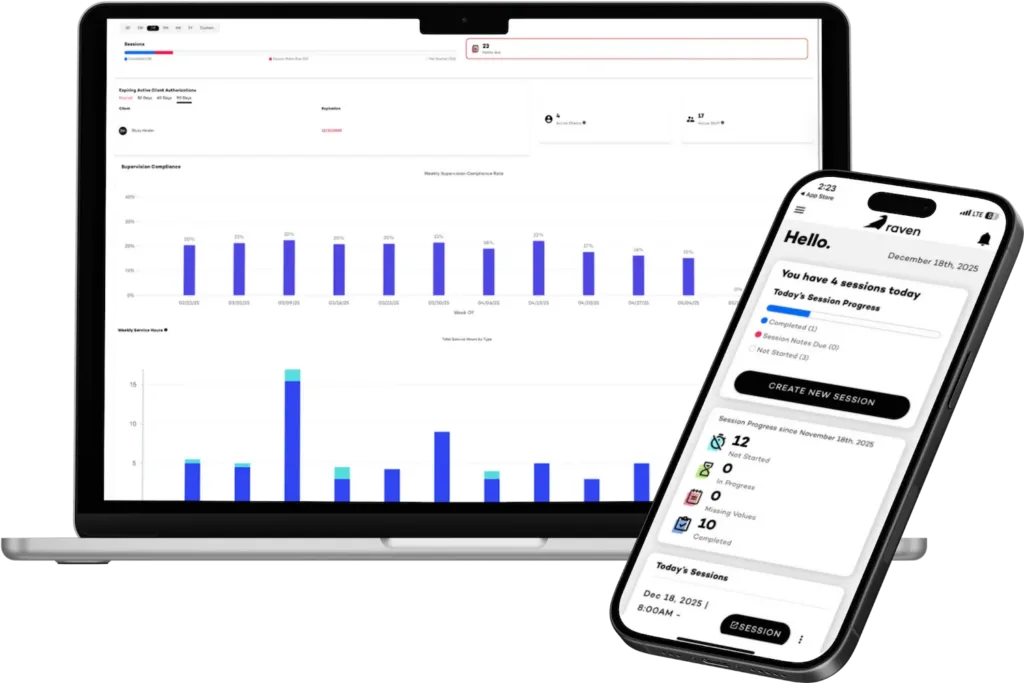
Raven Health is an all‑in‑one ABA practice management platform built specifically for therapy providers, especially startups and early‑year clinics. Instead of cobbling together multiple systems, Raven gives you a single, secure platform to support your clinic’s administrative and clinical needs.
What Raven Health provides includes:
- Practice Management & Centralized Records: A unified system that consolidates client data, treatment plans, session notes, and compliance documentation all accessible from one secure dashboard.
- Data Collection & Progress Tracking: Built‑in ABA data capture tools let clinicians record session notes and collect real‑time progress data, even offline, with customizable reporting and progress visualization.
- Scheduling & Staff Coordination: Smart appointment and calendar tools help you book sessions, manage staff calendars, automate reminders, and coordinate complex schedules easily.
- Billing & Revenue Cycle Management: Integrated claims tools (including self‑billing or fully managed billing services) automate invoicing and insurance submissions, reduce denials, and help you get paid faster.
With Raven Health, your clinic gets HIPAA‑aligned security, mobile‑friendly access, and workflows designed for ABA providers all in one platform so you can spend more time caring for clients and less time on administrative overhead.
Conclusion
Starting an ABA clinic is a huge milestone, but the daily administrative tasks can quickly take over if you aren’t prepared. Setting up the right software for your data, schedules, and billing from day one is the best way to protect your new business.
These tools handle the stressful background work, keep you compliant with strict insurance rules, and keep your cash flow steady. Ultimately, investing in the right tech means spending less time fighting with spreadsheets and more time delivering the life-changing care you initially set out to provide for your clients.