
When a child or adult engages in challenging actions like yelling, hitting, or running away, caregivers often instinctively rely on reprimands or timeouts. However, Applied Behavior Analysis takes a completely different, highly positive route. Instead of focusing heavily on what an individual is doing wrong, therapists focus almost entirely on what they should be doing instead.
This core philosophy is brought to life through a clinical strategy called differential reinforcement. By systematically managing how rewards are given and withheld, practitioners can permanently alter behavior without ever relying on punishment or negative consequences.
What Is Differential Reinforcement in ABA?
Differential reinforcement is a behavioral intervention strategy that performs two distinct actions at the exact same time. First, it delivers a high-quality reward (reinforcement) when an individual engages in a desired, appropriate behavior. Second, it completely withholds that exact same reward (extinction) when the individual engages in the competing, unwanted behavior.
The primary goal is to make the problem behavior completely useless. If an unwanted behavior no longer pays off, but a new, positive behavior consistently results in praise, toys, or breaks, the individual will naturally abandon the old habit.
It’s an approach rooted entirely in shaping choices through positive outcomes rather than making the individual feel bad or penalized. By manipulating the environment so that only the good choices work, the learner is highly motivated to adopt safer, more productive habits.
How Does Differential Reinforcement Work?
At its core, this strategy relies on the dual principles of extinction and positive reinforcement. Every differential reinforcement procedure follows a strict two-part mechanism: you must identify exactly what is maintaining the problem behavior in the natural environment, and you must safely withhold that specific payoff.
For the strategy to work effectively, the practitioner must first conduct a Functional Behavior Assessment (FBA) to discover the "why" behind the action. In ABA, all behavior serves a function, usually to gain attention, escape a demand, access a tangible item, or fulfill a sensory need.
If a child throws toys solely to get adult attention, the therapist stops making eye contact, gasping, or verbally scolding when the child throws toys. Simultaneously, the moment the child asks for attention calmly, the therapist immediately responds with massive enthusiasm and focused play.
Over time, the child's brain connects the dots: throwing toys results in a boring, empty room, but communicating nicely results in exactly the attention they crave.
Types of Differential Reinforcement
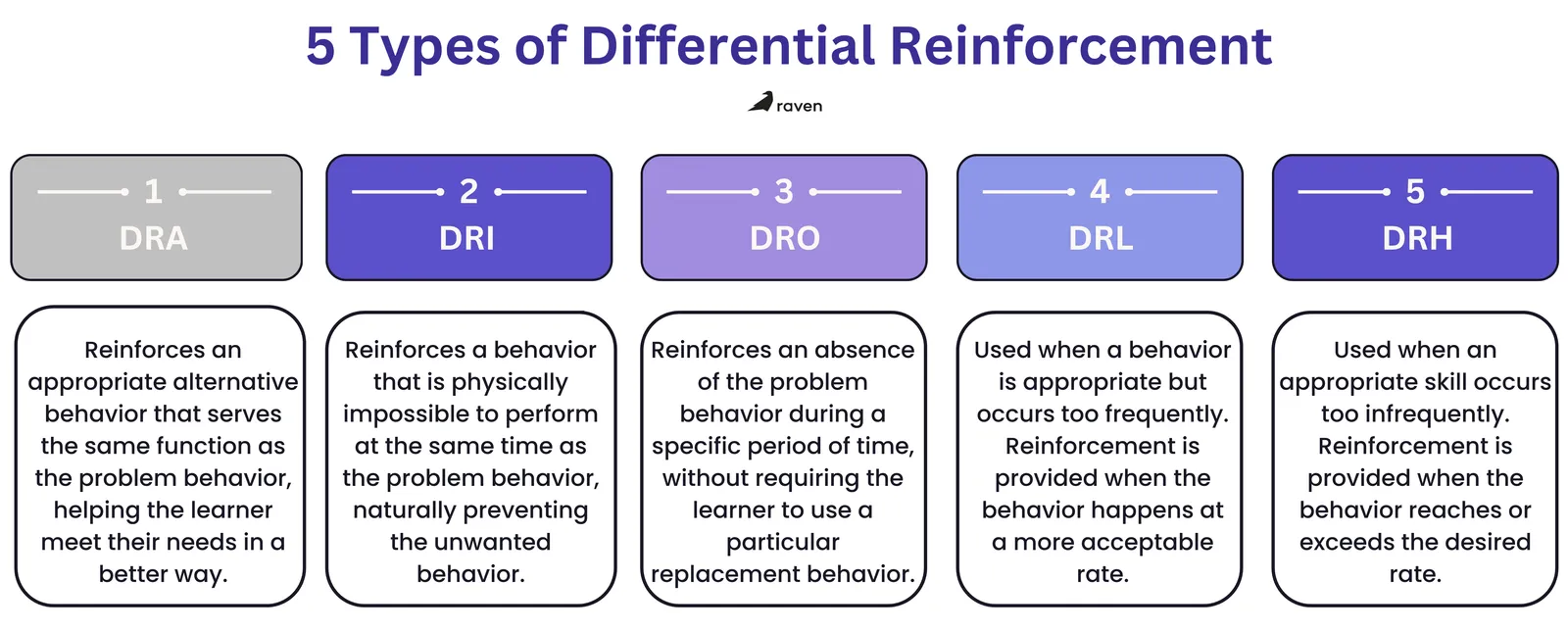
ABA practitioners rely on five primary variations of this procedure. Each variation is designed to target a distinctly different behavioral goal, whether that means replacing a missing skill, reducing an aggressive habit, or building up a weak routine.
Differential Reinforcement of Alternative Behavior (DRA)
DRA involves reinforcing a specific, appropriate alternative behavior that serves the exact same function as the problem behavior. The alternative action does not have to be physically incompatible with the bad behavior; it just has to be a safer, better way for the learner to get their needs met. DRA is the gold standard for teaching functional communication.
Differential Reinforcement of Incompatible Behavior (DRI)
DRI is a highly specific variation of DRA. It involves reinforcing a behavior that is physically impossible to perform at the same exact time as the problem behavior. By forcing the learner's body to do something else, the unwanted behavior is naturally blocked.
Differential Reinforcement of Other Behavior (DRO)
With DRO, the practitioner does not teach a specific replacement skill. Instead, they reinforce the total absence of the problem behavior during a set period of time. If the individual goes a full five minutes without engaging in the target behavior, they get the reward, regardless of whatever else they were doing. It is highly effective for rapid behavior reduction.
Differential Reinforcement of Lower Rates (DRL)
DRL is used when a behavior is actually appropriate, but it is happening way too often and becoming disruptive. The clinical goal is not to eliminate the behavior, but to dial it back to a socially acceptable frequency.
Differential Reinforcement of Higher Rates (DRH)
DRH is the exact opposite of DRL. It is utilized when an individual already possesses a good skill, but they do not use it enough for it to be functional. The therapist provides reinforcement only when the behavior occurs at or above a specific, desired rate to build fluency.
Examples of Differential Reinforcement in ABA
To deeply understand how these scientific concepts look in a real clinical setting, let us look at practical examples of each method in action.
DRA Example
A student frequently screams in the classroom because they want to escape a difficult math assignment. The teacher ignores the screaming and blocks escape. However, when the student hands the teacher a "break card," the teacher immediately allows them to step into the hallway for a two-minute rest. The scream and the card both serve the function of escape, but the card is the appropriate alternative.
DRI Example
A child constantly bites their own fingernails during stressful transitions. The therapist decides to heavily reinforce the child for keeping their hands tightly folded in their lap or squeezing a sensory stress ball. It is physically impossible to bite your nails while your hands are firmly gripping a ball.
DRO Example
A learner frequently spits on the floor to get peer attention. The therapist sets a digital timer for ten minutes. If the learner does not spit for that entire ten-minute window, they earn extra recess time. They can draw, read, or tap their foot as long as they do not spit, they win the reward.
DRL Example
A bright student constantly raises their hand to answer every single question, preventing classmates from participating. The teacher implements a DRL procedure, rewarding the student with a sticker only if they limit their hand-raising to exactly three times per class period.
DRH Example
A client is learning to eat independently but takes incredibly long pauses between bites, causing meals to last over an hour. The therapist uses DRH to reward the client with a token if they take three consecutive bites of food within a two-minute window, successfully increasing the pace of the appropriate behavior.
When Is Differential Reinforcement Used?
Practitioners use these strategies in almost every single behavior intervention plan because they are highly adaptable, ethical, and socially valid. They do not rely on aversive setups, making them safe for vulnerable populations.
They are primarily used in three core scenarios:
Decreasing dangerous or disruptive actions: Behaviors like physical aggression, elopement (running away), and severe property destruction are systematically reduced by starving them of their function using DRO, DRA, or DRI.
Increasing functional communication: DRA is heavily utilized in Functional Communication Training (FCT). Before a child can safely give up a tantrum, they must be given an easier, faster way to communicate their needs using words, signs, or digital devices.
Adjusting behavioral rates: When a behavior is not inherently wrong but is socially awkward due to its extreme frequency (like asking a teacher for reassurance fifty times a day), DRL and DRH safely adjust the pacing without punishing the learner for trying to communicate.
Common Mistakes When Using Differential Reinforcement
While these procedures are incredibly powerful, they fall apart very quickly if they are not implemented with strict consistency across the entire care team.
Accidental Reinforcement
The most common mistake is caving in. If a parent ignores a tantrum for twenty minutes but finally yells at the child out of sheer frustration, they have just accidentally reinforced the behavior. They taught the child that they just have to tantrum harder for twenty-one minutes to force an adult to pay attention.
Failing to Teach a Replacement Skill
Using a DRO procedure rapidly reduces bad behavior, but it leaves a gaping behavioral void. If you just teach a child not to hit, but you never teach them how to ask for personal space through DRA, they will eventually find a new, potentially worse behavior to fill that void.
Choosing Weak Reinforcers
If the reward offered for the good behavior is not significantly better or faster than the payoff for the bad behavior, the child simply will not switch tactics. The reinforcement must be highly motivating.
Setting the Bar Too High
If a child currently screams every two minutes, setting a DRO timer for thirty minutes guarantees immediate failure. Therapists must start with extremely short intervals the child can easily achieve and slowly stretch the time out as they succeed.
How to Track Progress with ABA Data?
Because ABA is a hard, evidence-based science, you cannot simply guess if a differential reinforcement plan is working. Practitioners must rely heavily on accurate & daily data collection to make clinical decisions.
First, the clinical team operationally defines the target behavior and the replacement behavior in explicitly clear terms so that everyone observes them the exact same way.
Next, they collect baseline data for several days to see how often the problem behavior happens naturally before any intervention begins.
Once the procedure is active, therapists track every single instance of the behavior, the interval successes, and the reinforcement delivered.
By graphing this data digitally, a Board Certified Behavior Analyst (BCBA) can monitor the trend lines. If the data shows the problem behavior is not decreasing after two solid weeks, the BCBA knows they need to change the reinforcer, shorten the interval timer, or retrain the staff on consistency to get the plan back on track.
Conclusion
Differential reinforcement is the absolute backbone of ethical, effective behavior change in modern ABA therapy. By completely removing punishment from the equation, practitioners empower individuals to make better choices simply because those choices are highly rewarding and heavily supported.
Whether a therapist is using DRA to teach functional communication, DRI to block a physical habit, or DRO to quickly reduce daily disruptions, the underlying mechanism is always identical: make the bad behavior utterly useless and make the good behavior highly valuable.
When implemented with consistent rigor, clear data tracking, and meaningful rewards, differential reinforcement creates lasting, positive changes that significantly improve an individual's independence and overall quality of life.
Sources:
https://www.stepaheadaba.com/blog/understanding-reinforcement-strategies-in-aba-therapy
https://certifyndaba.com/blog/clinical-skills/differential-reinforcement-aba-guide
https://epicmindstherapy.com/blog/differential-reinforcement-aba/
https://masteraba.academy/post/differential-reinforcement-in-aba