

Momentary Time Sampling (MTS) is a practical method for collecting behavioral data in Applied Behavior Analysis. It tells you whether a target behavior may be happening at specific moments rather than recording everything that happens across an entire observation period.
This makes MTS fast, reliable for trends, and especially useful in group or busy settings. In this article, you will explore more about MTS, know how it differs from partial and whole interval recording, and learn its uses in ABA.
What Is Momentary Time Sampling?
Momentary Time Sampling is a data collection method that involves observing at predetermined moments and recording whether the behavior is present exactly at that instant.
It works in the following ways:
You divide an observation session into equal-length intervals (for example, twenty 30-second intervals during a 10-minute observation).
At the end (or start) of each interval, you look up and mark whether the behavior is occurring at that moment.
Count the number of “yes” checks and divide by total moments observed to get a percentage (moments with behavior ÷ total moments × 100).
MTS will provide you with a snapshot series, many quick photos of behavior across time, rather than a continuous movie, making it a practical tool for ABA data collection.
How to Conduct a Momentary Time Sampling Session?
Define the Behavior Clearly
Make it observable and measurable. For example: On-task behavior = eyes on work and hands engaged with materials.
Choose Observation Length and Interval
Common choices include 10–30 minutes total and intervals of 15–60 seconds. Shorter intervals catch faster behaviors better. For example: 10 minutes with 20 thirty-second intervals.
Decide the Moment to Observe
Most practitioners use the end of each interval (e.g., at 0:30, 1:00, 1:30). This is simple and consistent.
Use a Timer or App
Set an audible timer or an interval timer app that beeps at each moment to mark.
Record at Each Moment
Mark “1” if the behavior is present at the instant, “0” if not.
Calculate Percent Occurrence
% = (number of yes marks / total intervals) × 100.
Check Reliability
Have a second observer collect data simultaneously during at least some sessions to compute Interobserver Agreement (IOA).
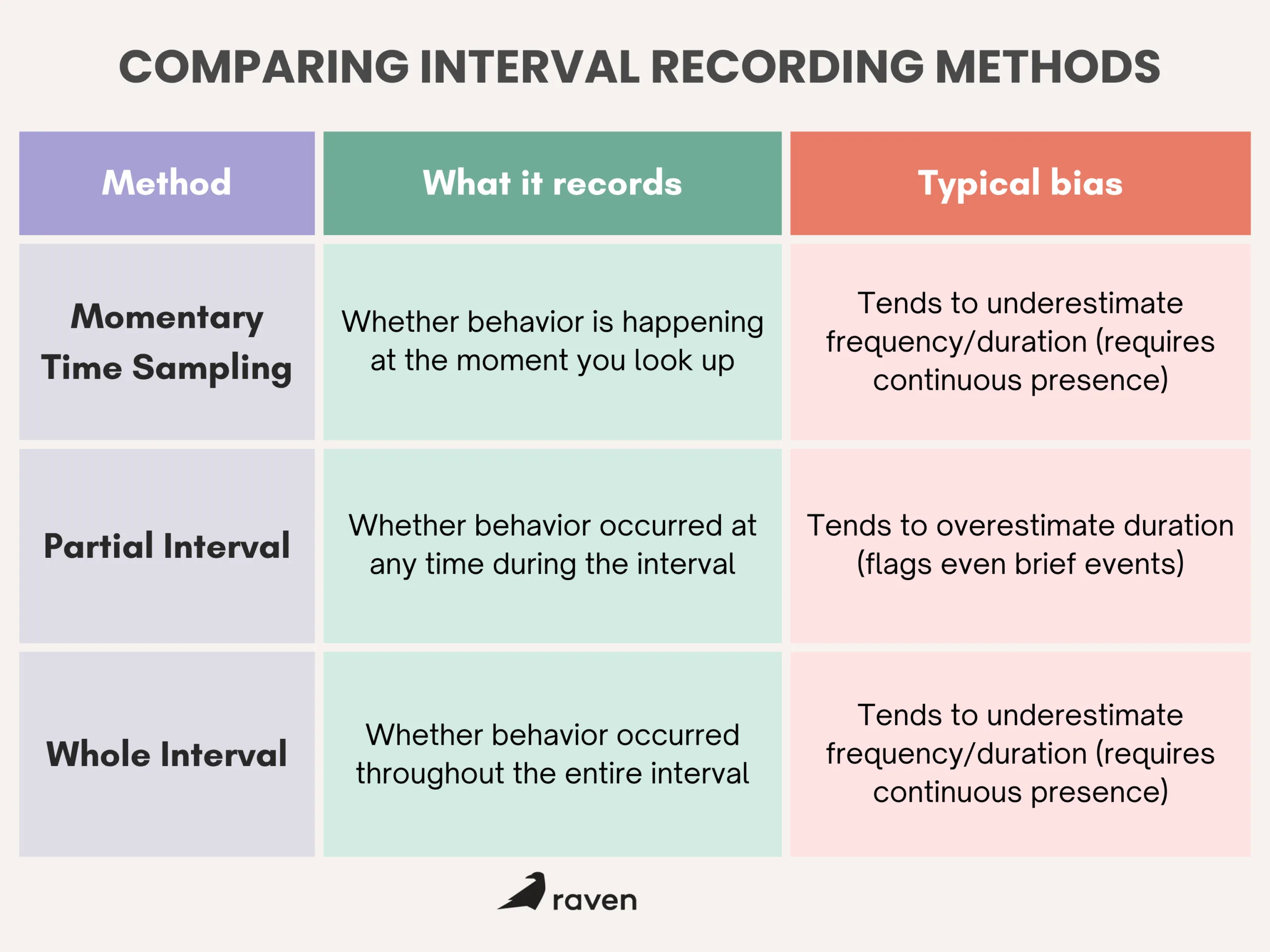
How MTS Differs from Partial and Whole Interval Recording?
Partial interval says “yes” even if the behavior happened briefly; it inflates time estimates.
The whole interval requires the behavior to last the full interval; it gives conservative (low) estimates.
MTS is the middle ground: it samples at moments and is efficient, but it can miss events that occur between moments.
When Is Momentary Time Sampling Most Useful?
Use MTS when:
You are observing groups (classroom, therapy group), and a single observer can’t track every child continuously.
Behaviors are high-frequency or occur many times a session, and counting every event is impractical.
You want a quick trend measure to see whether behavior is increasing or decreasing across sessions.
You need efficient data during community activities or natural settings where continuous recording is not feasible.
Some practical examples include:
Measuring how many students are on-task during a 20-minute lesson (one observer can scan the group at each moment).
Tracking hand-flapping in a classroom where it happens often. MTS gives a workable estimate without nonstop counting.
Observing engagement at a community outing where staff must also supervise safety.
Benefits of Momentary Time Sampling
Efficient: Requires less continuous attention than continuous recording, so it works well when observers have multiple responsibilities.
Good for trends: Repeated MTS sessions quickly show whether a behavior is increasing or decreasing.
Feasible in groups: One observer can collect data on multiple people by scanning at moments.
Easy to train: Staff learn to look at specific moments and make a single yes/no judgment; this lowers training time.
Reduced data volume: Less data to store and analyze than continuous methods, but enough to guide decisions.
Limitations of MTS and How to Reduce Them?
A few common limitations for MTS are as follows:
MTS misses behavior between moments. If a behavior happens briefly between checks, MTS won’t catch it.
Variable accuracy depending on interval length. Long intervals reduce accuracy for fast behaviors.
It results in potential bias. Depending on when the moments fall, MTS can over- or underestimate real occurrence.
How to reduce problems?
Use short intervals for fast behaviors (15–30 seconds). For slower behaviors, 30–60 seconds can be fine.
Run pilot sessions comparing MTS with continuous recording on the same behavior to estimate bias.
Train observers with video practice and use simultaneous IOA checks (aim ≥ 80% agreement).
Occasional spot-checks with continuous recording help validate your MTS results.
Interobserver Agreement (IOA) and data quality are essential with any sampling method. For MTS:
Have two observers record at the same moments and compute percent agreement: (agreements ÷ total moments) × 100. Check IOA regularly during training and periodically afterward. If IOA drops, review definitions, timing, and observer procedures, and retrain as needed.
Frequently Asked Questions
What Is Momentary Time Sampling?
Momentary time sampling is a data collection method in ABA where you check whether a behavior is happening at specific, pre set moments in time. Instead of watching continuously, you only record what is occurring at that exact instant.
When Should Momentary Time Sampling Be Used?
It is best used when you need an efficient way to collect data in busy or group settings. It works well for behaviors like on task behavior or engagement, especially when continuous observation is not practical or when one observer is tracking multiple learners.
How Accurate Is Momentary Time Sampling?
It provides a good estimate of behavior over time, but it is not perfect. Accuracy depends on things like interval length and how the behavior naturally occurs. Shorter intervals usually give more accurate results than longer ones.
Does Momentary Time Sampling Overestimate?
Not necessarily. Momentary time sampling can sometimes overestimate or underestimate behavior depending on when the observation moments fall and how often the behavior occurs. It is generally considered a balanced method, but it may still miss behavior that happens between observation points.
Conclusion
Momentary Time Sampling is a simple, efficient way to collect useful behavioral data when continuous recording isn’t practical. It’s best suited for group settings, busy clinics, and high-frequency behaviors where full-event recording would be too hard. With clear definitions, short intervals, careful observer training, and periodic validation, MTS gives dependable trend data that supports good clinical decisions.
Book a demo to see how Raven makes MTS data easy to collect on any device.