
Running an Applied Behavior Analysis (ABA) clinic takes a massive amount of heart, patience, and organization. You are dealing with highly trained staff, vulnerable children, and worried parents. But behind the scenes, an operational engine keeps the doors open, and the schedule is at its core.
For many practice owners, building the weekly calendar feels like assembling a jigsaw puzzle where the pieces keep changing shape. Scheduling is far more than just filling time slots on a screen. It connects clinical care directly to your financial health.
In fact, poor scheduling is easily one of the fastest ways a clinic loses money without even realizing it. In this blog, we’ll dive into why the calendar is so important, the biggest mistakes practice owners make, and how to fix them to keep your clinic healthy and profitable.
Why Scheduling Is One of the Biggest Profit Leaks in ABA
In a typical business, if a meeting gets canceled, you just move it to the next day. In ABA therapy, scheduling is uniquely difficult because it involves clinical rules, operational limits, and financial restrictions all at the same exact time.
A single therapy session requires matching a specific patient to a licensed therapist, working around school hours, figuring out travel time, and staying tightly within the rules of an insurance authorization.
When you have ten or fifteen clients assigned to a single therapist, trying to organize all of this manually becomes incredibly risky.
Every time a scheduled block breaks down, money slips through the cracks. Disconnected systems create massive gaps between the schedule, clinical notes, and billing. When these gaps occur, they cause errors and delays that ultimately lead to lost revenue.
If a session is missed, that is a billable hour that just disappears. Every 30-minute block of travel time that therapists navigate between clients directly impacts their utilization rate. The schedule is the absolute foundation of your revenue cycle. If the calendar is broken, the billing will be broken too.
The Most Costly Scheduling Mistakes ABA Practices Make
Even experienced clinic directors can fall into bad habits when they are rushing to get the calendar published on a Friday afternoon.
Small errors might seem harmless on a daily basis, but over a month or a year, they create serious financial damage. Here are the specific scheduling mistakes that hurt ABA practices the most.
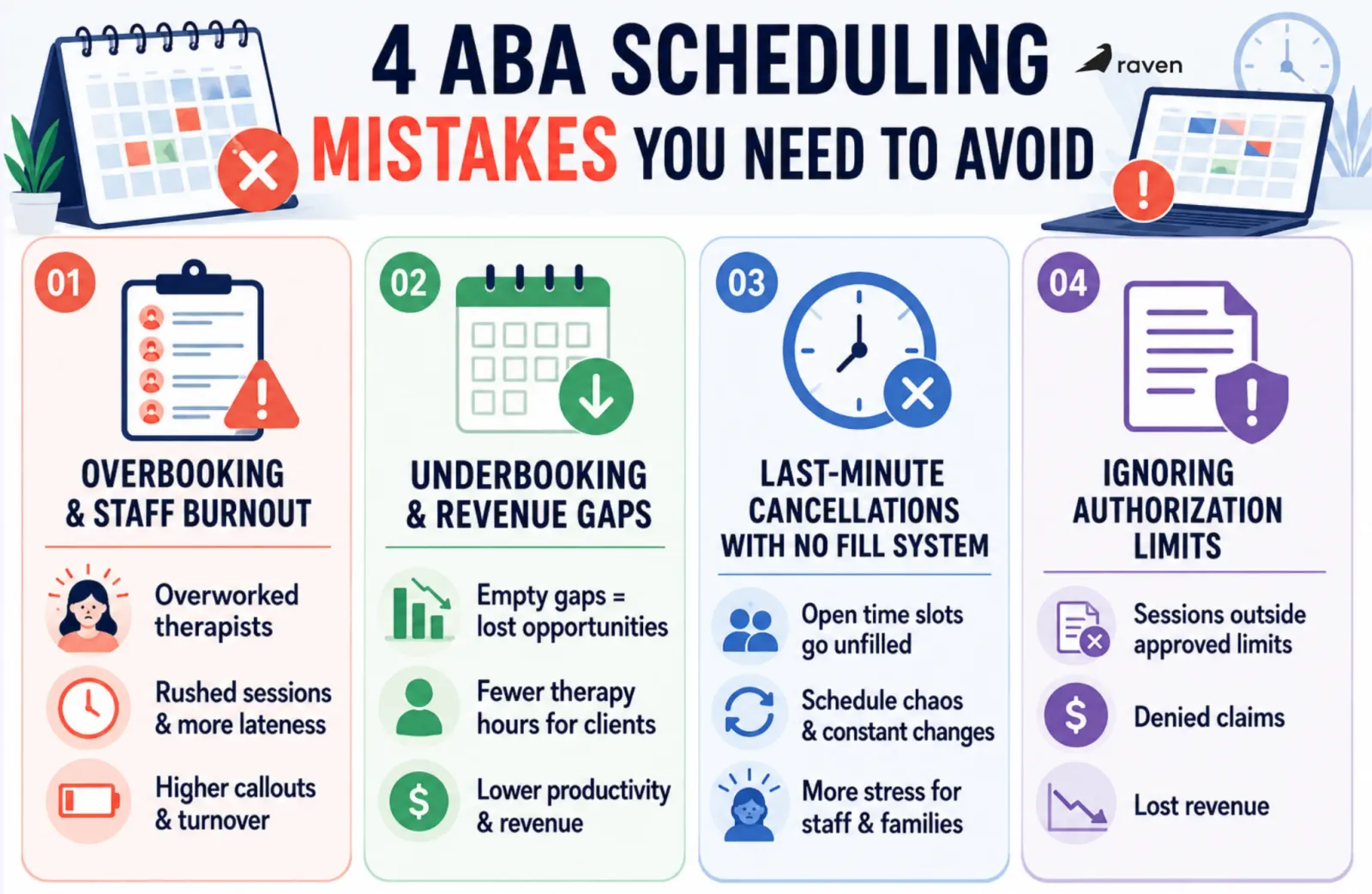
1. Overbooking and Staff Burnout
When a clinic has a long waitlist of eager families, it is incredibly tempting to squeeze in as many sessions as humanly possible. However, overbooking is a massive mistake.
Scheduling too many appointments back-to-back creates chaos and leads directly to overworked, exhausted therapists.
ABA therapy requires a lot of emotional and physical energy. If you do not leave enough time for sessions, therapists end up rushing through their appointments, which compromises the actual quality of care the child receives.
The ripple effects of overbooking are severe:
When technicians feel stretched too thin by heavy caseloads, they get frustrated and burn out quickly.
Rushing between appointments without proper travel buffers naturally increases lateness.
Sessions get shorter than they should be, even if the calendar says otherwise.
A burned-out therapist is far more likely to call in sick, which forces you to scramble and cancel even more sessions.
And once a few therapists start calling out regularly, turnover risk goes up right along with it.
2. Underbooking and Revenue Gaps
On the opposite end of the spectrum is underbooking. Sometimes, out of fear of stressing the staff or due to simple oversight, schedulers leave large, unused gaps in a therapist's day. Having too few appointments wastes valuable time slots and lowers the overall productivity of your clinical team.
Underbooking hurts both the business and the client. When clients receive fewer hours of therapy than their insurance company actually authorized, their clinical progress slows down drastically.
At the same time, your clinic's revenue drops because you are not billing for the services you are fully staffed to provide. Every empty gap on the calendar is a missed opportunity to help a child and generate income to keep the clinic running.
3. Last-Minute Cancellations with No Fill System
Kids get sick, cars break down, parents get stuck at work, or a therapist's own car won't start. Cancellations are inevitable for any ABA practice. The real mistake is not the cancellation itself; the mistake is not having a reliable system ready to fill that empty spot immediately.
When this process fails, it causes massive headaches:
If a session is canceled at the last minute and you have no way to pull another client into that time slot, that time block just sits empty for the day.
A single cancellation can ruin an entire day of sessions if it forces you to shuffle locations and staff around in a panic.
That empty slot is still a billable hour you're not getting back.
Without a backup plan, the supervisor gets overly stressed trying to hold the day together, and families get frustrated by the sudden changes.
4. Ignoring Authorization Limits When Scheduling
Insurance companies are incredibly strict about how many hours of ABA therapy a child can receive within a specific timeframe. A calendar might look perfectly full and highly profitable on your screen, but it could actually be hiding hours of therapy that you will never get paid for.
This happens when schedulers accidentally book hours that fall outside the approved insurance limits. If a child is approved for 20 hours a week and you blindly schedule them for 22, the payer will deny those extra two hours, and the clinic absorbs the loss.
Alternatively, if a provider covers a session they are not officially eligible to run, the claim gets denied. These authorization conflicts hide in plain sight and usually only become obvious weeks later when the billing cycle hits and the claims are flatly rejected.
How to Build a More Resilient ABA Schedule?
Fixing these expensive leaks requires shifting from a reactive mindset to a highly proactive one. You can never guess your way through the week. You need to build a resilient scheduling framework that protects your staff and your bottom line.
Here is how you can stabilize the process:
Use Predictable Templates
Do not start from scratch every single Monday. Ground your clients in a recurring pattern, like keeping a child's sessions at 8:00 a.m. every morning. This consistency stabilizes families and gives your staff a real sense of control over their week.
Protect Travel Time
Travel time is not optional. Build realistic time buffers into the calendar so therapists can drive between homes or schools safely. When travel is planned well, staff arrive calm, and schedules do not collapse under pressure.
Match Sessions to Authorizations Early
Map out every single session to align cleanly with the insurance authorization from the very first day. This prevents families from getting confused and stops your billing team from dealing with denied claims later.
Centralize Scheduling Data
You must keep all scheduling data in one centralized place so vital details do not live purely in someone's head. A single source of truth cuts down on confusion and stops avoidable double bookings. Using scheduling software ****can also give your team a clearer view of staff availability, client appointments, and authorization limits in one place.
How Scheduling Software Removes the Guesswork?
Managing all these moving parts by hand or through a spreadsheet is practically impossible once a clinic grows past a handful of clients. To stop the profit leaks entirely, clinics must adopt dedicated software to handle the heavy lifting.
Modern practice management systems are built to automatically prevent the exact mistakes that cost you money. Software instantly connects your scheduling directly to your authorizations, ensuring that no session goes over the approved limits.
Good platforms provide automated alerts if you try to schedule beyond what the insurance allows, completely stopping unauthorized sessions before they happen. They track expiration dates so you never accidentally provide care under an expired plan.
Furthermore, modern ABA platforms prevent session overlaps automatically and flag supervision gaps immediately. Without this level of integration, teams are forced to rely on manual processes that heavily increase the risk of errors.
Automated software can also handle last-minute gaps brilliantly. Instead of a chaotic rush to find a replacement, the system can use an automated waitlist to fill empty spots instantly.
Automated reminders go out to families, which drastically reduces no-shows and keeps attendance high. When scheduling is fully integrated with your billing workflow, claims reflect exactly what happened, and errors are reduced significantly.
For practices wanting to truly lock down their revenue cycles and automate their finances entirely, integrating a specialized financial platform like Flychain ensures that perfectly scheduled sessions translate directly into reliable cash flow.
Conclusion
Running a successful ABA practice requires incredible dedication to the children you serve, but you cannot provide top-tier care if your business is slowly losing money through basic calendar mistakes. Scheduling is the heartbeat of your clinic's operations.
Overbooking burns out your staff. Underbooking leaves money on the table. And ignoring authorization rules? That leads straight to denied claims. By building predictable templates, protecting travel time, and investing in high-quality scheduling software, you can plug the profit leaks for good.
A strong schedule keeps your therapists happy and ensures children get the hours they deserve. It also protects your bottom line, so your clinic can keep doing this work for years to come.
Sources
https://behavioralproz.com/blog/aba-scheduling-strategies/
https://www.abamatrix.com/revenue-cycle-management-in-aba-therapy-explained-simply/
https://therapypms.com/blog/aba-appointment-scheduling-common-mistakes-to-avoid