Teaching a child to complete a daily routine, like making a bed or putting on winter clothes, feels pretty simple to an adult. We do it without thinking because our brains have practiced the sequence thousands of times.
However, for a child with autism, a chore like that is actually a giant mountain of confusing, tiny steps. If you just look at a child and say, "Go get dressed," they might freeze up, start crying, or run away simply because they do not know where to begin the process. This is where Applied Behavior Analysis (ABA) steps in with a teaching strategy called chaining.
While there are a few ways to teach a chain of behaviors, one of the most powerful and rewarding methods is called backward chaining. By completely flipping the traditional teaching process upside down, adults can help children experience immediate success, lower their anxiety, and build real confidence.
What Is Backward Chaining in ABA?
Backward chaining is a teaching method used in ABA therapy in which a child learns a multi-step task by starting at the very end of the routine rather than the beginning. Instead of forcing the child to figure out the first step, the adult steps in and does almost all of the heavy lifting.
The parent or clinician fully guides the child through the entire task, stopping to allow the child to do the very last step independently.
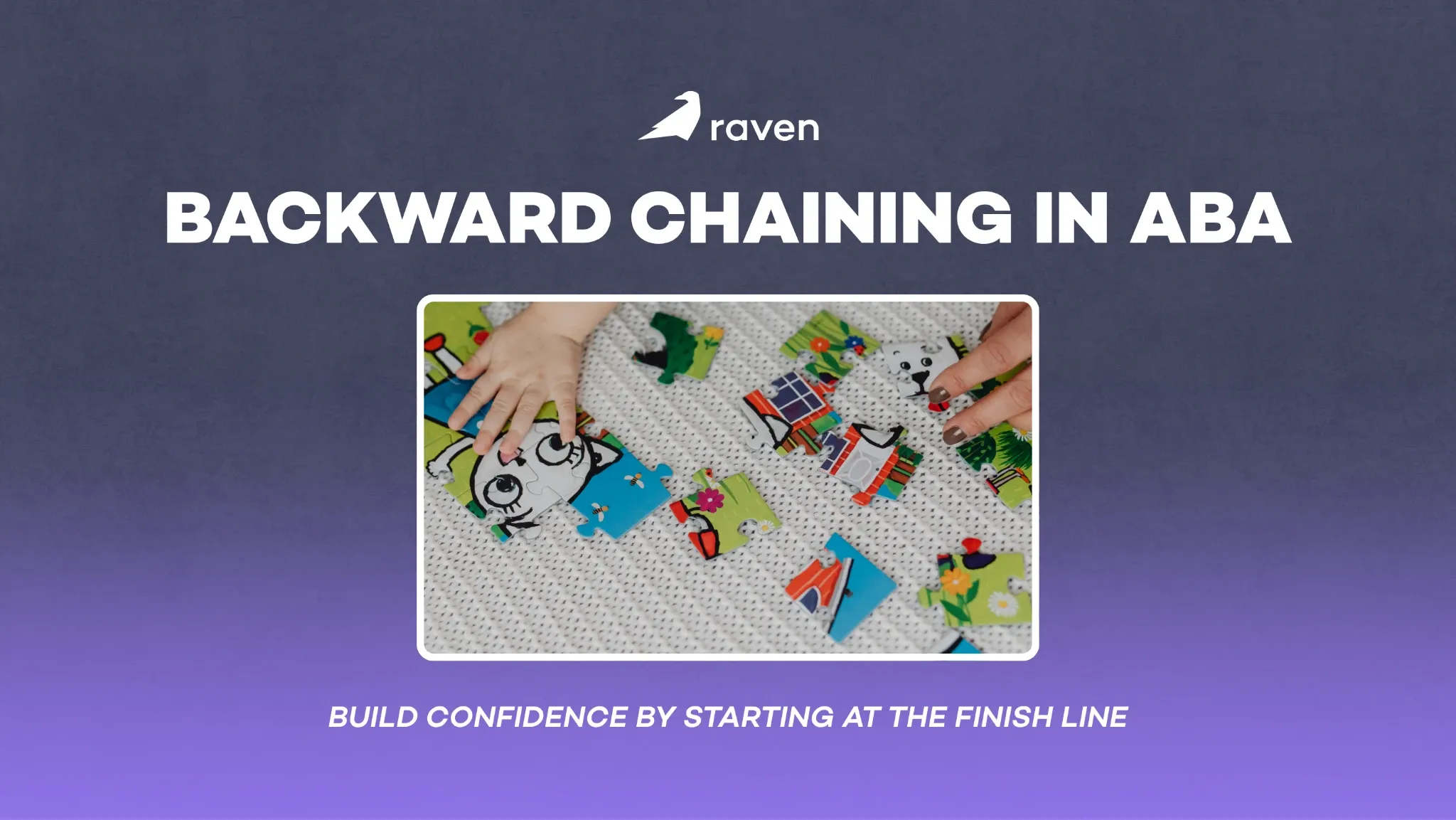
Think about teaching a child how to complete a jigsaw puzzle. If you dump fifty pieces on the table and say, "Go," the child will likely get overwhelmed and quit.
But if you put forty-nine pieces together yourself and hand the child the very last piece to press into the final open spot, they instantly get to see the finished picture. They get all the glory and the reward of finishing the puzzle without having to struggle through the hard parts.
That is the exact psychology behind backward chaining. The child gains the natural reinforcement of a finished product immediately. Once the child can confidently do that last step on their own for a few days, the adult changes the rules.
Now, the adult does all the steps except the last two. The child completes the second-to-last step, then the final step, and gets the reward. The teaching slowly moves backward up the chain until the child is doing the whole thing alone.
How Backward Chaining Works
To make this method work, you cannot simply improvise the steps. You must follow a strict, organized process to avoid confusing the learner. If you skip a step or alter the order, the child will struggle to memorize the routine.
Creating a Flawless Task Analysis
Before you teach anything, you must create a task analysis. This means writing down every single physical movement required to do the job. The best way to do this is to physically perform the task yourself and write down exactly what your hands are doing.
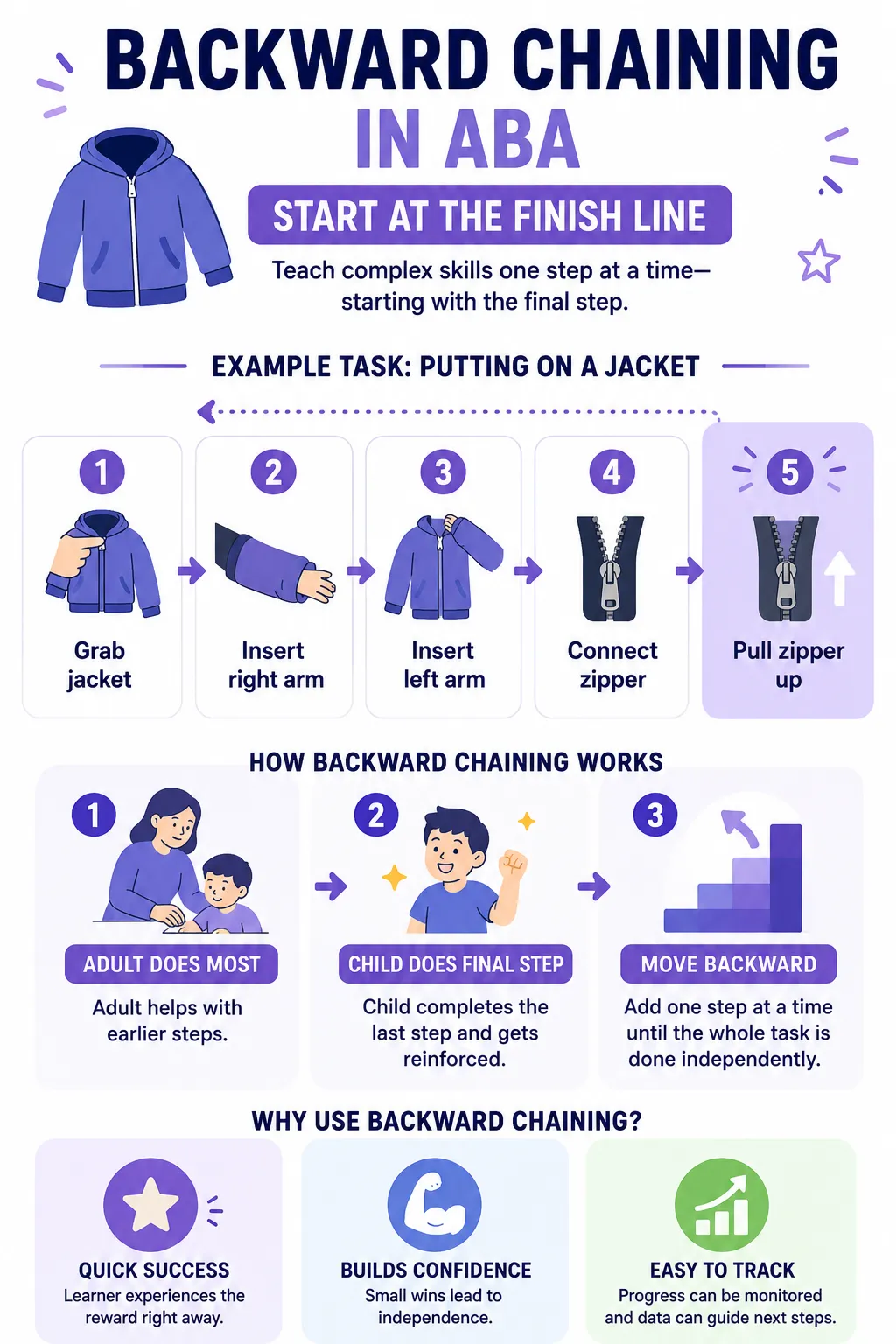
If you are teaching a child to put on a jacket, do not just write "put on coat." That is too big. You need to write down: grab the collar, slide the right arm in, reach around, slide the left arm in, grab the zipper, pull the zipper up. The steps must be small and clearly defined.
Prompting Through the Early Steps
Once you have your list, you bring the child to the learning area. Let's use the jacket example. You, the adult, do the first steps. You might literally place your hands over the child's hands and physically guide their arms into the sleeves.
You guide them to connect the zipper at the bottom. You do all of this quickly and smoothly so the child does not get bored or frustrated.
Teaching the Final Step
When you reach the very last step, pulling the zipper up to the chin, you stop helping. You let go of their hands. You might point to the zipper or say, "Pull it up." When the child pulls the zipper up, you immediately give them massive praise, a high-five, or access to a favorite toy. The jacket is on, they are warm, and they feel successful.
Fading Your Help Backward
After the child masters the final zipper pull for a few consecutive days, you begin to back away. Tomorrow, you will physically guide their arms into the sleeves, but you will stop before connecting the zipper at the bottom.
Now, the child must connect the zipper (the second-to-last step) and pull it up (the final step) to get the reward. You keep slowly peeling away your physical help, moving backward one step at a time, until you can just hand them the jacket and they do the whole thing.
Backward Chaining with Leaps Ahead: A Variation to Know
Sometimes, a child does not need to be taught every single step in a chain because they already know how to complete a few actions naturally.
Making a child practice steps they have already mastered can make them bored, which often leads to behavioral issues. To fix this, BCBAs use a variation called "backward chaining with leaps ahead."
What It Means to Leap Ahead?
This variation follows the exact same backward process, but if the therapist knows the child already possesses the skill for step number four, they simply skip teaching it. They "leap ahead" over the steps the child already knows how to do independently.
The adult still requires the child to perform that known step during the routine, but they do not spend days tracking data and slowly fading prompts for it.
Why This Variation Is Useful
Leaping ahead saves an incredible amount of clinical time. It keeps the child engaged because the therapy moves at a faster, more natural pace.
For example, if a child is learning to wash their hands, they might already be great at rubbing their hands together, but terrible at turning the water on and getting the soap.
A therapist will leap over the hand-rubbing step and focus their teaching energy purely on the harder mechanical steps of the faucet and soap pump.
When Backward Chaining Outperforms Forward Chaining
In ABA therapy, you also hear a lot about forward chaining, which is simply teaching a routine starting from step one. While forward chaining is great for some things, backward chaining has specific advantages that make it the clear winner for certain types of learners and specific types of tasks.
Ideal for Kids with Low Frustration Tolerance
If a child gives up easily, cries when things get hard, or has a history of throwing tantrums to escape work, forward chaining can be a disaster. If you make them start at step one, the finish line feels miles away.
Backward chaining is the ultimate tool for these kids because it practically guarantees they will succeed. Because the adult does 90% of the work, the child does not have time to get frustrated.
Accessing the Natural Reward Instantly
When you make a bed, the reward is seeing a clean, neat room. When you bake cookies, the reward is eating a cookie. In backward chaining, the learner gets to experience that natural, built-in reward within seconds of doing their part. This is incredibly motivating.
In forward chaining, if a child only learns how to get the flour out of the pantry (step one), they do not get to eat a cookie. They just get a high-five, which is simply not as motivating as the real thing.
Best Tasks for the Backward Method
Backward chaining naturally fits chores that have a very clear physical result at the end. Things like tying shoes, drawing a picture, zipping a backpack, or putting together a toy are perfect candidates.
Academic tasks, like reciting the alphabet or counting to ten, usually do not work well backward because they rely heavily on chronological time and order to make sense to the brain.
How to Document Backward Chaining Progress Digitally
In the world of ABA, if you do not write the data down, it technically never happened. Taking data is how a clinical supervisor actually knows if the child is learning or if the therapist is just permanently doing the chore for them. Documenting a task analysis requires very specific paperwork, and clinics are rapidly changing how they handle this.
Tracking Prompt Levels
You cannot just write a checkmark on a piece of paper to say the child got dressed. You have to record exactly how much help the adult gave the child for every single step.
Therapists track the "prompt level." They use letters to show what happened: "I" for Independent, "V" for Verbal (telling them what to do), "G" for Gestural (pointing), or "P" for Physical (guiding their hands).
The Shift to Digital Software
In the past, therapists walked around with heavy clipboards and messy paper grids. Trying to write down prompt letters for fifteen different steps while physically helping a squirmy toddler put on a jacket was incredibly stressful and led to bad data.
Today, almost all modern ABA clinics use digital data collection software on tablets or smartphones. With an app, the therapist sees the exact steps listed clearly on the screen. They just tap a button to record the prompt level.
The software automatically graphs the progress in real-time, allowing the BCBA to look at the chart and instantly see if the backward chaining process is working.
If a child is stuck on the third-to-last step for two weeks, the digital graph alerts the supervisor so they can step in and change the teaching plan before the child gets frustrated.
Conclusion
Backward chaining is an incredibly clever and highly effective way to teach complex skills to individuals who might otherwise feel completely overwhelmed by everyday expectations. By starting at the finish line and only requiring success on one tiny step at a time, adults can completely remove the stress and anxiety from the learning process.
It allows the learner to build genuine confidence because they are constantly succeeding and getting access to the natural reward of a finished job. Whether you are a parent trying to teach your child how to tie their shoes in the morning or an RBT working in a busy clinic, using this reverse method changes the entire dynamic. It turns a scary, demanding chore into an easy, guaranteed win for the child.
Sources:
https://www.thetreetop.com/aba-therapy/backward-chaining-in-aba/
https://leafwingcenter.org/backward-chaining/
https://learnbehavioral.com/aba-glossary/backward-chaining
https://behaviorprep.com/glossary/backward-chaining-with-leap-aheads/
https://www.advancedautism.com/post/forward-chaining-in-aba-therapy
Paper vs Digital Data Collection in ABA: Pros & Cons
https://brightbridgeaba.com/blog/types-of-chaining-in-aba-backward-forward-total-task-chains