

Starting a new ABA practice is an exciting venture, but before you can treat your first patient and collect your first payment, you have to clear a major administrative hurdle.
Credentialing is one of the first major steps toward generating revenue. Without it, your clinic is effectively invisible to insurance payers. For new ABA owners, navigating the maze of applications, verifications, and payer networks can feel completely overwhelming.
This guide breaks down exactly what the ABA credentialing process entails, the documentation you need, the realistic timelines, and the costly mistakes you must avoid to get your practice fully operational.
What Is ABA Credentialing?
ABA credentialing is the formal, multi-step process where insurance companies verify that a behavioral healthcare provider is legally and professionally qualified to deliver services. It acts as a strict quality control measure to protect patients.
During this process, insurance payers perform Primary Source Verification (PSV). This means they do not just take your word for it when you submit a resume.
Instead, the payer directly contacts the original issuing organizations like universities, state licensing boards, and the Behavior Analyst Certification Board (BACB) to ensure that every degree, license, and certification is authentic and in good standing.
Credentialing answers the fundamental question of whether a BCBA or RBT has the required qualifications, credentials, and background checks to practice behavioral therapy in their state.
Why Credentialing Matters for New ABA Practices
For a new ABA clinic, credentialing is not just a regulatory checkbox; it is the foundation of your business revenue. In the United States, most families rely on commercial insurance or state Medicaid to afford intensive ABA therapy.
If your practice and your providers are not credentialed and in-network, you cannot bill those insurance companies for the services you provide.
Furthermore, many new practice owners confuse ABA credentialing with enrollment, which leads to massive financial leaks.
Credentialing is the process of proving a provider is qualified, while enrollment is the process of registering that provider with a specific payer network so they can actually submit claims. You cannot enroll without being credentialed first.
If you skip these steps, or assume a BCBA can start working on day one just because they hold a national certification, any claim you submit will be instantly denied by the payer as "provider not eligible." This mistake routinely costs clinics thousands of dollars in unbillable sessions that cannot be recovered retroactively.
Steps in the ABA Credentialing Process
To get credentialed successfully, new practices must follow a highly structured sequence of events. Skipping a step or rushing the process can lead to delays or rejected applications.
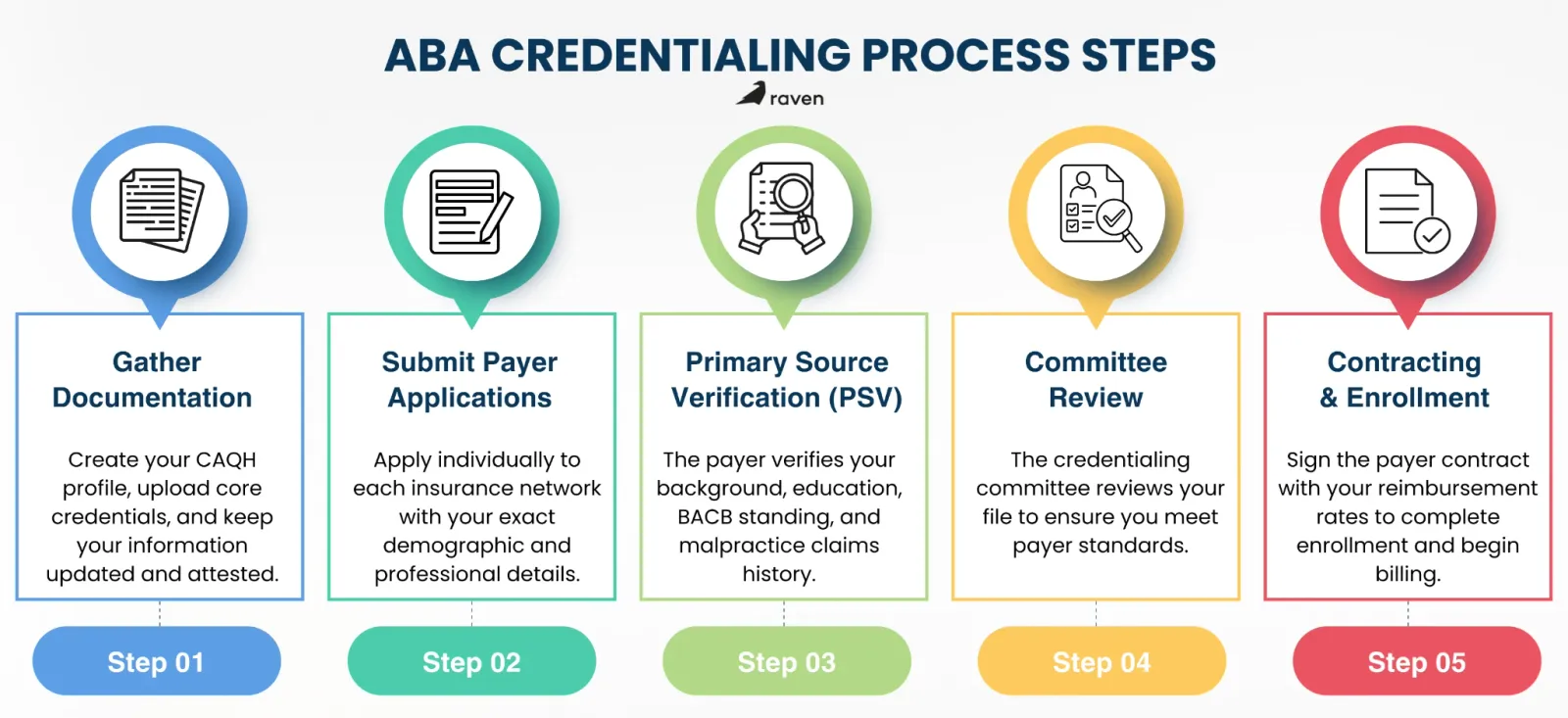
Step 1: Gather Documentation and Build a CAQH Profile
The Council for Affordable Quality Healthcare (CAQH) is a centralized database used by most major commercial health plans. Providers must create a profile and upload their core credentials here. Keeping this profile updated and actively attested is the first mandatory step.
Step 2: Submit Specific Payer Applications
Every insurance company (like Aetna, Cigna, or local Medicaid Managed Care Organizations) has its own unique application forms. You must apply individually to each network you want to join, providing exact demographic and professional details.
Step 3: Primary Source Verification (PSV)
Once the payer receives your application, their internal team will independently verify your background, education, BACB standing, and malpractice claims history. This is where the payer contacts your previous employers and state boards.
Step 4: Committee Review
After the data is verified, a credentialing committee at the insurance company reviews the file to ensure the provider meets their ethical, professional, and network-adequacy standards.
Step 5: Contracting and Enrollment
Once approved by the committee, the payer will issue a contract detailing your specific reimbursement rates. After you sign the contract, you are officially enrolled and can begin billing for services.
What Documents Do ABA Practices Need for Credentialing?
Missing documentation is the top reason credentialing applications get stalled or rejected. New practices must be incredibly organized before they ever submit an application. Having digital, high-quality copies of all necessary paperwork ready on day one will save months of frustration.
To complete the CAQH profile and individual payer applications, ABA providers must gather the following items:
Personal Identification: Government-issued ID, full legal name, date of birth, and Social Security Number for background checks.
Professional Identifiers: An active National Provider Identifier (NPI) number and the clinic's Employer Identification Number (Tax ID/EIN).
Educational Records: Copies of relevant degrees, transcripts, and graduation dates from accredited institutions.
Licensure and Certification: Active BACB certification numbers (for BCBAs, BCaBAs, or RBTs) and state-specific behavior analyst licenses (if required by your local state laws).
Work History: A detailed employment history covering the last five years. Any gaps in employment of more than a few months must be accompanied by a written explanation.
Liability Insurance: Proof of active malpractice and professional liability insurance, including the policy number, coverage limits, and expiration date.
Practice Details: A W-9 form for the clinic, the practice's physical and billing addresses, and a signed collaborative agreement or supervision documentation if applicable.
How Long Does ABA Credentialing Take?
One of the hardest truths for new ABA practice owners to accept is the timeline. ABA Credentialing is an incredibly slow process. On average, you can expect the entire credentialing and contracting process to take anywhere from 90 to 120 days per provider.
This timeline depends entirely on the specific insurance payer and the state you operate in. Commercial payers usually hit the 90-day mark, while state Medicaid and local Managed Care Organizations (MCOs) can easily stretch to 120 days or longer.
Because payers have to wait for universities, state boards, and professional references to reply during the primary source verification phase, administrative delays are frequent.
If you are launching a new clinic, start the credentialing process three to four months before you plan to open your doors to patients. Factor that delay into your startup budget, too. Flychain’s 2026 ABA Practice Financial Benchmark Report found that new practices may be cash-negative during their first 60 to 90 days as credentialing, enrollment, authorizations, and initial claims work their way through the system. Waiting until you have a signed lease and an active waitlist to begin credentialing could leave you paying rent for months before insurance revenue starts coming in.
Common ABA Credentialing Mistakes to Avoid
Because the ABA credentialing process is so tedious, it is easy to make simple mistakes that carry massive financial consequences. Avoiding these common errors will keep your applications moving smoothly.
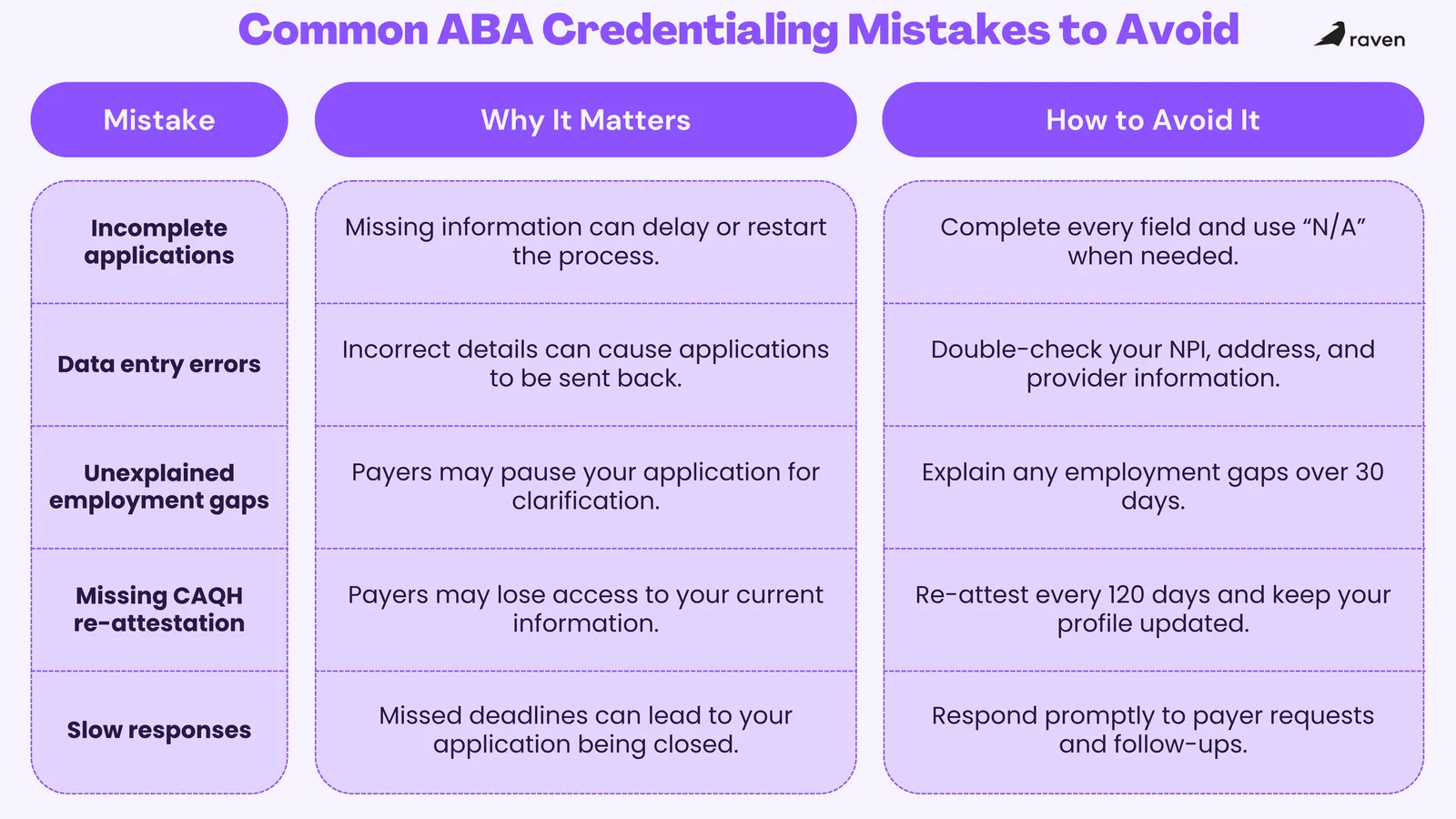
Submitting Incomplete Data
Leaving fields blank on an application is a guaranteed way to get rejected. If a question does not apply to your practice, you must explicitly write "N/A" rather than leaving it empty. Furthermore, simple data entry errors like flipping two digits in an NPI number or misspelling an address will force the payer to kick the application back, restarting the 90-day clock.
Failing to Explain Employment Gaps
Insurance credentialing committees look closely at a provider's work history. If there is a six-month gap between jobs, they will pause the application to ask why. Providing a proactive, written explanation for any gap over 30 days keeps the review moving forward.
Ignoring CAQH Re-Attestation
The CAQH database requires providers to log in and attest that their information is accurate every 120 days. If you forget to click the attestation button, payers will lose access to your profile, and they will immediately halt your credentialing application or suspend your active in-network status.
Slow Response Times
If an insurance company emails you asking for a clarified document or an updated malpractice certificate, they usually give a strict deadline. If your administrative team is too busy and misses that email, the payer will close the file, forcing you to start the entire process over from the beginning.
How ABA Practice Management Software Can Help?
Managing credentialing for a growing team through spreadsheets can quickly become difficult. This is where modern ABA practice management software becomes invaluable for a new clinic.
High-quality software platforms offer dedicated compliance and credentialing tracking modules. Instead of relying on sticky notes and calendar alarms, the software securely stores all digital copies of licenses, liability insurance, and board certifications in a centralized hub.
The system tracks the specific expiration dates for every document. Long before a BCBA's state license or an RBT's background check expires, the software automatically sends alerts to the administrative team and the provider, giving them plenty of time to renew.
Furthermore, when credentialing is tied directly into your scheduling software, the system acts as a hard stop; it will physically prevent a scheduler from booking a session with a provider whose credentialing has lapsed or whose insurance enrollment is not yet active, protecting you from unbillable claims.
Conclusion
Credentialing is undeniably one of the most frustrating and time-consuming parts of starting a new ABA practice. However, it is also the most critical step in ensuring your clinic's financial survival.
By understanding the distinct difference between credentialing and enrollment, gathering your exact documentation early, and anticipating the 120-day timeline, you can prevent major revenue leaks before they start.
Avoiding careless data entry errors and leveraging practice management software to track your renewals will keep your clinicians compliant, your claims clean, and your focus exactly where it belongs: on providing high-quality behavioral therapy to the families who need it most.
Sources:
https://ensorahealth.com/blog/what-is-credentialing-in-aba-therapy/
https://www.pacemave.com/post/credentialing-vs-enrollment-what-aba-providers-need-to-know
https://www.cubetherapybilling.com/step-by-step-credentialing-guide-for-healthcare-providers
https://credentialing.org/blogs/checklist-for-behavioral-health-credentialing/
https://ensorahealth.com/blog/what-is-credentialing-in-aba-therapy/
https://www.advancedmd.com/blog/six-common-mistakes-healthcare-practices-make-during-credentialing/
https://www.flychain.us/resources/2026-aba-practice-financial-benchmark-report