
Have you ever stopped to think about how we naturally learn the unspoken rules of our daily lives? We instinctively know to stop walking when a traffic light turns red, to use quiet voices when entering a public library, and to answer our phones only when they are ringing. Most people pick up on these environmental cues without any formal instruction.
However, for children and adults with autism or developmental delays, these critical social and environmental signals are not always obvious. They often need to be taught systematically. This highly structured learning process is the absolute backbone of effective behavior therapy, allowing individuals to navigate their world safely and independently.
What Is Discrimination Training in ABA?
Discrimination training is a foundational teaching strategy used in Applied Behavior Analysis (ABA) that helps a learner recognize the subtle and major differences between various cues in their environment.
In the simplest terms, it teaches an individual to engage in a specific behavior only when the correct cue is present, and to withhold that behavior when the cue is missing. It is the process of learning exactly when, where, and under what conditions a specific action will be successful.
Without the ability to discriminate, the world is an incredibly confusing place where every object and situation looks the same.
For example, a toddler might learn the word "dog" and suddenly start calling every four-legged animal, including cats and cows, a dog. Discrimination training steps in to help the child notice the specific features that make a dog unique.
By learning to tell things apart, individuals gain the ability to make accurate choices, communicate their needs clearly, and follow safety rules in their community.
How Does Discrimination Training Work?
The mechanics of this training rely heavily on the core principles of behavior analysis, specifically the strategic use of positive reinforcement. Practitioners set up the learning environment by introducing two very distinct concepts to the learner: the "discriminative stimulus" and the "S-delta."
The Discriminative Stimulus (SD)
This acts as the green light. It is the specific instruction, object, or environmental cue that signals to the learner that a reward is currently available if they perform the correct action.
The S-Delta (SΔ)
This acts as the red light. It is the incorrect option or the absence of the cue, signaling that no reward will be given if the behavior happens now.
Positive Reinforcement
When the learner correctly responds to the SD, the therapist immediately provides a high-quality reward, such as verbal praise, a favorite toy, or a small treat. If the learner responds to the S-delta, the therapist simply resets the trial without providing any reward or reprimand.
By consistently praising the child for choosing the SD and ignoring the S-delta, the child's brain quickly connects the dots. They learn that paying attention to the correct cue pays off, while guessing or responding to the wrong cue is simply a waste of time.
Over time, the reinforcement naturally shapes their behavior, highly motivating the learner to make the right choice completely independently.
Examples of Discrimination Training
To truly understand how this scientific concept looks in a real clinical or home setting, it is helpful to look at practical, everyday examples where therapists apply these rules.
Identifying Everyday Objects
Imagine a practitioner is teaching a young child to identify their favorite snack. The therapist places a real banana and a plastic apple on the table. The therapist says, "Touch the banana." The spoken instruction is the SD.
If the child reaches out and touches the banana, they get a high-five and a piece of the fruit. If they touch the apple (the S-delta), the therapist gently resets the items and tries again without a reward. Eventually, the child learns to look closely at the fruit rather than just swiping at the table.
Navigating Social Greetings
Social rules are notoriously tricky, but discrimination training makes them concrete. A therapist might teach a teenager to say "Hi, how are you?" when a familiar friend or family member walks into the room (the SD).
However, the teenager must also learn not to walk up to total strangers on the street and offer the exact same greeting (the S-delta). The reward in this scenario is the positive, warm social interaction they get from their friends.
Improving Functional Communication
Consider a child who wants to play with a toy car. Instead of using their words, they usually just grab the therapist's hand and pull them forcefully toward the toy box. The therapist uses discrimination training by holding the car and prompting the child to say "Car."
When the child uses the verbal word (SD) instead of aggressive pulling (S-delta), they immediately receive the toy car. The child learns that speaking is a much faster, easier way to get what they want.
Types of Discrimination Training
Because every learner has a completely different skill level, ABA practitioners do not use a one-size-fits-all approach. They utilize several different variations of this training to match the specific cognitive and developmental needs of the individual.
1. Simultaneous Discrimination Training
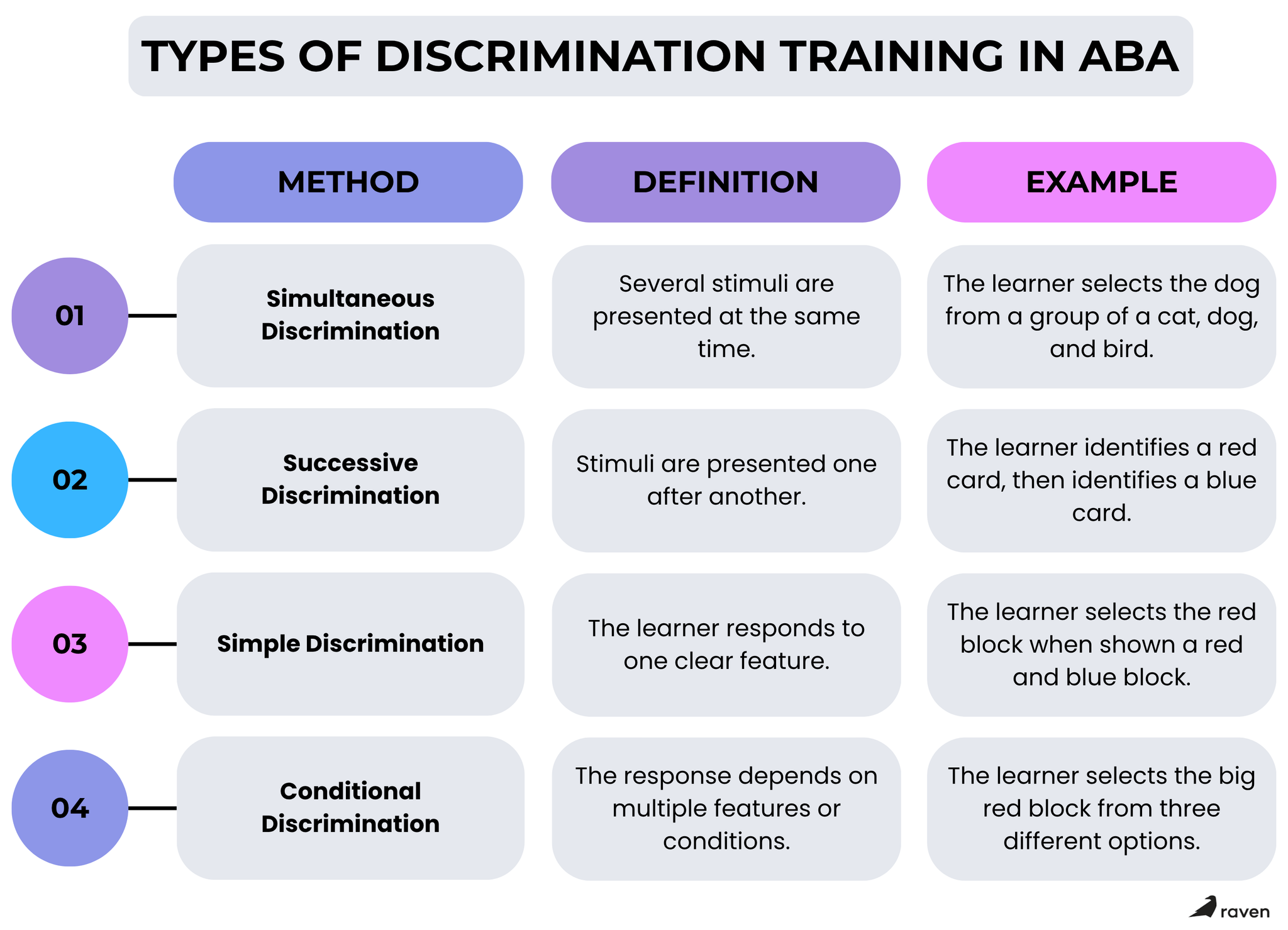
In this method, the therapist places multiple items in front of the child at the exact same time. The learner gets to visually scan the field of options like looking at a picture of a cat, a dog, and a bird all lined up on a desk before making their choice. This is great for visual learners who need to compare items side by side.
2. Successive Discrimination Training
Here, there is no field of items to look at all at once. The stimuli are presented one after the other. For example, the therapist might hold up a red card and ask "What color?" then put it away, and hold up a blue card and ask again. The learner has to rely on their memory and knowledge rather than process of elimination.
3. Simple Discrimination
This focuses on identifying an item based on a single, obvious characteristic. Teaching a child to point to a red block when placed next to a blue block is a simple discrimination based purely on color.
4. Conditional Discrimination
This is an advanced skill where the correct answer actually changes depending on the context or an additional rule. For example, if a therapist puts out a big red block, a small red block, and a big blue block, and says, "Give me the big red one," the child has to process two different features (size and color) at the same time to get the reward.
Discrimination Training vs. Generalization
While these two clinical terms are often discussed together, they actually represent two completely different sides of the learning process. You cannot have a fully independent learner without mastering both concepts.
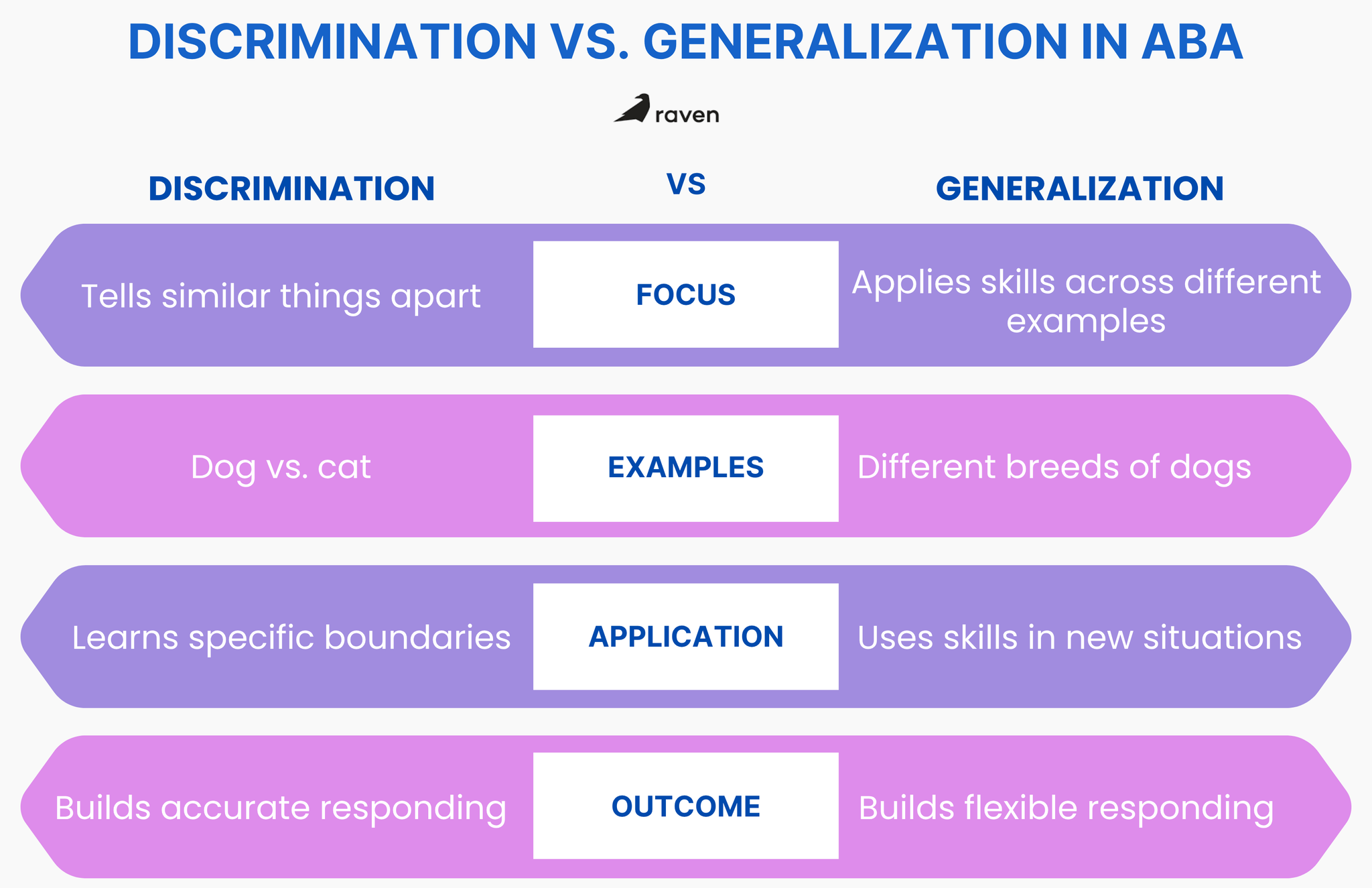
Discrimination is all about strict precision. It teaches a child to establish boundaries around a concept. It is the skill of knowing that a golden retriever is a dog, but a fluffy cat is not. Generalization, on the other hand, is all about real-world flexibility.
Once the child learns the boundaries of what a dog is, generalization is their ability to look at a tiny toy poodle, a massive Great Dane, and a cartoon dog on a television screen, and correctly label all of them as "dogs."
Discrimination training ensures the learner does not make embarrassing or dangerous mistakes by mislabeling things, while generalization ensures the learner can actually use their new skills outside of the rigid therapy room.
A great ABA program builds precise discrimination first, and then immediately tests for generalization in the natural environment.
Common Challenges During Discrimination Training
Teaching a child to tell the difference between highly similar items is not always a smooth journey. Practitioners frequently run into behavioral and learning hurdles that require careful troubleshooting.
Prompt Dependency
This is one of the most common traps in early ABA therapy. If a therapist always points their finger slightly toward the correct flashcard, the child will learn to just watch the therapist's hands instead of actually looking at the pictures. The child becomes dependent on the hint and refuses to guess on their own.
Moving Too Fast
Therapists sometimes get overly eager and introduce five new items at once before the child has even mastered the first two. This causes massive confusion, leading the learner to shut down, throw materials, or simply start guessing randomly out of frustration.
Using Similar Items Too Early
If you are teaching a child to identify a spoon for the very first time, putting it next to a fork is a terrible idea because they look too similar. A better approach is to put the spoon next to something completely unrelated, like a shoe. Once they master that, the therapist can slowly introduce items that look similar.
How to Track Progress in Discrimination Training?
Because ABA is a hard, evidence-based science, practitioners do not just guess if a child is learning; they rely heavily on continuous, accurate data tracking. Without data, a therapist has no real proof that their teaching methods are actually working.
During a session, therapists use a data sheet or a digital tablet to record every single correct and incorrect response the learner makes. At the end of the day, they calculate the child's daily mastery percentage.
If a child touches the correct colored block nine out of ten times, they achieve a 90% mastery rate. The clinical team plots these daily percentages on a line graph to look for ascending trends.
If the graph shows the child has been stuck at 40% accuracy for two straight weeks, the supervising behavior analyst knows they need to immediately change their teaching strategy, switch up the rewards, or simplify the targets.
Managing this massive amount of daily clinical data, alongside billing and scheduling, can easily overwhelm a growing practice.
This is why modern clinics frequently rely on specialized operational and financial platforms like Flychain to streamline their backend processes. By automating the heavy administrative and revenue cycles, clinic owners ensure their BCBAs and technicians can keep their focus exactly where it belongs: on analyzing the clinical data and celebrating the learner's daily progress.
Conclusion
Understanding how to teach a child to correctly interpret the physical and social world around them is one of the most powerful and transformative tools in a behavior therapist's toolkit.
Discrimination training removes the overwhelming chaos of daily life by breaking down environmental rules into clear, simple, and highly rewarding steps.
Whether a therapist is using simultaneous presentation to teach basic colors, or advanced conditional training to teach complex safety rules, the underlying goal is always the same.
By patiently teaching learners when and where their actions will be successful, practitioners open the door to better communication, safer daily habits, and much deeper social connections within their communities.
Sources:
https://www.levelaheadaba.com/blog/discrimination-training-aba
https://www.allstaraba.org/blog/discrimination-training-in-aba
https://www.armswideopenaba.com/blog/discrimination-training-in-aba-therapy