It is easy for caregivers to feel caught off guard when a child with autism or a developmental delay exhibits intense behaviors like hitting or yelling, as these episodes frequently seem to come completely out of nowhere.
However, in the field of Applied Behavior Analysis, we know that behavior is never truly random. Every single action is a form of communication, and there is always a trigger and a payoff. To figure out exactly what the child is trying to communicate, therapists act like detectives.
They use a specific, highly structured observation tool called ABC data collection. By closely observing what happens right before and right after the behavior, the clinical team can decode the hidden meaning behind the outbursts.
This article will explore exactly how ABC data works, how to record each piece accurately, and how this information is used to change lives.
What Is ABC Data Collection in ABA Therapy?
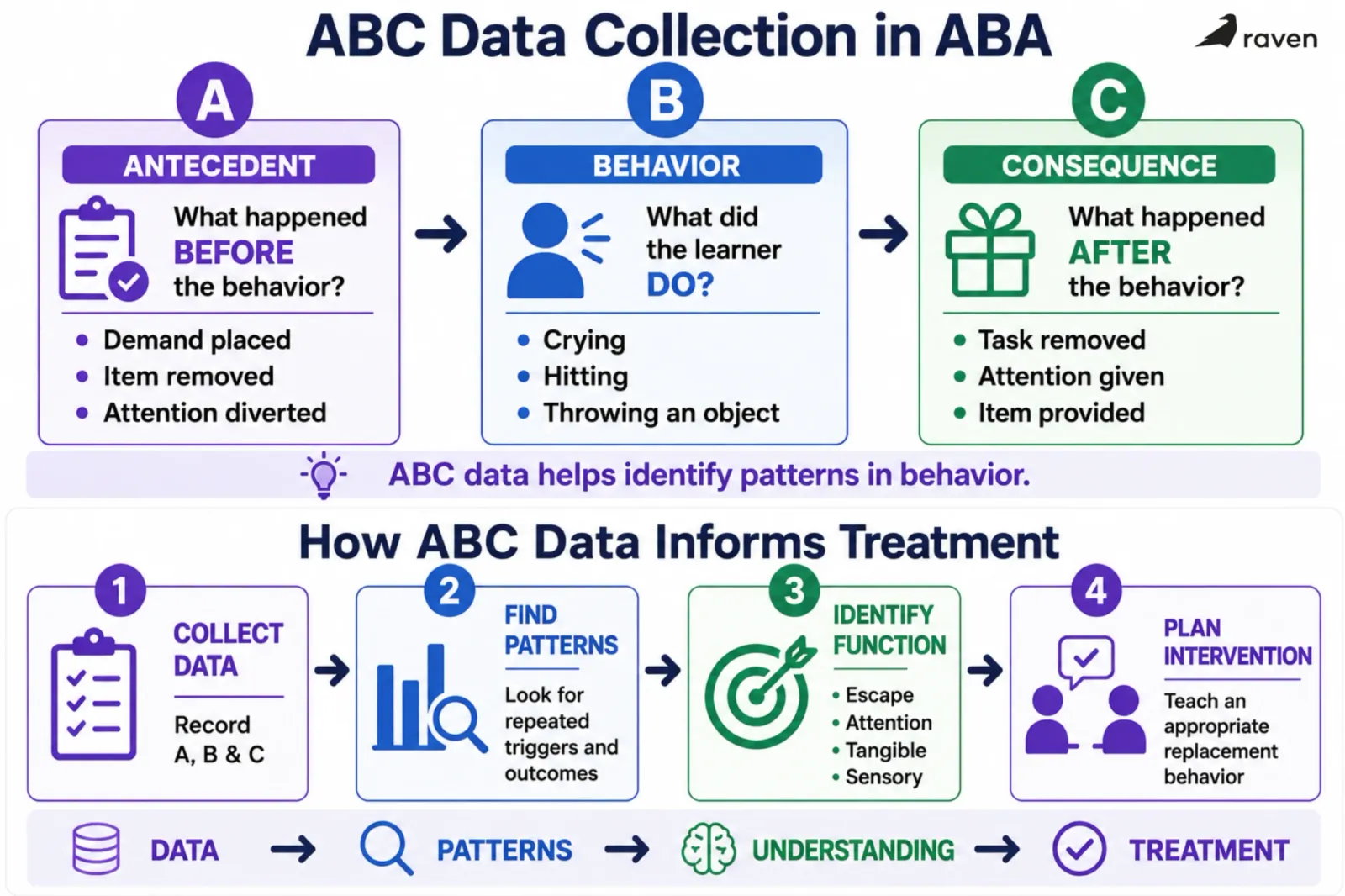
ABC data collection is an observational tool used by Board Certified Behavior Analysts (BCBAs) and Registered Behavior Technicians (RBTs) to figure out the "why" behind a specific behavior. The letters A, B, and C stand for Antecedent, Behavior, and Consequence.
It is a core component of a Functional Behavior Assessment (FBA). Instead of just guessing why a child is acting out, therapists use this method to gather hard, objective facts in the child's natural environment.
The main goal of taking ABC data is to find a clear pattern over time. If you only look at a single tantrum, you might not learn much. But if a therapist records twenty different tantrums over two weeks using the ABC format, a clear pattern almost always emerges.
They might notice that the behavior only happens when the child is asked to do math homework or when the teacher is paying attention to another student.
By gathering this data, the clinical team can stop reacting to behaviors emotionally and start addressing them scientifically.
Antecedent, Behavior, Consequence: Breaking Down Each Component
To use this tool correctly, you have to understand the three distinct parts of the behavior chain. Every action a human takes happens within this three-part cycle. If any piece of the data is recorded incorrectly, the entire analysis will be flawed, leading to the wrong treatment plan.
1. How to Identify and Record Antecedents
The antecedent is exactly what happens in the environment immediately before the behavior occurs. It is the trigger or the spark.
When recording the antecedent, it is incredibly important to write down only exactly what you see and hear, not what you think the child is feeling. You cannot see "frustration," but you can see a teacher handing a child a difficult worksheet.
When trying to identify the antecedent, therapists look for specific environmental shifts. Common antecedents include:
A demand is placed: An adult tells the child to clean up their toys or sit at the table.
An item is removed: A parent takes away a tablet or turns off the television.
Attention is diverted: A mother starts talking on the phone instead of playing with the child.
Sensory changes: A loud fire alarm goes off, or the room suddenly gets very crowded.
When writing this down, keep it factual. Instead of writing, "He got mad because I told him no," a good therapist writes, "Adult said 'no more cookies' and closed the pantry door."
2. Defining the Target Behavior Clearly
The "B" in ABC stands for the target behavior. This is the actual action the child takes in response to the antecedent. In ABA, a behavior must be defined operationally.
This means the description must be so clear that a stranger could walk into the room, read your definition, and immediately know if the behavior is happening or not.
Vague descriptions ruin ABC data. If you write down that the child had a "meltdown," that genuinely doesn’t have enough detail for a BCBA. A meltdown for one learner might mean crying quietly, while for another, it might mean throwing chairs. Instead, the behavior should be written with clear, observable details:
"The child dropped to the floor and cried with tears for two minutes."
"The child swung his open hand and made contact with the therapist's arm."
"The child threw three wooden blocks across the room."
By keeping the behavior description purely physical and objective, the clinical team can track exactly how severe the problem is and measure if it is getting better or worse over time.
3. Recording Consequences Accurately
The consequence is what happens immediately after the behavior occurs. In everyday life, people often think the word "consequence" means a punishment, like getting put in a time-out. But in ABA therapy, a consequence is essentially whatever happens next in the environment.
It can be a good thing, a bad thing, or a neutral thing. A consequence is the most important part of the data because it tells us what the child is getting out of the behavior.
When recording the consequence, therapists pay close attention to how the adults and peers in the room react.
Did the adult give the tablet back to the crying child to calm them down?
Did the teacher send the child to the principal's office, allowing them to escape the math test?
Did a sibling laugh when the child made a funny noise?
If a child screams and the adult immediately gives them a toy, the consequence is "gaining access to a toy." This teaches the child that screaming is a highly effective way to get what they want.
Recording the consequence honestly, even if it means admitting that you gave in to a tantrum, is vital for fixing the problem.
Paper ABC Forms vs. Digital ABC Data Collection
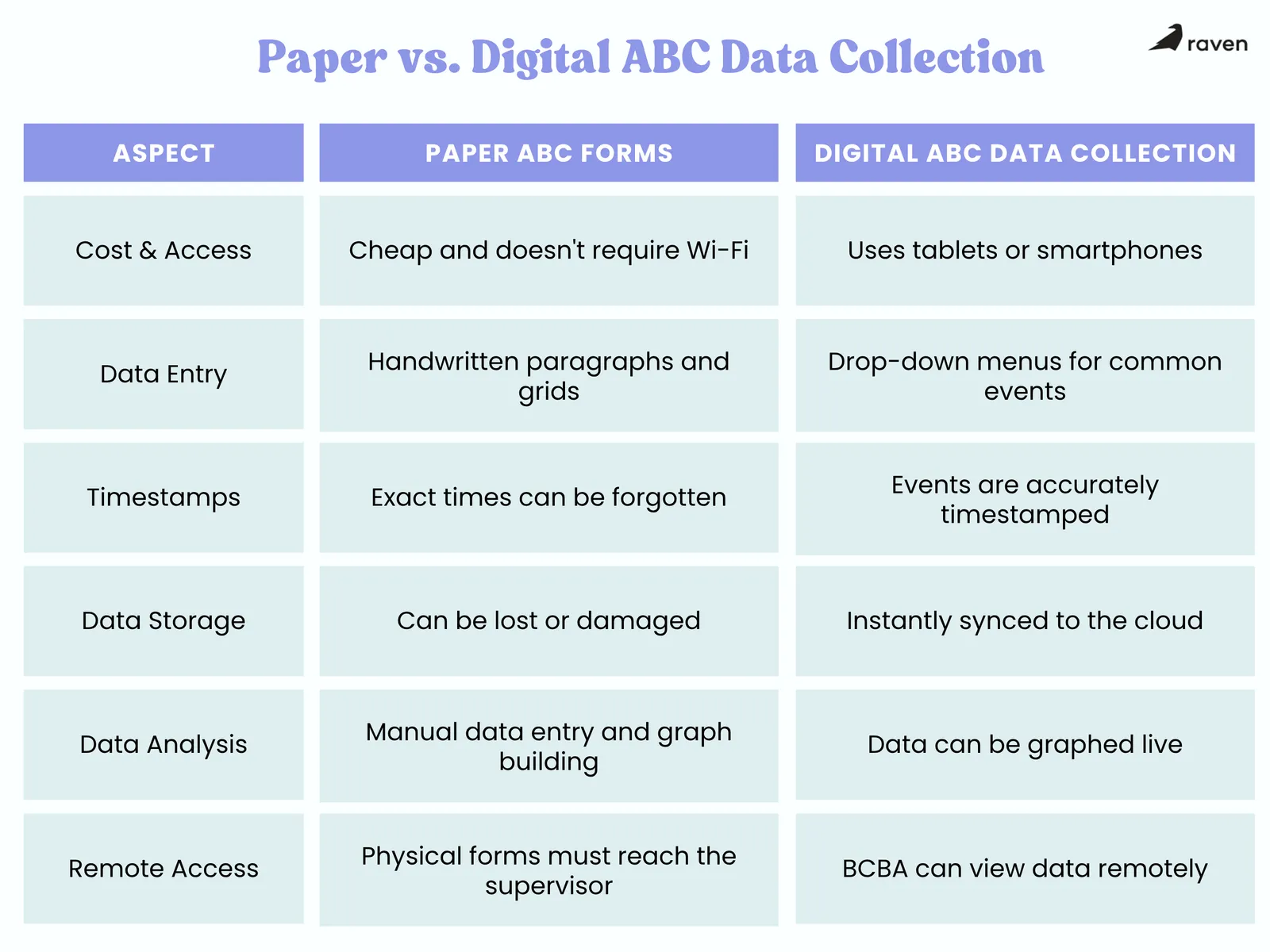
For decades, ABA clinics relied entirely on paper ABC data sheets. Therapists walked around with heavy clipboards, drawing grids on paper and frantically writing down paragraphs of information while simultaneously trying to keep a child safe during a severe behavioral episode.
While paper forms are cheap and do not require Wi-Fi, they are notoriously flawed. Handwriting is often messy, exact timestamps are frequently forgotten, and the data is easily lost or damaged before it ever makes it to the supervisor's desk.
Today, the industry is rapidly shifting toward digital ABC data collection. Therapists use customized apps on tablets or smartphones to track behaviors in real-time. Digital systems allow a clinic to set up drop-down menus for common antecedents and consequences.
Instead of writing a paragraph, the RBT simply taps "Demand placed," then taps "Hitting," then taps "Task removed." This takes three seconds and accurately timestamps the exact moment the event occurred.
Furthermore, digital data is instantly synced to the cloud, allowing the BCBA to view the data graph live from a remote location. This eliminates hours of manual data entry and graph building.
Because modern clinics are moving heavily toward digital efficiency, they often upgrade their entire administrative backend at the same time, using specialized financial platforms like Flychain to seamlessly bridge the gap between accurate clinical session data and automated revenue cycle management. When the data is clean and digital, both the therapy and the billing run flawlessly.
How to Use ABC Data to Inform Treatment Planning
Collecting the data is only the first step; the real magic happens when the BCBA analyzes it. Once enough ABC data is collected, the supervisor looks for the common thread to determine the "function" of the behavior.
In ABA, all behavior serves one of four functions: to escape something, to gain attention, to access a tangible item, or for sensory stimulation.
If the ABC data shows that 90% of the time, the antecedent is "told to clean up" and the consequence is "sent to time-out," the BCBA can confidently say the function of the behavior is Escape. The child is throwing a tantrum specifically to get out of doing their chores.
With this knowledge, the BCBA writes a customized Behavior Intervention Plan (BIP). Since they know the child wants to escape, they will teach a replacement behavior. They might teach the child to hand over a card that says "I need a break."
If the child uses the break card, they get a quick rest. If they throw a tantrum, the therapist gently but firmly follows through with the chore demand so the tantrum no longer works. The ABC data acts as the exact blueprint for this entire intervention strategy.
Conclusion
ABC data collection is the cornerstone of effective ABA therapy. Without it, parents and therapists are simply guessing at why problem behaviors occur, which often leads to accidentally making the behaviors worse.
By carefully breaking down an event into the antecedent, the target behavior, and the consequence, the clinical team can see the hidden patterns driving a child's actions.
Whether a clinic uses traditional pen-and-paper grids or advanced digital software, the goal remains exactly the same: to understand the learner's communication and build a supportive, scientific plan that teaches them safer, easier ways to have their needs met.
SOURCES:
https://masteraba.com/abc-data/
What Is an Antecedent-Based Intervention in ABA?
How to Take Great ABC Data - The Autism Helper
Antecedent Interventions: Complete Guide
Operational Definitions: Clearly Define the Behavior
Focus on Five: Data Sheets I'm Using In My Classroom Right Now with Freebies - The Autism Helper
Functional Behavior Assessments | Enhance Behavior Insights Today — Behaviorbabe