
When parents first receive an autism diagnosis for their child, one of the earliest and biggest questions they face is about time. How many hours of Applied Behavior Analysis (ABA) therapy does my child actually need every week?
You might hear about one child receiving forty hours a week, while another child in the exact same neighborhood only goes for ten hours. This huge difference often leaves parents feeling confused or worried they aren't doing enough.
The truth is that there is no magic, one-size-fits-all number of hours that works for every child. ABA therapy is built entirely around the individual.
Qualified behavior analysts look closely at a child's unique strengths, daily challenges, and family routine to build a schedule that supports real progress without overwhelming the child.
How Are Weekly ABA Therapy Hours Determined?
A clinic never picks a random number of therapy hours out of thin air. Before any therapy begins, a Board Certified Behavior Analyst (BCBA) conducts a thorough, multi-step initial assessment.
This process usually involves interviewing parents, observing the child in their natural environment, and running standardized skill evaluations like the VB-MAPP or ABLLS-R.
During this evaluation, the analyst maps out what the child can already do and where they need the most help. They look closely at communication skills, social interactions, daily living habits like getting dressed or brushing teeth, and any challenging behaviors that might block learning or pose a safety risk.
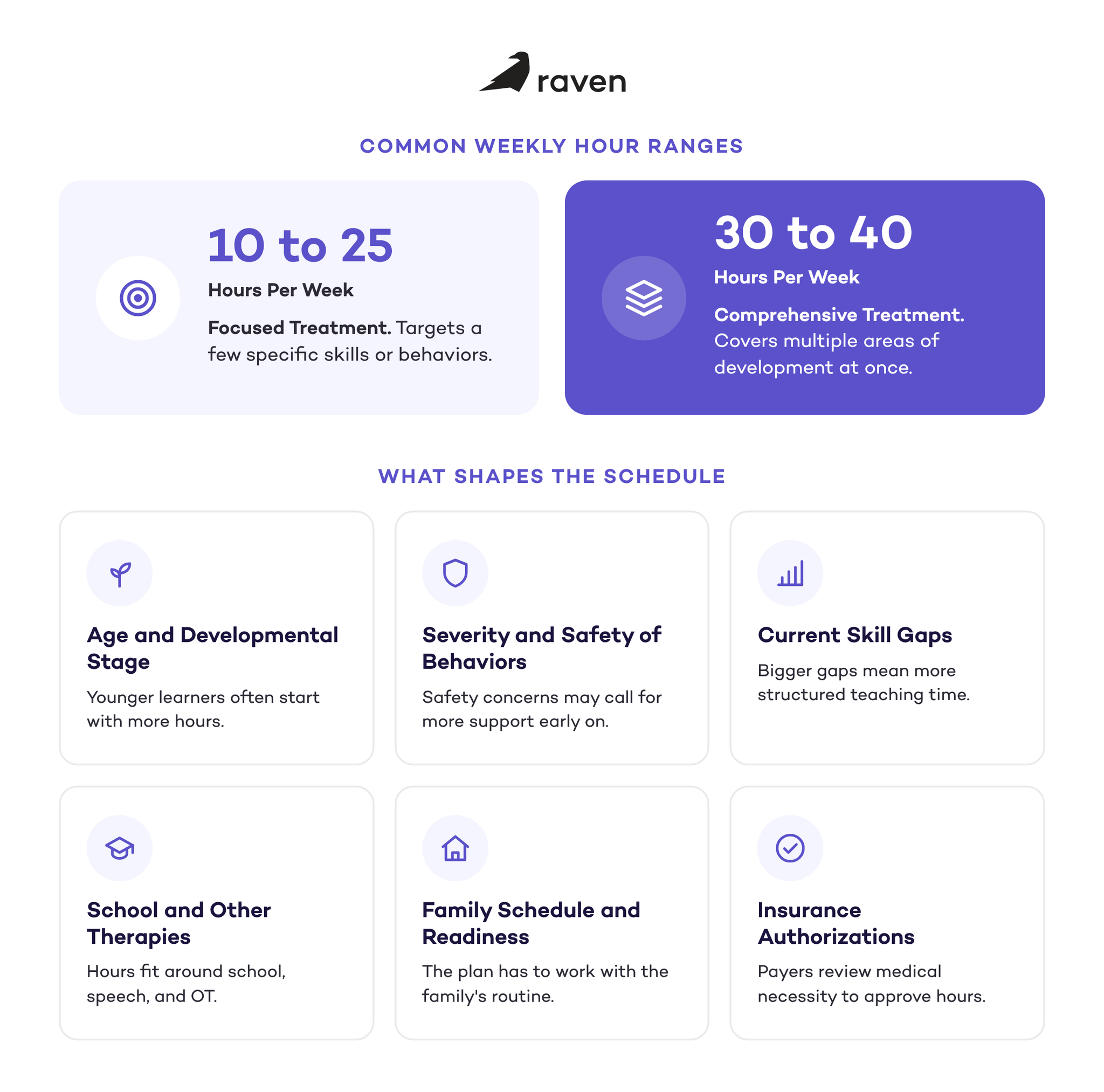
Once the assessment is complete, the BCBA writes a detailed treatment plan with clear, measurable goals. Based on how many goals need to be addressed and how much support the child needs to reach them, the analyst recommends a specific weekly hour range. Generally, recommendations fall into the two broad categories described in the CASP ABA practice guidelines:
Focused ABA Treatment (10 to 25 Hours per Week)
This approach targets a limited number of specific skills or behaviors. For example, a child might attend therapy primarily to build social conversation skills with peers, manage frustration during transitions, or learn a specific safety skill.
Comprehensive ABA Treatment (30 to 40 Hours per Week)
This intensive model addresses multiple developmental areas at once, including expressive language, cognitive skills, play, self-care, and significant behavioral challenges. It is often recommended for young children who have a wide gap to close before starting school. Research backs up the role of intensity. A 2017 study of 1,468 children found that both weekly hours and total time in treatment predicted how many learning goals children mastered.
Factors That Affect ABA Therapy Hours
Because no two children learn at the exact same pace or live in the exact same home environment, several practical and clinical factors shape the final schedule.
Age and Developmental Stage
Early intervention often involves higher weekly hours because young brains are exceptionally adaptable, and building foundational communication skills early makes future learning much easier.
Older children and teenagers usually balance therapy around full-time school schedules, leading to fewer weekly clinic hours.
Severity and Safety of Behaviors
If a child engages in intense challenging behaviors such as self-injury, aggression, or elopement (running away from caregivers), more intensive support is usually needed right away to keep them safe and teach safer ways to communicate their needs.
Current Skill Gaps
A child who doesn't yet communicate vocally and needs help with basic daily routines requires much more structured teaching time than a child who already speaks in full sentences and just needs help navigating group play.
School and Other Therapies
ABA does not happen in a vacuum. Analysts must factor in how much time the child spends in preschool, special education classes, speech therapy, or occupational therapy so the child is not stretched too thin.
Family Schedule and Readiness
A therapy plan only works if the family can realistically stick to it. Work schedules, transportation, nap times, and caregiver availability all play a major role in building a sustainable routine.
Insurance Authorizations
While clinical need drives the initial recommendation, health insurance providers review the assessment data to approve medical necessity, which can sometimes influence how many hours are funded at a given time. Clinics that track authorized hours against scheduled sessions, often through practice management software, can help make sure learners receive the full care they're approved for.
What Does a Typical ABA Therapy Schedule Look Like?
Parents often worry that a high-hour recommendation means their child will be forced to sit at a desk doing flashcards for eight hours straight. Good ABA therapy looks nothing like that. Sessions are broken up into manageable, engaging blocks that follow the child's natural energy levels and daily routines.
For a Young Child (30 to 40 Hours/Week)
A child in a full-time clinic or home program usually attends sessions Monday through Friday for six to eight hours a day.
However, those hours are heavily mixed with play-based learning, snack breaks, outdoor movement, group circle time, and quiet rest periods. Teaching happens naturally while playing with trains, eating lunch, or practicing sharing toys with a peer.
For a School-Aged Child (10 to 20 Hours/Week)
Older kids typically attend sessions after school for two to three hours a day, three to five days a week, sometimes with a weekend morning session included. These sessions focus heavily on real-world life skills, homework routines, emotional regulation, and social skills with peers.
Parent and Caregiver Training
Nearly every weekly schedule also sets aside dedicated time, often one to two hours a week or every other week, for the BCBA to coach parents directly. This ensures caregivers feel confident using the same helpful strategies when therapists are not around.
Can ABA Therapy Hours Change over Time?
Yes, and in fact, they are supposed to change. An ABA schedule is never meant to be permanent. The ultimate goal of behavior therapy is to help the child become as independent as possible so they eventually need less support, not more.
The supervising BCBA completes a formal reassessment at regular intervals, often every six months when insurance authorizations come up for renewal. Between reassessments, BCBAs review session data and progress graphs much more often, usually weekly. Digital data collection makes those trends easier to spot, so the team can adjust hours based on real progress.
As a child masters their communication goals, builds strong daily routines, and reduces challenging behaviors, the clinical team gradually steps down their weekly hours.
For example, a toddler who starts at thirty-five hours a week might drop down to twenty hours after a year of strong progress, then move to ten hours as they transition smoothly into a mainstream kindergarten classroom.
On the other hand, if a child goes through a major life transition like moving to a new school or experiencing a sudden spike in challenging behaviors, the team can temporarily increase hours to provide extra stability until things settle down.
Conclusion
Determining the right number of weekly ABA therapy hours is a collaborative process between your family and a qualified clinical team. Rather than comparing your child's schedule to someone else's, focus on how well the plan fits your child's specific learning needs, daily energy, and family life.
With regular progress tracking and open communication with your BCBA, your child's therapy hours will naturally evolve as they build confidence, master new skills, and gain lasting independence.
Sources:
https://www.autismspeaks.org/applied-behavior-analysis
Clarifications_ASD_Practice_Guidelines_2nd_ed.pdf
How Much Therapy Will My Child with Autism Need? - Bluesprig Autism
How Many Hours of ABA Therapy Does My Child Need? | Hopebridge Autism Therapy Center