Learning a brand new skill inside a quiet, highly controlled therapy room is a massive victory, but it is really only the first step of the journey. In Applied Behavior Analysis (ABA), a skill is not truly mastered until the individual can use it outside the clinic doors in their everyday life.
If a child learns how to ask for help at a desk but cannot ask their parents for help in the kitchen, the therapy has not yet served its ultimate purpose. The invisible bridge that connects clinical training to real-world success is a behavioral concept called generalization.
Practitioners focus heavily on stimulus generalization to ensure that the things a learner practices on Monday can actually help them navigate the unpredictable world on Tuesday.
What Is Stimulus Generalization in ABA?
Stimulus generalization occurs when a behavior that was successfully taught in one specific situation is evoked by new, untrained situations that share similar features. It is the ability to take a learned response and stretch it across different people, places, and objects without needing to be retrained from scratch.
Instead of having to teach a person how to act in every scenario they might ever face (which is practically impossible), generalization allows them to recognize familiar environmental cues and respond correctly on their own.
It essentially means taking a newly mastered skill out of the isolated therapy environment and applying it successfully at home, in a busy public school classroom, or out in the community.
How Does Stimulus Generalization Work?
This process depends on how learners respond to features that new situations share with the original teaching materials. When an ABA therapist teaches a new skill, they present a specific cue, known in behavioral science as a discriminative stimulus. If the learner responds correctly to that specific cue and receives a meaningful reward, that behavior gets stronger and more reliable.
Eventually, when the learner encounters a brand new cue that looks, sounds, or feels somewhat similar to the original training materials, those shared features evoke the same learned response.
The gradual shift in how strongly a learner responds based on how closely the new item matches the original is called the generalization gradient. If the new item is very similar, the response is usually strong and immediate; if the new item looks vastly different, the response naturally weakens.
Stimulus Generalization Examples in ABA
You can see this concept playing out constantly in successful therapy programs and everyday life. A great example involves early academic skills, like teaching a child to identify letters.
If a child learns to read the letter "A" printed in a standard, neat font on a flashcard, stimulus generalization occurs when they can also recognize and name the letter "A" when it is written in messy chalk on a sidewalk.
Another common example involves following basic safety instructions. If a therapist teaches a learner to "stop" while practicing in a clinic hallway, generalization happens when the child also stops walking at a busy intersection when a caregiver gives the same instruction.
It also heavily applies to social skills. A child who learns to wave and say "hello" to their primary therapist shows stimulus generalization when they start happily waving and saying "hello" to new cashiers they meet at the grocery store.
Stimulus Generalization vs. Response Generalization
These two terms sound almost identical and are incredibly important in ABA, but they highlight different sides of the learning process. Understanding the difference is critical for building flexible, natural behaviors.
Stimulus Generalization
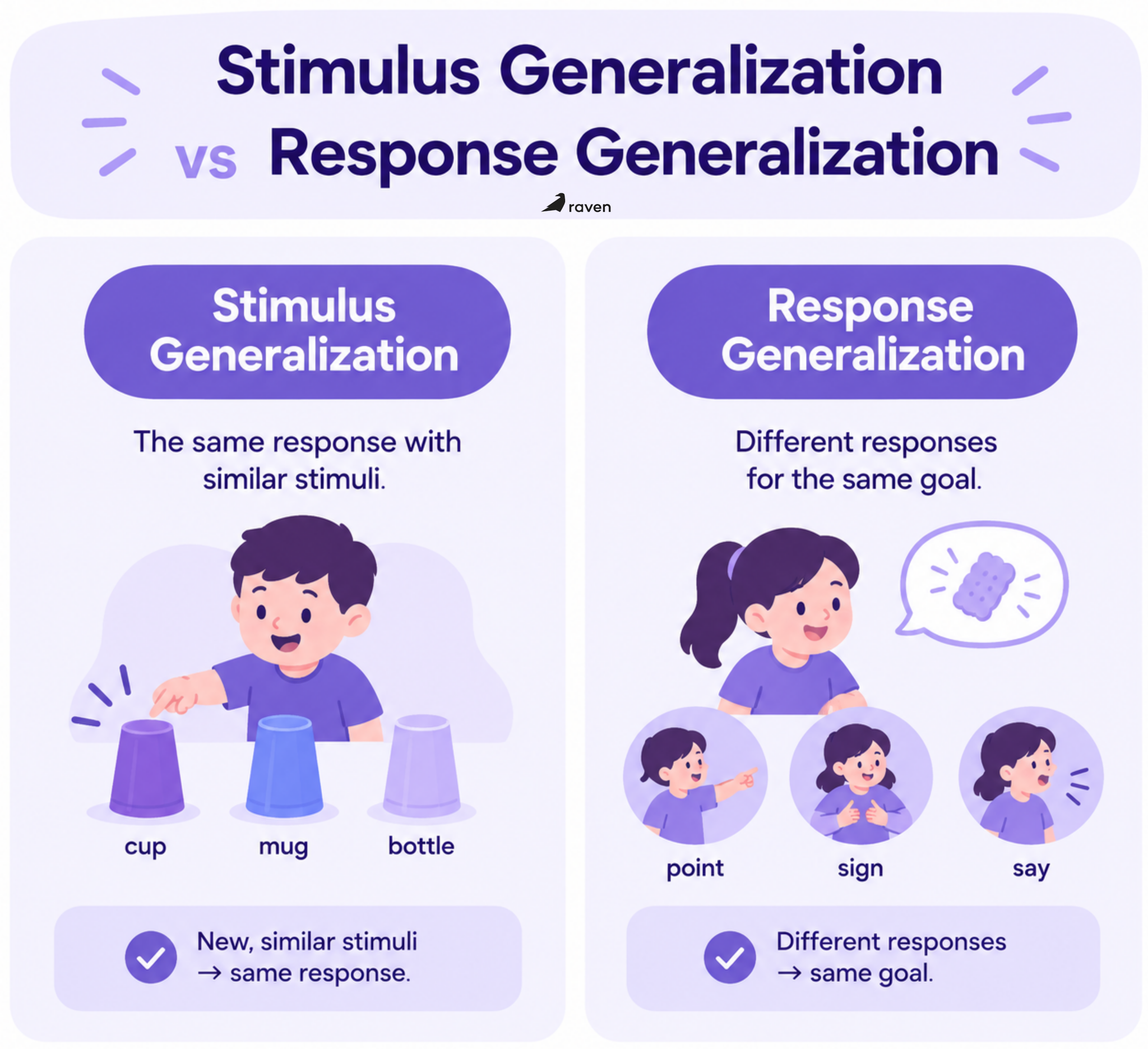
Stimulus generalization involves doing the same behavior when presented with multiple new, similar situations. The environmental cue changes, but the learner's action stays the same. For example, a child learns to say "dog" when they see their family's pet, and they also say "dog" when they see a neighbor's dog.
Response Generalization
Response generalization happens when one cue evokes multiple different, but equally correct, behaviors. The cue stays the same, but the learner's action becomes flexible. For instance, when a peer asks "How are you?", response generalization means the learner might reply with "I'm good," "Doing well," or "I'm fine," instead of repeating the same scripted phrase every time.
Why Is Stimulus Generalization Important in ABA?
Without this critical step, skills stay limited to the specific conditions where they were taught. If a learner only knows how to perform a task under highly specific, controlled clinic conditions, their behavior becomes extremely rigid. This is known as becoming "stimulus-bound," meaning they simply cannot perform the skill if the lighting, the chair, or the teacher changes.
Generalization makes the learning process highly efficient. Practitioners do not have the time or resources to teach a child every variation of a cup in the world.
By selecting a few strong, representative examples during training, generalization naturally fills in the gaps so the learner can recognize any cup they ever encounter. Ultimately, this process prevents rote memorization, builds true independence, and ensures that individuals with developmental delays can actually use their skills to live more adaptable, fulfilling lives.
How to Promote Stimulus Generalization in ABA
Practitioners cannot just run a therapy program and hope that generalization magically happens on its own; they must actively plan for it and program it into the curriculum from the very first day of training.
1. Use Multiple Exemplars
When teaching a new concept, do not just use one single flashcard or one type of object. If you are teaching a child to identify a car, use pictures of red cars, blue cars, big trucks, and then go outside to point at real vehicles in a parking lot. This varied training teaches the learner to respond to the broader category.
2. Vary the Teaching Environment
Do not stay glued to the same therapy desk. Move the lesson to the living room floor, practice in the kitchen, and run the same program at a local park. This ensures the skill does not become permanently tied to the clinic's four walls.
3. Include Different People
Have parents, siblings, and alternate therapists deliver the instructions. This helps the learner realize that they have to listen to everyone, not just their primary RBT.
4. Use Natural Reinforcement
As the learner progresses, therapists must fade out artificial rewards like stickers or small candies. If a child successfully uses their words to ask for a specific toy, the natural reward should simply be getting to play with that exact toy. This mimics how the real world actually works.
Common Challenges with Stimulus Generalization
Teaching a skill to generalize across environments comes with a few predictable roadblocks. ABA practitioners must constantly monitor data to ensure the learner is applying the rules correctly. Running regular generalization probes across settings, people, and materials, and tracking them in your data collection software, shows whether a skill is actually carrying over.
The most common hurdle is overgeneralization. This happens when a learner takes a new rule and applies it way too broadly because their understanding of the cue is not sharp enough.
For example, after learning to correctly label a red apple as an "apple," the child might start calling a red bouncy ball or a red toy car an "apple" just because they share the color red. The behavior is under the control of a broader class of stimuli than the therapist intended.
To fix this, practitioners use strict discrimination training, explicitly teaching the child to notice the distinct differences between the target item and similar, incorrect items.
Another frequent issue is prompt dependence. If a therapist constantly hints at the right answer, always looks at the correct item, or leaves their hand hovering near the correct flashcard, the learner will start relying on the therapist's body language rather than paying attention to the actual teaching materials.
This blocks generalization, because the child will not know how to respond when the therapist leaves the room.
Conclusion
Mastering a challenging new skill in a quiet, organized clinic is a fantastic starting point, but true clinical success is always measured by what a learner can achieve in their everyday community. Stimulus generalization is the vital engine that drives this real-world adaptability.
By intentionally teaching with multiple examples, practicing across various natural settings, and carefully watching out for errors like overgeneralization, ABA professionals can effectively bridge the gap between therapy and real life.
This proactive approach ensures that learners are fully equipped to confidently navigate a complex, ever-changing world with the skills they worked so hard to build.
Sources:
https://behaviortechcourse.com/generalization-and-maintenance-in-aba-therapy/
https://www.ambitionsaba.com/resources/understanding-stimulus-generalization-in-therapy