Every human action, from tapping a pencil on a desk to a child throwing a massive tantrum in a grocery store, happens for a very specific reason. Behavior is simply communication in disguise. When children or adults lack the verbal skills to explain exactly what they need or how they feel, they rely on their physical actions to get the job done.
In the field of Applied Behavior Analysis (ABA), professionals do not look at behavior as just "good" or "bad." Instead, they look at the underlying purpose, which is called the function of the behavior.
By figuring out the exact reason why a behavior is happening, parents and therapists can completely change how they respond. Rather than just punishing a challenging behavior, they can teach safer, easier ways for the individual to get their needs met.
What Are the 4 Functions of Behavior in ABA?
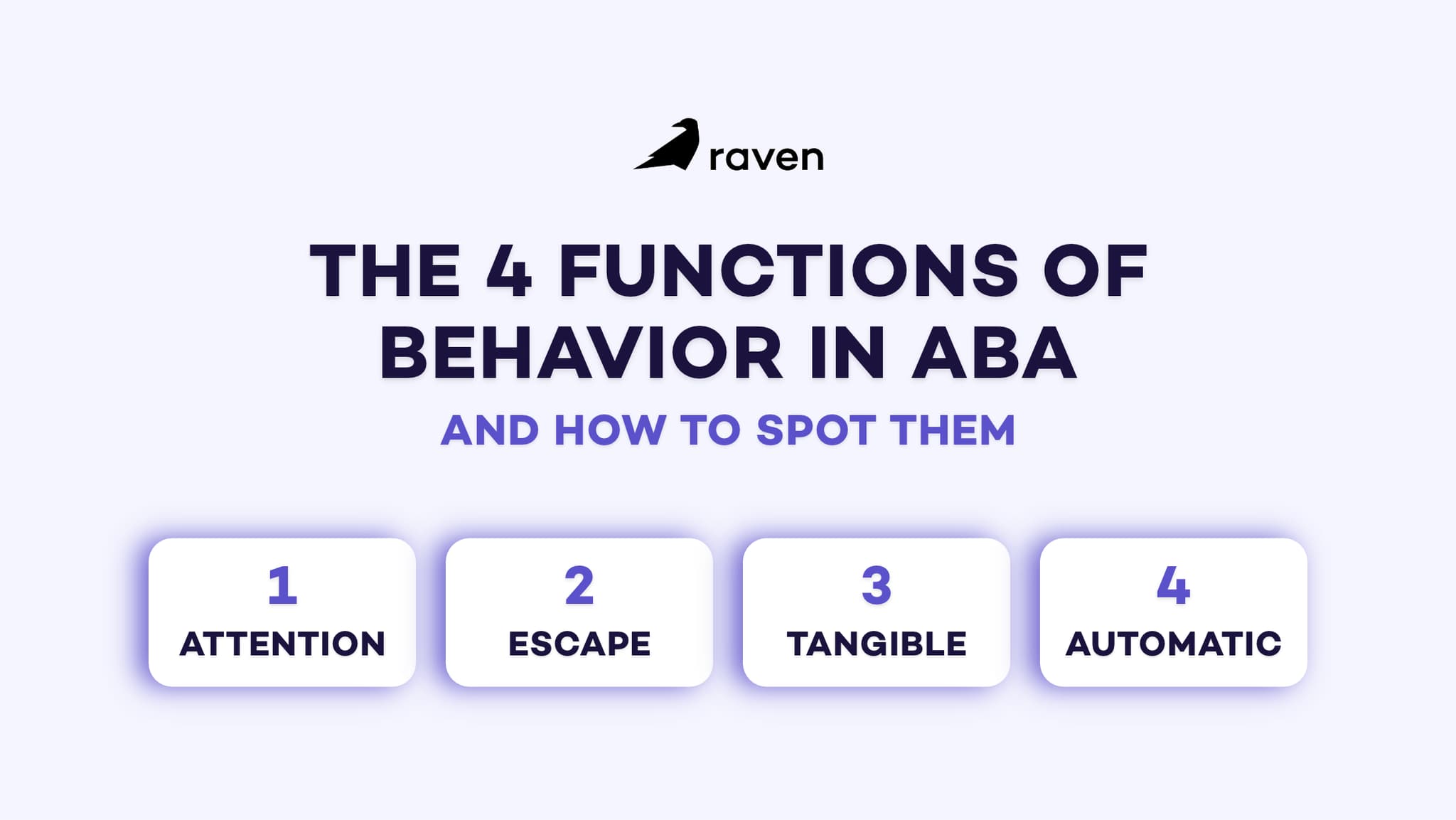
In behavior analysis, challenging behavior is generally maintained by one or more of four functions, even if the reason is not immediately obvious to the people watching. Practitioners often use the simple acronym SEAT (Sensory, Escape, Attention, Tangible) or EATS to remember these four core categories.
Understanding these categories shifts how a clinical team approaches a treatment plan, moving away from frustration and toward practical solutions.
1. Attention
As humans, we naturally crave social interaction and connection. Sometimes, a child acts out simply because they want another person to look at them, talk to them, or interact with them in some way.
This includes both positive attention, like hugs, praise, and eye contact, as well as negative attention, like scolding, reprimands, or yelling.
For a child who feels isolated or ignored, getting yelled at is still better than being completely ignored. This means that delivering a harsh reprimand can actually reward and strengthen the challenging behavior.
2. Escape or Avoidance
This function occurs when an individual wants to get away from a situation that they find difficult, boring, unpleasant, or overwhelming.
If a child feels anxious about a loud, crowded room, or if a math worksheet is simply too difficult to complete, they will use behavior to escape that exact environment or delay the start of the task.
The challenging behavior serves as a clear signal that the current demand or environmental expectation is too much for them to handle at that specific moment.
3. Access to Tangibles
This is one of the most common and easily recognizable functions in daily life. It happens when a child engages in a behavior specifically to obtain a physical item, access an activity they highly prefer, or gain a specific privilege.
If a child realizes that screaming at the top of their lungs results in a stressed adult handing them an iPad just to quiet them down, they quickly learn that screaming is a highly effective tool to get exactly what they want.
4. Automatic Reinforcement
While the attention, escape, and tangible functions all rely entirely on another person to deliver the reward, automatic reinforcement is completely different.
Automatic reinforcement, frequently referred to as the sensory function in the SEAT acronym, happens when a behavior is internally rewarding.
This means the behavior feels good physically or helps the individual self-regulate, regardless of who else is in the room or what is happening around them.
Because these behaviors do not rely on external reactions or the delivery of physical items from parents, they can be the most difficult actions to address in therapy.
Examples of automatic reinforcement include rocking back and forth to soothe deep anxiety, humming loudly because the vibration in the chest feels pleasant, or scratching a mosquito bite because it brings immediate physical relief.
The action itself provides the direct, instant consequence. When a therapist identifies that a behavior is maintained by automatic reinforcement, the goal is never just to stop it.
Instead, the goal is often to teach the child how to access that exact same necessary sensory input in a safer, less disruptive, or more socially appropriate way.
Examples of the 4 Functions of Behavior
Seeing these functions in real-world scenarios makes them much easier to understand, track, and spot in your own home or clinical environment.
Example of Attention Behavior
A mother is on an important phone call for work and is not looking directly at her toddler. The toddler walks over to the living room coffee table and slowly pushes a glass of water off the edge so it shatters.
The mother immediately hangs up the phone, runs over, and starts loudly scolding the child. Because the child successfully got the mother's eyes and voice focused entirely on them, they will likely knock over another item the next time she gets on the phone.
Example of Escape Behavior
A special education teacher hands a student a brand new spelling test. The student immediately rips the paper in half, throws the pencil across the room, and flips their desk.
As a result of this dangerous action, the teacher sends the student out of the classroom and down to the principal's office. While the teacher thinks this removal is a strict punishment, the student actually achieved their ultimate goal: they successfully escaped taking the difficult spelling test.
Example of Tangible Behavior
A family is waiting in a long checkout line at the local grocery store. The child asks for a candy bar from the shelf, and the father says no. The child immediately drops to the floor and starts screaming at the top of their lungs.
Feeling highly embarrassed by the stares of other shoppers in the store, the father quickly buys the candy bar and hands it to the child just to stop the crying. The child learns that throwing a massive public tantrum is the fastest way to get a tangible treat.
Example of Automatic Behavior
A child sits completely alone in their bedroom, entirely unbothered by anyone, and repeatedly flaps their hands in front of their face while watching a ceiling fan spin above them. Nobody is asking them to do difficult chores, and they are not trying to get a specific toy from a sibling.
The visual stimulation of the moving hands and the physical movement simply feel good to their brain and help them feel regulated.
How to Identify the Function of a Behavior
To figure out the true, underlying purpose of a challenging behavior, ABA practitioners use an objective data collection method known as ABC data tracking. This process breaks the situation down into three distinct, measurable parts: the Antecedent, the Behavior, and the Consequence.
The antecedent is exactly what happened in the immediate environment right before the behavior started. Did an adult tell the child it was time to turn off the television? Did a younger sibling walk into the quiet room? Was a demand placed?
The behavior is the exact physical action the child took, described so objectively that anyone reading the notes would know exactly what happened, such as open-handed hitting, crying with tears, or running away.
Finally, the consequence is what happened immediately after the behavior occurred. Did the adult give the television remote back? Did the adult offer a hug to calm them down? Did the teacher remove the worksheet?
By collecting this data over several days or weeks, clear patterns begin to emerge for the clinical team. The consequence that reliably follows the behavior usually points directly to the function. ABC data is often one part of a broader functional behavior assessment (FBA), and some teams also run a functional analysis to test each possible function directly. Tracking ABC data in ABA data collection software makes these patterns easier to spot across sessions, settings, and staff.
If a tantrum always ends with the child getting out of doing their homework, the function is likely escape. If the tantrum always ends with the parent picking the child up, talking to them, and comforting them, the function is likely attention.
Why Understanding Behavior Function Matters
Guessing why a behavior happens without tracking the data can lead to well-meaning interventions that actually make the problem much worse. For example, if a child is throwing toys specifically to escape a messy playroom, putting them in "time-out" in their quiet bedroom gives them exactly what they want.
You inadvertently reinforced the challenging behavior by providing an escape. When you truly understand the core function, you stop reacting emotionally to the chaos and start responding strategically.
Knowing the specific function allows trained therapists and caregivers to teach powerful replacement behaviors through Functional Communication Training (FCT). Instead of just trying to stop a child from screaming for an iPad, you actively teach them to use a picture exchange card, a speech-generating tablet, or a spoken word to ask for it.
If the new communication method gets them the iPad faster and easier than screaming does, the screaming naturally fades away because it is no longer useful. Behavior analysis provides a structured, respectful framework that helps individuals communicate their needs safely and clearly, ultimately reducing daily frustration and building lifelong independence.
Conclusion
Patience and consistency are always required when addressing complex behavioral challenges. Once you begin to view every challenging action through the scientific lens of attention, escape, tangible access, or automatic reinforcement, you will no longer see a child who is just trying to be difficult or stubborn.
Instead, you will see a learner who simply needs a better tool to navigate their environment. This fundamental shift in perspective is what makes behavior therapy so deeply effective, compassionate, and life-changing for families.
Sources:
https://headwayaba.com/aba-functions-of-behavior/
https://www.admireabatherapy.com/blog/functions-of-behavior-aba/
https://howtoaba.com/podcast/episode-069-what-are-the-4-functions-of-behavior/