Data collection is the backbone of Applied Behavior Analysis (ABA). Without accurate measurement, therapists can't tell whether an intervention is working, a behavior is changing, or a child is learning a new skill. One of the most common and practical ways to track behavior in a clinical, school, or home setting is frequency data collection.
This method provides clear, quantifiable evidence of a learner's progress over time. By counting how often a target behavior occurs, practitioners can create highly effective treatment plans, communicate progress to caregivers, and make objective, data-driven adjustments to clinical interventions.
What Is Frequency Data Collection in ABA?
Frequency data collection, frequently referred to in clinical literature as event recording, is a continuous measurement technique used to count the exact number of times a specific behavior occurs.
Unlike discontinuous measurement methods that only take small samples of time to estimate behavior, frequency recording captures every single instance of the behavior during an entire observation period.
The goal is to produce a simple, straightforward numerical tally that leaves no room for guesswork. If a child claps their hands, the therapist records one tally mark. If they clap again a minute later, they record a second mark.
This method provides a highly accurate and comprehensive picture of how often a behavior happens because absolutely nothing is left to estimation. Because it is a continuous measurement system, the observer must be present and focused for the entire duration of the session to ensure no instances are missed.
Frequency is exclusively suited for discrete behaviors. It means the behavior has a very obvious beginning and a very obvious end. By establishing clear start and stop points, therapists ensure that every single team member counts the behavior in the exact same way, preserving the integrity of the data.
How to Collect Frequency Data?
To collect this data accurately, the very first step is to create a rigid, highly specific operational definition of the target behavior. If the clinical definition is vague, the data collection will be inherently flawed.
For example, simply instructing a teacher to track when a child is "being aggressive" is not measurable, as aggression looks different to different people. An operational definition must be strictly objective, such as "the child makes forceful physical contact with another person using an open palm or closed fist." This level of mechanical detail guarantees that any therapist observing the child will score the behavior identically.
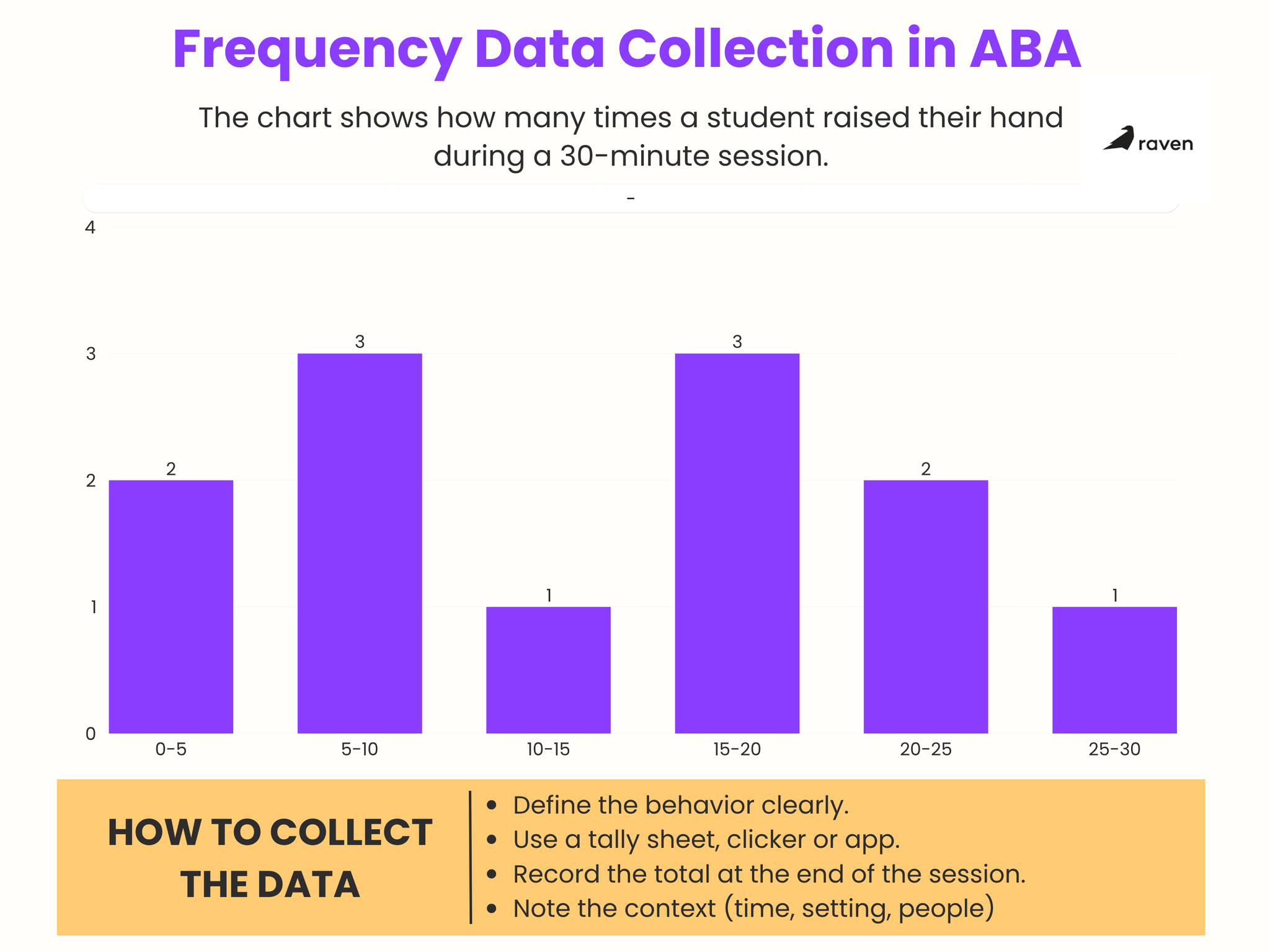
Once the operational definition is set, the practitioner prepares their measurement tools. This could be a traditional paper data sheet on a clipboard, a physical mechanical clicker counter kept in a pocket, or a digital tablet application.
During the active session, the observer simply adds a tally mark or clicks a button every single time the defined behavior occurs. At the end of the session, the total number of tallies is summed up to represent the total raw frequency for that specific observation block.
It is also critical for the practitioner to record the environmental context along with the raw frequency count. A therapist should note exactly how long the observation period lasted, who was present in the room, and what specific activities or demands were taking place.
This contextual information helps the supervising Board Certified Behavior Analyst (BCBA) look for behavioral patterns over time and determine if the behavior is linked to specific environments, times of day, or particular daily routines.
Frequency vs. Rate in ABA
While frequency and rate are closely related concepts and are often used interchangeably in casual clinical conversation, they are distinctly different measurements in the science of ABA.
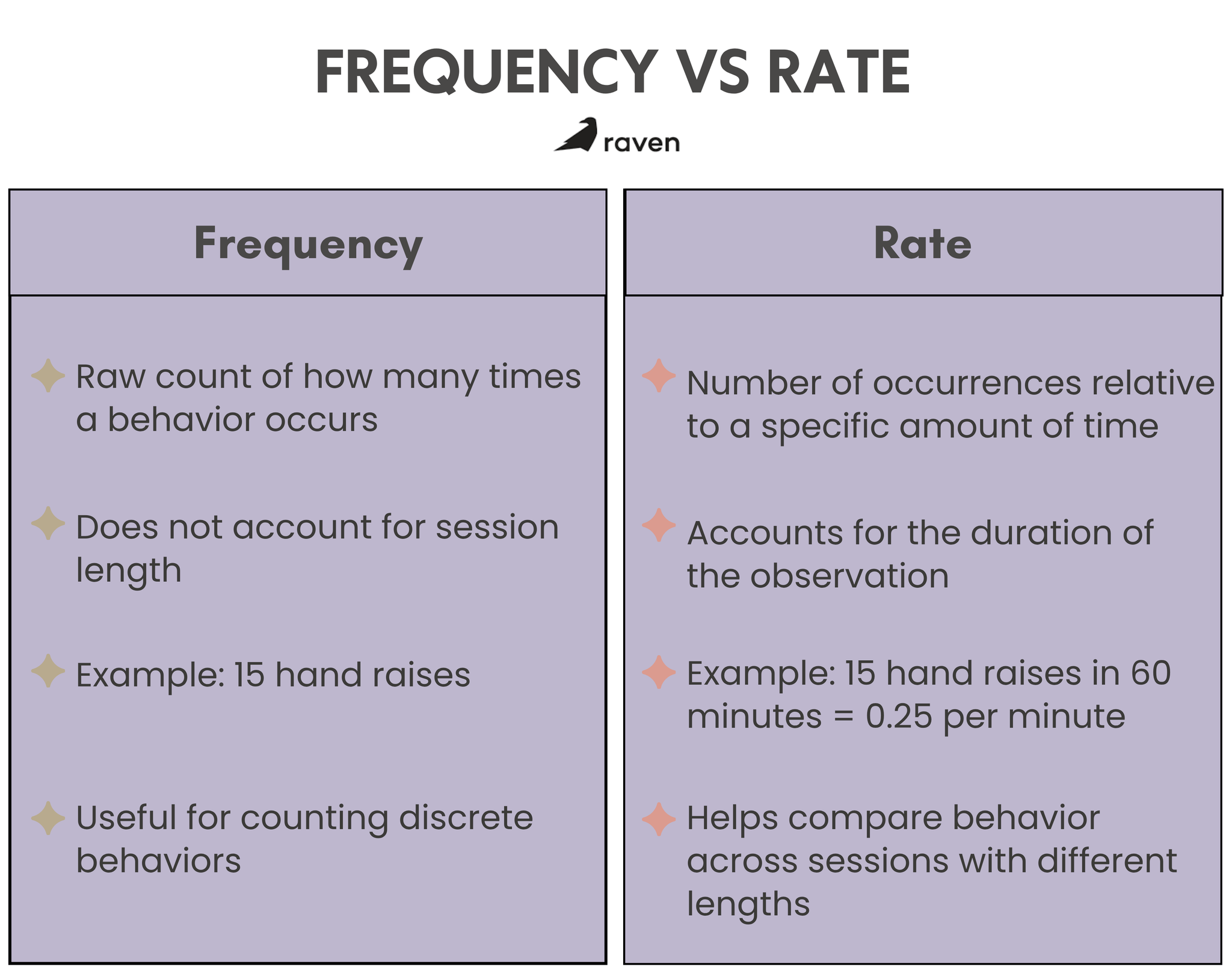
Frequency is just the raw, unadjusted count of how many times a behavior happened. If a student raises their hand 15 times in a day, the frequency is exactly 15. There is no time element attached to a raw frequency score; it is just a flat number.
Rate, on the other hand, is a mathematical ratio that combines the raw frequency count with a specific, standard unit of time. To calculate the rate of a behavior, you divide the total frequency by the exact duration of the observation.
If the student raised their hand 15 times during a 60-minute class, the rate is 15 times per 60 minutes, which simplifies down to 0.25 times per minute. Rate is universally considered a much more powerful and accurate metric than simple frequency because it standardizes the data across sessions of vastly different lengths.
Consider a scenario where a therapist observes a child for two hours on Monday and counts 20 instances of an aggressive behavior. On Tuesday, the therapist only observes the child for one hour and counts 10 instances. Looking purely at frequency, it appears the behavior dropped by half.
However, the actual rate of the behavior remained exactly the same (10 times per hour) on both days. Using rate prevents practitioners from making false assumptions about behavior reduction when the lengths of therapy sessions naturally vary from day to day.
Examples of Frequency Data Collection
To see how this looks in practical application, imagine a clinic setting where a non-verbal child is learning to independently request a break instead of trying to run out of the room. The target behavior is defined strictly as the child handing a physical break card to the therapist.
Every time the child successfully hands over the card, the therapist records one tally mark on their clipboard. By the end of a three-hour session, the therapist counts 12 tallies. This simple, undeniable count provides concrete evidence that the child is successfully acquiring and utilizing their new functional communication skills.
Another common example is tracking problem behavior in a busy classroom environment. A teacher wants to measure how often a specific student shouts out answers without raising their hand to wait for permission.
The behavior is operationally defined as any vocalization made by the student during instruction without a raised hand and direct teacher acknowledgment. The teacher keeps a small mechanical clicker in their pocket so they do not have to disrupt the lesson to write on paper.
Every time the student shouts out, the teacher clicks the device once in their pocket. At the end of the school day, the clicker shows a final frequency of 45, giving the teacher a clear baseline to start an intervention.
When Should Practitioners Use Frequency Data?
Frequency recording is the absolute best choice when a practitioner needs to track a behavior that is discrete, meaning it happens quickly and has a very clear start and finish.
Actions like hitting, kicking, raising a hand, asking a question, throwing an object, or manding (requesting) for an item are all perfect candidates for frequency tracking. Because these physical actions do not last very long, counting them one by one is the most logical and accurate way to measure their occurrence in the natural environment.
Practitioners also heavily rely on frequency data when their clinical goal is strictly to increase or decrease the total number of times a behavior happens, rather than changing how long the behavior lasts.
If the clinical goal is to get a withdrawn child to initiate greetings with their peers more often, frequency provides the exact metric needed to prove the social intervention is working. It gives the BCBA a clear, day-by-day numerical trend line that can be easily graphed and analyzed.
However, it is equally vital to know when this method is completely inappropriate. Frequency should never be used for behaviors that occur at extremely high rates like rapid hand-flapping, fast finger-tapping, or continuous humming.
If a behavior happens so fast that a human observer cannot physically keep up with counting every single instance, the frequency data will be wildly inaccurate. In those specific cases, discontinuous measurement methods like partial interval recording or momentary time sampling are much better suited for the task.
Common Challenges with Frequency Recording
While counting sounds incredibly simple on paper, accurately recording frequency in a chaotic, real-world setting presents several distinct clinical challenges.
Challenge of Continuous Observation
The most prominent issue is that the observer must remain entirely focused on the learner for the entire duration of the session.
If a teacher is managing a classroom of twenty active students and is also tasked with taking frequency data on one specific child, they will inevitably miss occurrences when their back is turned. This leads directly to underreporting and skewed data that makes the behavior look less severe than it truly is.
Defining Exact Boundaries
Another major challenge is defining the exact boundaries of the target behavior. If a behavior is not truly discrete, frequency tracking falls apart entirely.
For instance, if a child engages in a severe tantrum that involves crying, stopping to catch their breath for five seconds, and then crying again, the observer has to make a subjective guess on whether that was one continuous long tantrum or two separate short tantrums.
Without strict operational definitions specifying exactly how much time must pass between incidents for them to be counted as separate events, data integrity is permanently lost across different therapists.
Limitation of Counting Without Context
Raw frequency data completely lacks behavioral context. It tells the practitioner exactly how many times a behavior happened, but it tells them absolutely nothing about how intense the behavior was or how long the episode lasted.
Two instances of physical aggression could be recorded as a frequency of two, but one instance might have been a soft tap on the shoulder while the other was a severe strike that caused an injury.
To overcome this critical limitation, BCBAs often combine frequency recording with duration tracking or severity scales to paint a much more complete and accurate clinical picture of the client's needs.
How ABA Data Collection Software Simplifies Frequency Recording
In the past, therapists relied entirely on paper grids, heavy clipboards, stopwatches, and mechanical clickers to track behavior during active sessions.
Managing multiple pieces of paper and writing down tally marks while actively trying to teach a squirming toddler or de-escalate a crisis is highly stressful and highly prone to basic human error.
Modern ABA software has completely revolutionized how practices handle frequency recording by fully digitizing the workflow.
With customized data collection software, therapists can use a standard smartphone or tablet to track multiple behaviors with a single tap of a finger. The software automatically logs the exact timestamp of each occurrence in the background.
It also instantly converts raw frequency counts into highly accurate rate data without requiring the therapist to pull out a calculator or do any manual math at the end of a long shift. This eliminates simple calculation errors and ensures that all session durations are accounted for perfectly in the final behavioral graphs.
Furthermore, software centralizes all clinical data instantly. When a Registered Behavior Technician (RBT) taps their screen to record a frequency count in a client's home, that data is immediately uploaded to a secure, HIPAA-compliant cloud server.
The supervising BCBA can log in from a remote office location, view the automatically generated graphs in real-time, and make immediate clinical decisions without having to wait until Friday for the technician to physically hand in their paperwork.
By removing the heavy administrative burden of calculating, tracking, and graphing data by hand, software allows therapists to keep their eyes safely on the learner and focus entirely on providing high-quality care.
Conclusion
Choosing the right measurement system is just as vital to client success as selecting the right behavioral intervention. Frequency data collection offers an elegant, straightforward solution for tracking distinct, countable behaviors in both natural and clinical environments.
By clearly defining behaviors, strictly maintaining observation standards, and avoiding continuous tracking for rapid behaviors, practitioners can rely on frequency counts to build powerful, evidence-based treatment plans.
Mastering the nuances between raw frequency and calculated rate remains an essential foundational skill for any ABA professional dedicated to helping their learners achieve meaningful independence.
Sources:
https://www.achievebt.com/blog/data-collection-in-aba
https://www.myteamaba.com/resources/continuous-vs-discontinuous-measurement-aba