

Running an Applied Behavior Analysis (ABA) clinic means managing massive amounts of daily data, treatment plans, and insurance paperwork. Most clinic owners know they need digital software to ditch the filing cabinets, but the terminology gets confusing fast.
Vendors throw around acronyms like EMR and EHR as if they mean the exact same thing. While they overlap, picking the wrong type of system can create major headaches for your clinical team and your billing department. Here is a clear breakdown of how these two systems differ and how to pick the exact software your clinic needs to thrive.
What Is an EMR in ABA Therapy?
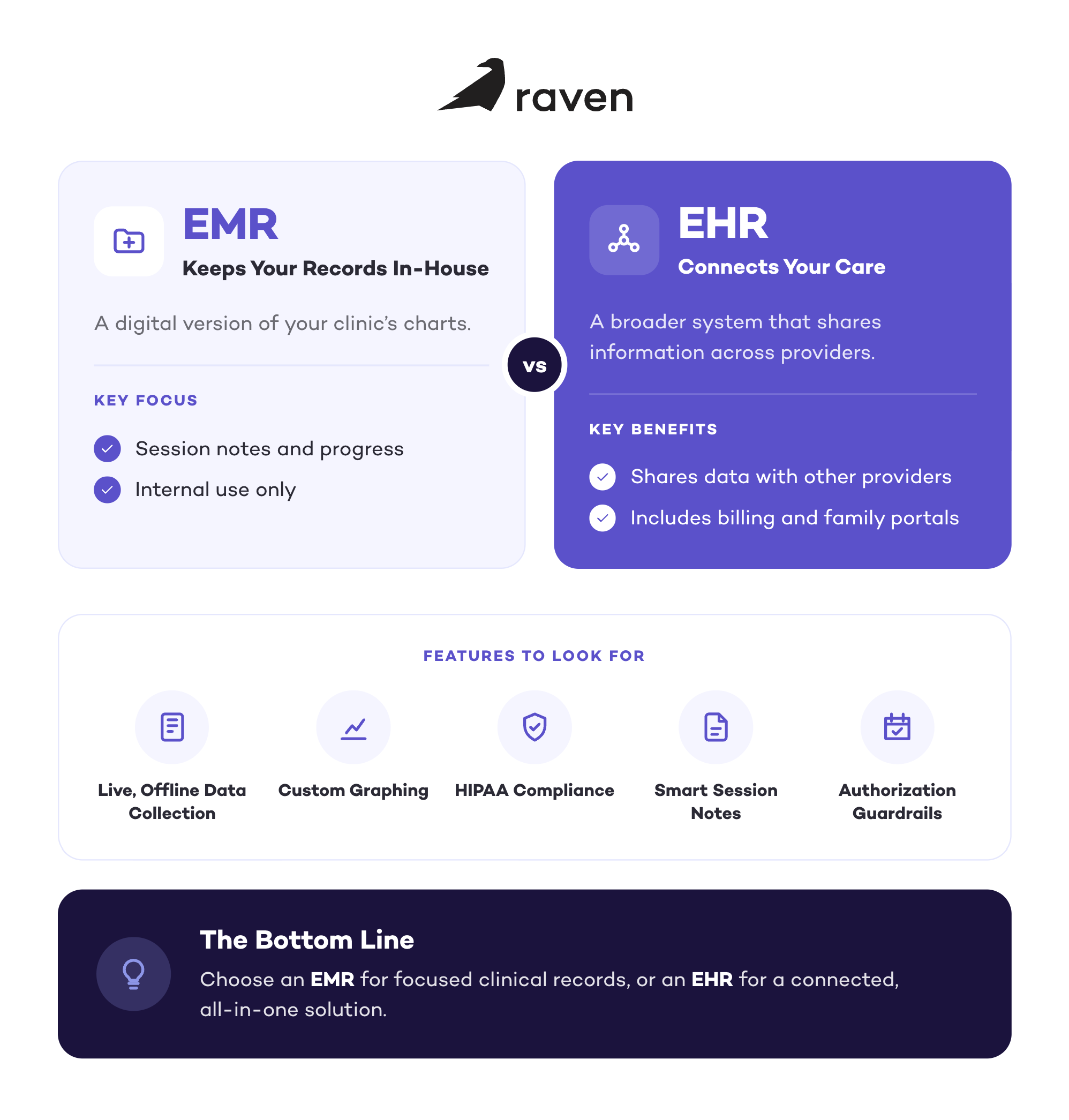
An Electronic Medical Record (EMR) is essentially a digital version of the paper charts you used to keep in a locked filing cabinet. Inside an ABA practice, an EMR holds everything that happens inside your four walls for a specific client.
When a Registered Behavior Technician (RBT) finishes a session, they use the EMR to type up their narrative session note, record behavioral frequency counts, and check off mastered skill targets.
Board Certified Behavior Analysts (BCBAs) use it to build behavior intervention plans, write progress reports for insurance renewals, and track supervision hours.
The most important thing to know about an EMR is that the data stays inside your clinic. It is built purely for internal clinical documentation, tracking learner progress over time, and keeping your records neat for insurance audits.
If a child switches to a different therapy clinic or needs to see a developmental pediatrician across town, an EMR cannot easily send those digital files over to the new doctor. You usually have to print the charts out or fax them over manually.
ABA EMR vs EHR
While an EMR keeps records locked safely inside your agency, an Electronic Health Record (EHR) is built to share information across the entire healthcare ecosystem. Think of an EMR as a single clinic's digital notebook, whereas an EHR is a connected network that follows the client wherever they go.
Data Sharing and Care Coordination
Most children receiving ABA therapy also work with speech therapists, occupational therapists, pediatricians, and school specialists. An EHR allows all of these outside providers to securely access and update the child's medical history, medication changes, and treatment goals in real time. An EMR simply does not have that outward connectivity.
Scope of Information
An EMR focuses heavily on your specific therapy notes, session data, and internal assessments. An EHR pulls together a much broader picture of the child's overall health, including lab results, immunization records, allergies, and notes from external doctors.
Practice Management Integration
Modern ABA EHR platforms almost always bundle clinical tools together with heavy back-office business tools. Beyond just storing session notes, a full EHR usually handles insurance eligibility checks, electronic claim scrubbing, payroll tracking, and multi-staff scheduling.
Basic EMRs often stick strictly to clinical notes and require you to buy separate billing software.
Parent and Caregiver Portals
EHR systems typically include interactive family portals where parents can log in from home to sign treatment plans, view upcoming schedules, and read session summaries. Traditional EMRs rarely offer that level of outside access.
Features to Look for in an ABA EMR or EHR
Whether you lean toward a simple digital chart system or a massive all-in-one healthcare network, generic medical software will not work for behavioral health.
Software built for a regular dentist or family doctor will frustrate your staff immediately. You need tools built specifically for the unique workflows of ABA therapy.
Live, Offline Data Collection
Behavior technicians work in basements, schools, and rural homes where Wi-Fi drops constantly. Your software must let staff collect trial-by-trial data, ABC data, and duration timers on a tablet without an internet connection, automatically syncing everything to the cloud once they reconnect. Reliable capture matters. In a survey of 232 BCBAs published in Behavior Analysis in Practice, 76% said they had doubted the accuracy of reported data at some point.
AI-Generated Session Notes
Technicians spend way too much unpaid time writing daily notes. Look for a system that automatically pulls the day's behavioral graphs and mastered targets straight into the session note template so staff only have to add the specific environmental context.
Authorization Guardrails
Insurance rules are unforgiving. A good system should automatically block your schedulers from putting a session on the calendar if the client's insurance authorization has expired or if they have run out of approved hours for the week.
Custom Graphing and Visual Analysis
BCBAs rely on visual data to make quick clinical decisions. Good ABA software should automatically generate clean, easy-to-read line graphs with phase change lines the second a session ends, saving supervisors hours of manual spreadsheet work.
HIPAA Compliance and Audit Trails
Every click, edit, and signature inside the platform needs a permanent digital timestamp. If an insurance auditor asks to see proof of supervision from six months ago, you need to be able to pull that signed record in seconds. The BACB Ethics Code also requires supervisors to keep supervision documentation for at least seven years.
How to Choose the Right System for Your ABA Practice
Picking between an EMR and a full EHR comes down to the size of your clinic, your budget, and how you plan to grow over the next few years.
If you are a solo BCBA just starting out with a handful of private-pay clients, paying hundreds of dollars a month for a massive, interconnected EHR is usually overkill. A clean, standalone ABA EMR that handles session notes, graphing, and basic scheduling will keep your overhead costs low while keeping your clinical records organized.
However, if you run a growing clinic with multiple technicians, bill major insurance networks, and regularly coordinate care with outside speech therapists or school districts, a full EHR is the smarter investment.
Paying for separate systems to handle your clinical data, your scheduling, and your insurance billing creates dangerous gaps where information gets lost. Having everything live under one roof stops billing errors before they happen and saves your administrative staff from doing double data entry every day.
Before signing any contract, always ask the vendor for a live demo where your actual BCBAs and technicians can test out the data collection screens on a tablet to make sure it feels fast and natural during a busy session.
Conclusion
Choosing between an EMR and an EHR does not have to be an overwhelming technical hurdle. By understanding that an EMR keeps your clinical notes organized in-house while an EHR connects your data to billing teams and outside doctors, you can easily match the software to your daily workflow.
Focus on finding a platform built specifically for behavioral therapy, test the mobile data collection tools with your actual staff, and pick a system that eliminates manual paperwork so your team can focus entirely on helping learners succeed.
Sources:
https://lumary.com/post/best-aba-practice-management-software-solutions-2026-buyers-guide