A Behavior Intervention Plan (BIP) is the clinical roadmap that turns assessment findings into everyday teaching strategies. Rather than simply reacting to challenging actions after they happen, a well-crafted plan focuses on preventing triggers, teaching functional communication, and building supportive environments.
Ethical, individualized planning respects the learner's dignity. Every challenging behavior communicates an unmet need, so the objective is never to strip away a person's coping mechanism without offering a safer, more effective alternative. When written in clear, jargon-free language, a BIP keeps therapists, teachers, and parents aligned so the learner receives consistent support across every setting.
Key Components of a Behavior Intervention Plan
A complete, ethical behavior plan relies on specific building blocks that work together to reduce interfering actions while building independence.
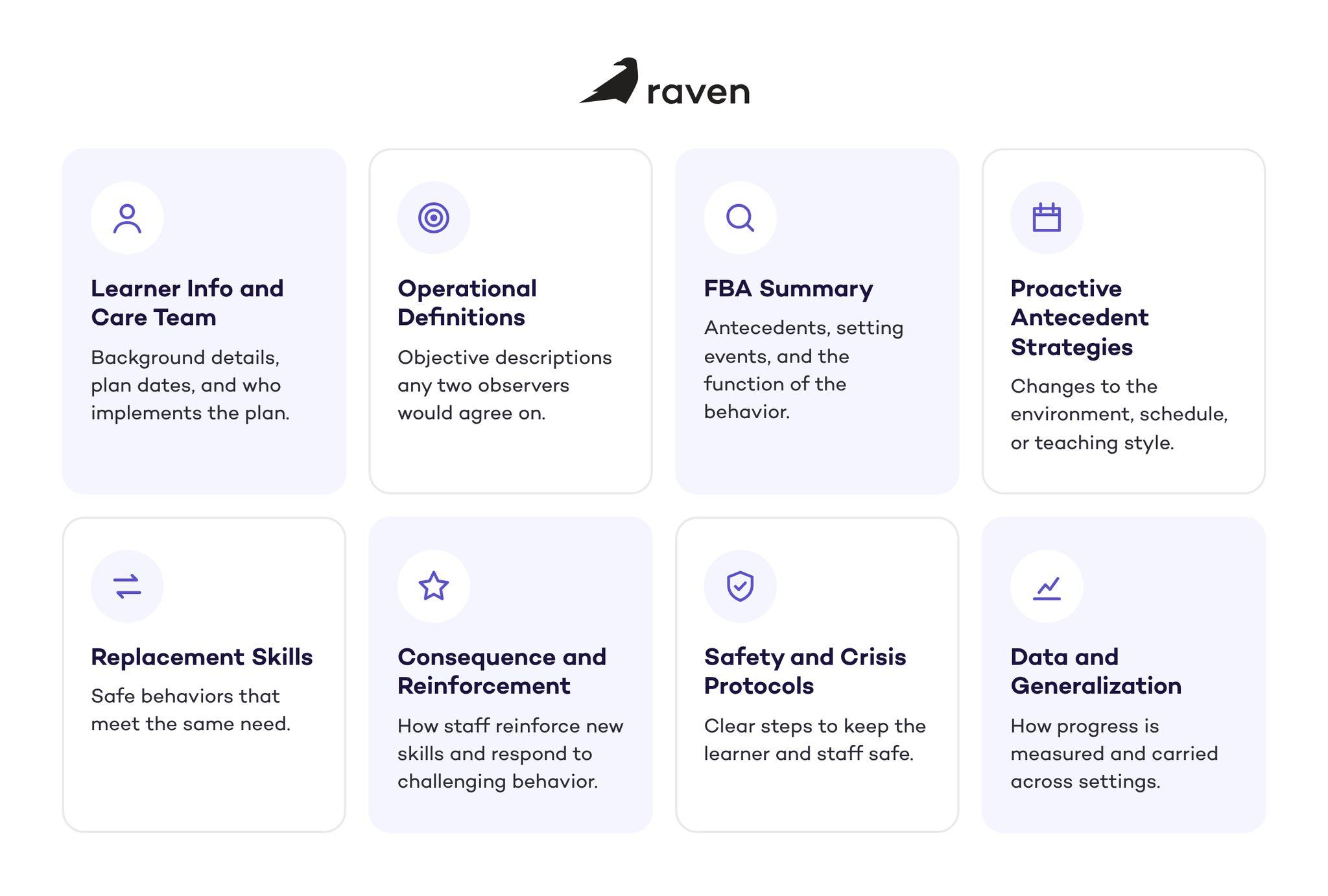
Learner Demographics and Care Team
Basic background details, relevant medical or diagnostic context, plan dates, and the specific clinicians or caregivers responsible for implementing the plan.
Operational Definitions
Clear, objective descriptions of the target behaviors. Instead of using vague labels like "aggressive" or "noncompliant," the plan must describe exact physical movements so any two observers would agree on whether the action occurred.
Functional Behavior Assessment (FBA) Summary
A concise explanation of what triggers the behavior (antecedents), any broader background factors like poor sleep or hunger (setting events), and the exact purpose or "function" maintaining the action, such as escaping a hard task, gaining attention, accessing an item, or fulfilling a sensory need.
Proactive Antecedent Strategies
Adjustments to the environment, schedule, or teaching style designed to reduce triggers before a challenging moment begins.
Replacement Skills
Functionally equivalent, safe behaviors the team will actively teach so the learner can get their needs met without relying on the challenging behavior.
Consequence and Reinforcement Procedures
Step-by-step instructions detailing how staff will reward the new replacement skill and how they will respond safely and neutrally if the target behavior still occurs.
Safety and Crisis Protocols
Immediate, clear safety steps to protect the learner and staff if a behavior poses a physical risk.
Data Collection and Generalization Plan
Specific instructions on how progress will be measured and how skills will be carried over into the home, school, and community.
How to Write a Behavior Intervention Plan Step by Step
Writing an effective plan requires translating raw assessment data into practical instructions that frontline staff can easily follow during a busy session.
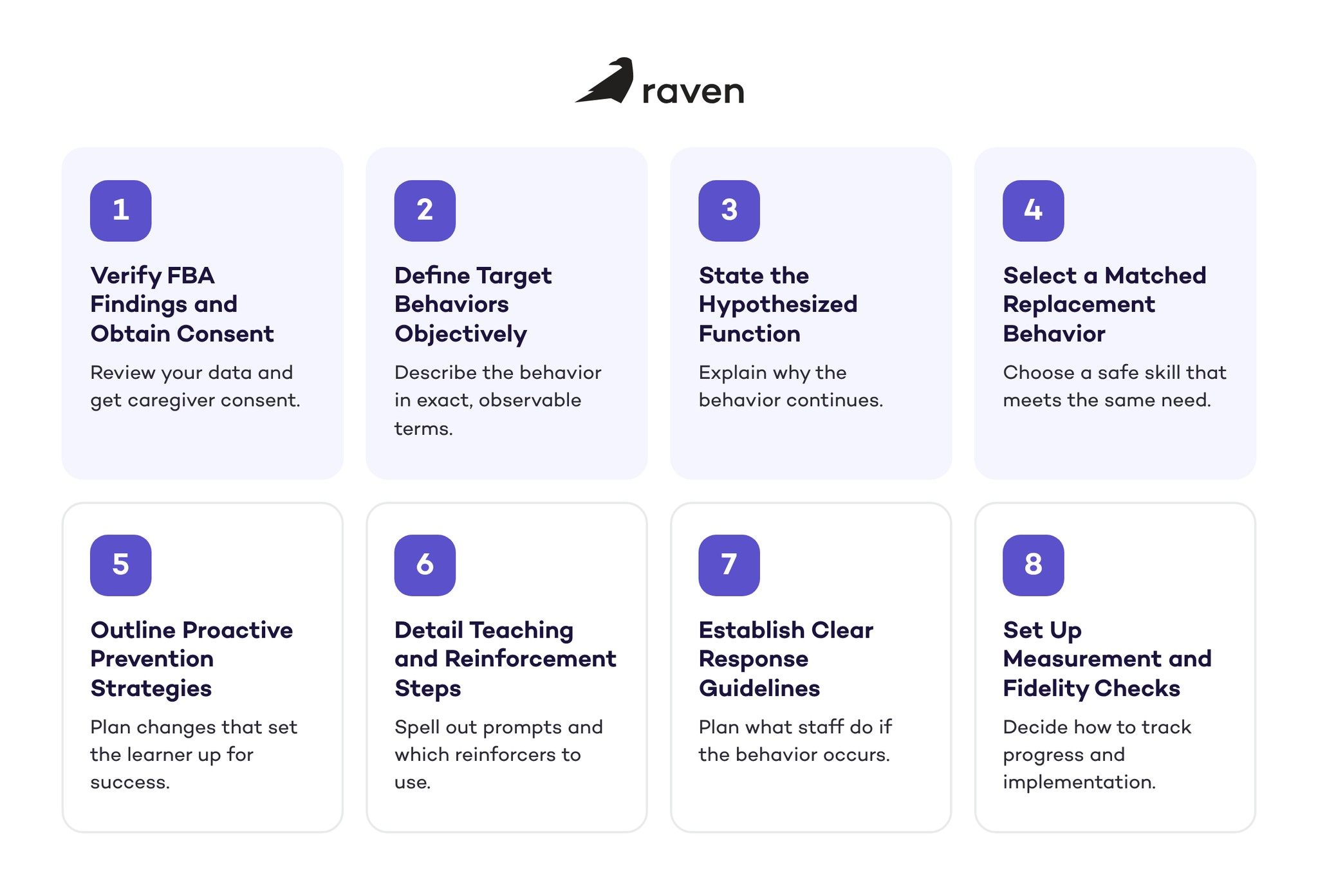
1. Verify FBA Findings and Obtain Consent
Before drafting anything, confirm you have informed consent from caregivers, as the BACB Ethics Code requires, and review your interviews, direct observations, and ABC (Antecedent-Behavior-Consequence) logs. If the data points in conflicting directions, conduct more observations until the pattern is clear.
2. Define Target Behaviors Objectively
Write down the exact physical appearance of the behavior. Prioritize behaviors that pose safety risks or heavily block learning and social connection.
3. State the Hypothesized Function
Summarize why the behavior continues in one or two plain sentences. For example, note that screaming occurs primarily when difficult academic demands are presented and reliably results in the worksheet being removed.
4. Select a Matched Replacement Behavior
Choose an alternative skill that achieves the exact same outcome as the problem behavior. If a learner hits to get a break from a noisy room, teaching them to hand over a "break" card gives them that exact same relief safely. This approach, called functional communication training (FCT), is one of the most common and effective interventions for severe challenging behavior.
5. Outline Proactive Prevention Strategies
Detail the daily changes staff will make to set the learner up for success, such as using visual schedules, offering choices, or breaking large tasks into smaller steps.
6. Detail Teaching and Reinforcement Steps
Spell out the exact prompt hierarchy staff should use to teach the new skill, what counts as a successful response, and which reinforcers will immediately follow that success.
7. Establish Clear Response Guidelines
Explain exactly what staff should say and do if the challenging behavior happens anyway, ensuring the team does not accidentally reward the behavior while keeping everyone safe.
8. Set Up Measurement and Fidelity Checks
Define the exact data tracking method (such as frequency counts or duration timers) and establish a schedule for checking that staff are following the written plan accurately.
Examples of Strategies in an ABA Behavior Plan
To make a plan truly actionable, strategies must be tailored directly to the function of the behavior rather than relying on generic reward systems.
When the Function Is Escape (Avoiding Demands)
Antecedent Strategy: Break a twenty-problem math worksheet into four short strips of five problems, or allow the learner to choose which task to complete first.
Replacement Skill: Teach Functional Communication Training (FCT), such as using a spoken phrase, sign, or picture card to request "Break please" or "Help."
Consequence Strategy: Immediately honor the break request when the learner uses their new communication skill. If the challenging behavior occurs, stay calm, avoid lecturing, and gently prompt the learner to use their break card before stepping back.
When the Function Is Attention
Antecedent Strategy: Provide non-contingent attention by checking in with the learner every five minutes with warm praise before challenging behavior is likely to occur.
Replacement Skill: Teach the learner to tap a teacher's shoulder, raise their hand, or say "Excuse me" to start an interaction.
Consequence Strategy: Deliver enthusiastic, immediate attention when the learner uses the appropriate greeting. Keep responses to the challenging behavior brief, neutral, and emotionally flat.
How to Monitor and Update a Behavior Intervention Plan
A Behavior Intervention Plan is a living document, not a static file that sits untouched in a binder. As a learner masters new skills or moves into new environments, the plan must evolve alongside them.
Consistent Data Tracking
Frontline technicians and caregivers record daily metrics, such as how often the target behavior happens, how long it lasts, and how frequently the learner uses their new replacement skill independently.
Visual Graphing and Trend Reviews
Board Certified Behavior Analysts (BCBAs) review visual progress graphs regularly to see if the challenging behavior is trending down while the replacement skill is trending up.
Treatment Fidelity Checks
Supervisors observe sessions to verify that every team member is following the steps accurately. Often, a plan stalls not because the strategy is wrong, but because different staff members are applying it inconsistently.
Data-Driven Revisions
If data shows no improvement after a reasonable timeframe, the clinician analyzes whether triggers were missed, rewards have lost their value, or the replacement skill is currently too difficult, adjusting the plan accordingly.
How to Choose the Right System for Your ABA Practice
Managing complex behavior plans, daily ABC logs, and visual progress graphs across a growing caseload requires reliable practice management software. Selecting the right software platform ensures your clinical plans are easily accessible and accurately tracked in real time.
Live, Offline Mobile Access
Behavior technicians frequently work in homes, schools, or community settings with spotty internet. Choose a platform that lets staff view updated BIP instructions and log behavioral data on mobile devices, with offline access and automatic syncing once reconnected.
Instant Visual Graphing
Look for systems that convert raw frequency and duration entries into clean line graphs the moment a session ends, allowing BCBAs to spot behavioral trends and update intervention phases without manual spreadsheet work.
Automated Session Notes
Select software that pulls daily BIP data directly into automatically generated session notes, reducing administrative burnout for staff while keeping documentation audit-ready.
Version Control and Team Alerts
Because BIPs are living documents, your software should notify the entire care team immediately whenever a supervisor updates a protocol so nobody accidentally uses an outdated strategy.
Conclusion
Writing an effective Behavior Intervention Plan bridges the gap between understanding why a behavior happens and helping a learner build lasting, positive skills.
By grounding every section in clear assessment data, prioritizing respectful replacement behaviors, and equipping staff with straightforward, practical steps, clinicians create a supportive environment where learners can thrive.
Regular data reviews and open communication across the care team ensure the plan adapts as the learner grows, turning daily challenges into meaningful, long-term independence.
Sources:
Ethics Code for Behavior Analysts (BACB)
https://www.artemisaba.com/blog/aba-behavior-intervention-plan
https://magnoliabehaviortherapy.com/what-is-a-behavior-intervention-plan-bip/