If you run an ABA practice in Florida, the last two years have asked a lot of you. First, behavior analysis services moved into Medicaid managed care. Then the Children's Medical Services (CMS) Health Plan changed hands on October 1, 2026, moving from Sunshine Health to Molina Healthcare.
Florida clinic owners have shared some tough stories with us. One practice owner told us she lost "a couple hundred thousand" dollars over two years cycling through bad billing vendors, before the Molina transition even started. Another provider was dropped by her billing vendor mid-onboarding because her practice was out-of-network with Molina, undoing two months of setup work in a single meeting.
This guide breaks down what changed in Florida, where payer transitions put your revenue at risk, and the steps you can take now so the next change doesn't catch your practice off guard.
What Changed for Florida ABA Providers
Florida providers have dealt with two major payer shifts in less than two years. Each one changed who providers contract with, where authorizations live, and how claims get paid.
The Move to Medicaid Managed Care in February 2025
On February 1, 2025, Florida's Agency for Health Care Administration (AHCA) launched the third version of its Statewide Medicaid Managed Care program, known as SMMC 3.0. Under it, behavior analysis services for Medicaid enrollees under 21 moved from fee-for-service into managed care (OPEN MINDS).
Instead of billing Florida Medicaid directly, providers now contract, credential, and request authorizations through the health plans that serve their clients. For many practices, that meant new contracts, new portals, and new rules to learn all at once.
The CMS Health Plan Transition to Molina in October 2026
The CMS Health Plan serves children and youth under 21 with special health care needs, and it covers behavior analysis services. Sunshine Health ran the plan through September 30, 2026. On October 1, Molina Healthcare of Florida took over statewide, and current members moved over automatically (AHCA).
Provider contracts with Sunshine did not transfer. To keep serving CMS Health Plan members after the continuity of care period, providers have to contract directly with Molina (Sunshine Health). For members who moved from Sunshine, that continuity of care period runs up to 240 days, into late May 2027 (Acuity News).
What Providers Have Reported Since the Switch
Within weeks of the transition, ABA providers in South Florida reported unpaid claims, and AHCA said it was actively investigating payment concerns raised by behavior analysis providers (CBS News Miami).
In early November, AHCA reported that Molina had paid more than 218,000 behavior analysis claims since October 1, with about 79,000 more still in inventory. The agency also said it had received 33 complaints from behavior analysis providers (Acuity News). Large transitions like this take time to settle, and small practices often feel the delays first.
Where Payer Changes Put Your Revenue at Risk
A payer transition touches almost every step of the revenue cycle. These are the areas where practices most often lose time and money.
Contracting and Credentialing Gaps
When contracts don't transfer, every practice has to get in-network with the new plan. Molina requires an active Florida Medicaid ID and a complete CAQH profile for each practitioner before credentialing can finish (Molina Healthcare). If one BCBA's enrollment stalls, every client on their caseload can be affected.
Authorizations That Don't Carry over Cleanly
Molina said active Sunshine authorizations should appear in its portal under each member's new Molina ID. If one is missing, providers are told to contact Molina before canceling or rescheduling services. Any gap between what you have on file and what the payer shows can lead to denied claims for sessions you already delivered.
New Payment and Claim Setup
A new payer means a new payer ID, new submission rules, and new payment enrollment. For the CMS Health Plan, that includes Molina's payer ID and enrollment with its payment vendor for EFT and ERA. Miss a step, and payments can slow down or arrive in a format your team isn't set up to reconcile.
Cash Flow Strain
Most ABA practices run on tight margins. A few weeks of delayed payments can put payroll at risk, especially for small and midsize practices that serve a large share of Medicaid clients.
Administrative Overload
Someone has to make the calls, check the portals, resubmit the claims, and track down missing authorizations. In many practices, that someone is the owner or a busy office manager, which pulls them away from clinical quality and growth.
How to Protect Your Revenue Cycle During a Payer Transition
Payer changes are out of your hands, but these steps will help your practice be ready for the next one.
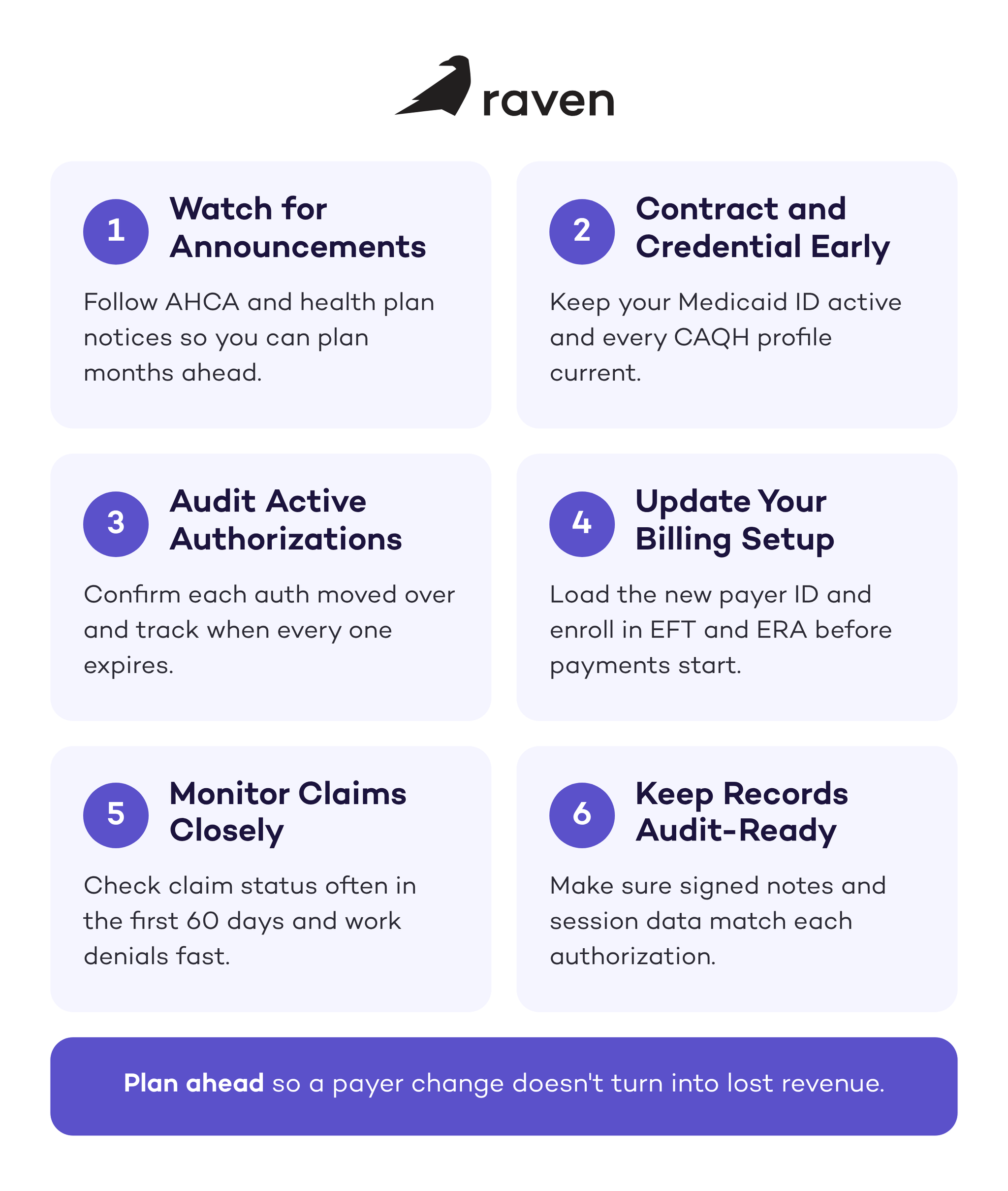
1. Watch for Announcements Early
Sunshine announced the CMS Health Plan transition in April 2026, more than five months before it took effect. Check AHCA updates and your payers' provider pages regularly so you can plan before deadlines get close.
2. Start Contracting and Credentialing Right Away
Begin as soon as a change is announced. Confirm your Medicaid ID is active, update every CAQH profile, and track each provider's enrollment status with each payer.
3. Audit Every Active Authorization
Build a list of every active authorization, its approved units, and its end date. Then confirm each one appears correctly with the new payer. Set reminders well ahead of each end date so renewals go to the right payer on time.
4. Update Your Billing Setup Before the First Claim
Load the new payer ID, confirm claim submission rules, and enroll in EFT and ERA early. Split claims by date of service when a transition date falls in the middle of a billing period.
5. Monitor Claims Closely for the First 60 Days
Watch claim status and aging reports often in the first two months. Work denials quickly and keep a record of every call and reference number. Know your dispute window too. Molina allows provider disputes within one year of the payment or denial date.
6. Keep Documentation Audit-Ready
Session notes should be signed, complete, and tied to an active authorization. Clean documentation makes it easier to resubmit claims and defend them if a payer asks questions.
Of course, you don't have to do all of this yourself. Raven was founded by a BCBA, and our ABA billing, credentialing, and authorization experts can take this work off your plate.
What to Look for in Billing Support
If you're comparing billing support, especially ahead of a payer change, look for these qualities.
Experience with Payer Transitions
Your billing team should know how to move authorizations, update payer setup, and follow up on stalled claims without waiting for you to point out the problem.
Authorization Tracking Built into Scheduling
When authorizations connect directly to scheduling, staff see remaining units before a session is booked. That helps prevent sessions from going unpaid.
Hands-on Credentialing Support
Credentialing during a transition is time-sensitive. A team that guides enrollments and keeps provider information organized saves your staff hours of paperwork and follow-up.
Clear Revenue Visibility
You should be able to see collections, denial rates, and claim aging without digging through spreadsheets, so problems show up early.
Raven's managed billing services cover this kind of work. With Concierge, our ABA experts prepare and submit every claim and work every denial. Concierge Pro adds authorization management, reauthorization monitoring, and hands-on credentialing support.
Conclusion
Florida's shift to Medicaid managed care and the CMS Health Plan move to Molina won't be the last payer changes ABA providers face. Each one brings new contracts, new authorization rules, and new billing setup, and smaller practices tend to feel it most.
Practices that track announcements early, stay on top of credentialing and authorizations, and watch claims closely are in a much better position to keep revenue steady. And with the right billing partner, your team can spend less time on the phone with payers and more time with clients.
Want help protecting your revenue through the next payer change? Schedule a demo to see how Raven supports Florida ABA practices.
Sources:
CMS Plan Transition, Florida Agency for Health Care Administration
Florida Medicaid Moves Behavior Analysis Services to Health Plans, OPEN MINDS (February 2025)
CMS Health Plan Transitions to Molina Healthcare on October 1, 2026, Sunshine Health (April 2026)
CMS Plan Behavior Analysis Provider Training, Molina Healthcare of Florida (2026)
ABA Providers Report Unpaid Claims After Molina Takeover, CBS News Miami (October 2026)
Florida ABA Providers Report Unpaid Molina CMS Plan Claims, Acuity News (November 2026)