Writing session notes is one of the most critical parts of an Applied Behavior Analysis (ABA) professional's day. These notes act as the official record of everything that happens during therapy. They support the clinic's billing, guide the ongoing treatment plan, and protect the organization if an insurance company audits the clinic.
However, writing notes manually on paper or in generic text documents takes time away from what therapists could spend directly with their learners. That is exactly why growing clinics are moving away from outdated methods and adopting specialized ABA session notes software.
In this guide, we will break down exactly what you need to look for and compare the top software options available to help you streamline your documentation.
What to Look for in ABA Session Notes Software
When evaluating different platforms for your ABA practice, you need to look far beyond the basic marketing features.
You have to focus on how the tool actually functions in the hands of a technician during a live, chaotic session. The software should make the therapist's job easier, not add more frustrating administrative steps.
1. Customizable Templates
Every clinic operates differently, and different insurance funders have highly specific requirements. Quality software should allow you to build and easily modify note templates that meet those specific payer rules so nothing gets missed or denied.
2. Offline Capabilities
Behavior technicians frequently work in family homes, public schools, or community settings where Wi-Fi is either weak or completely unavailable. The software must allow them to collect data and write notes completely offline, automatically syncing the information the second they reconnect to a network.
3. Built-in Compliance Guardrails
A great system actively prevents mistakes before they happen. It should flag missing signatures, require data for targeted behavioral goals before a note can be submitted, and ensure the session times exactly match the scheduled insurance authorization.
4. Mobile Accessibility
The platform needs to run smoothly on standard tablets and smartphones. This lets therapists document quickly on the go without hiding behind a bulky laptop screen while trying to teach a learner.
5. Simple Onboarding
Turnover in the ABA field is notoriously high. If a software platform is overly complicated and takes weeks to learn, new staff will constantly struggle. The interface must be intuitive and easy to pick up quickly.
Best ABA Session Notes Software Options
There are several strong platforms on the market today, but a few stand out specifically for how well they handle clinical documentation and connect it to overall practice management.
1. Raven Health
Raven Health is an all-in-one ABA therapy platform built for ABA providers of every size that prioritize a mobile-first, offline-capable experience. It distinguishes itself by offering an AI-powered session note generator specifically designed for ABA therapy.
The platform uses artificial intelligence to automatically transform live session data, such as behavioral targets, prompted responses, and frequency counts, into detailed, HIPAA-compliant narrative notes with a single click. This eliminates the need for therapists to manually draft summaries at the end of the day, drastically reducing administrative time.
It also features robust offline capabilities, allowing behavior technicians to collect data and generate notes seamlessly on mobile devices when working in homes or schools without internet access.
By combining pre-built, customizable note templates with real-time progress syncing, Raven Health ensures that the clinical documentation perfectly matches the raw session data before it is submitted for billing.
Raven Health started by serving small and growing clinics and now supports practices of every size, from single-location startups to large multi-location franchise organizations. It also powers ABA programs in schools, universities, and group homes.
2. CentralReach
CentralReach is essentially the giant of the ABA software industry. It provides a massive, end-to-end solution that handles everything from clinical data collection and session notes to complex enterprise billing, HR integration, and learning management.
For session notes specifically, CentralReach offers advanced customization, auto-progression for mastered targets, and robust compliance checks. With its broad capabilities, it is a strong fit for large, multi-location enterprise practices that want powerful business intelligence tools.
3. Theralytics
Theralytics is designed to be a highly intuitive, all-in-one practice management tool built directly by a Board Certified Behavior Analyst (BCBA). It connects scheduling, clinical data, billing, and session notes together in one clean, easy-to-use interface.
Reviewers consistently praise it for its built-in compliance guardrails that physically block staff from scheduling outside their authorizations, which naturally cuts down on session note discrepancies and billing errors.
It is a great option for mid-sized clinics looking for strong, reliable functionality in a streamlined, all-in-one system.
4. Motivity
Motivity is a clinically focused platform developed with input from ABA practitioners. It connects data collection directly to session documentation.
When a technician finishes running a program, the targets, prompt levels, and trial data carry over into the session note. The platform also includes compliance checks before notes go to billing.
It is a good fit for clinics that want customizable templates and visibility into data for their supervising BCBAs.
5. Catalyst by Therapy Brands
Catalyst focuses heavily on the clinical data collection side of ABA therapy. It allows practitioners to eliminate paper entirely by automating progress reports and daily session summaries.
Once a technician records their discrete trial training or frequency data, Catalyst uses its intelligent automation to help generate comprehensive visual graphs and pull that exact data into the documentation.
It is widely adopted by BCBAs who want deep, highly granular control over how their clinical data is tracked and analyzed.
ABA Session Notes Software Comparison
Comparing these systems helps clarify which tool actually aligns with your clinic's specific needs, budget, and operational size.
If you are running a massive, multi-state organization, CentralReach is generally the industry standard because it handles complex enterprise needs like deep HR integrations, payroll, and massive revenue cycle management.
For mid-sized clinics that want everything under one roof in a streamlined setup, Theralytics provides a highly balanced, all-in-one practice management solution that connects scheduling, billing, and clinical notes in an easy-to-use interface.
For clinics that want granular control over how clinical data is collected and graphed, Catalyst and Motivity are both solid options. They are built for behavior analysts who want customizable programming that flows into their session notes.
On the other hand, Raven Health takes a different, modern approach to speed up documentation. By using AI to automatically generate the narrative text based on the live session data, Raven Health is a strong fit for clinics whose technicians consistently struggle with writing detailed notes at the end of a tiring shift.
If your behavior technicians are constantly working in family homes or public school buildings, they will inevitably hit dead zones with terrible Wi-Fi. Software that crashes without the internet will ruin a therapy session.
Raven Health is built around a mobile-first design and true offline capabilities. It allows therapists to take data, run programs, and generate session notes completely offline, safely syncing the information to the cloud the second the device reconnects to a network.
How Session Notes Software Saves Practitioners Time
Before digital software became the industry standard, BCBAs and Registered Behavior Technicians (RBTs) spent hours each week manually typing up notes, copying physical graphs, and double-checking insurance authorization codes. Modern software changes that by automating the repetitive work.
By using shared, standardized templates within the software, technicians do not have to stare at a blank screen wondering what to write at the end of a long day.
The software provides specific prompts, checkboxes, and dropdown menus to ensure all required fields, like the exact location, the session duration, and any behavioral barriers that popped up, are filled out quickly and accurately.
Furthermore, because the note is tied directly to the live clinical data sheet, the software automatically pulls the daily percentages, trial counts, and mastered targets straight into the text.
That means therapists don’t have to do manual math at the end of a tiring session, which saves administrative time and reduces the risk of data entry errors.
Session Notes and ABA Data Collection
You cannot have an accurate session note without accurate data. In ABA, the session note gives the narrative context, while the data collection provides the hard, objective proof. The best software platforms merge these two elements perfectly so they never contradict each other during an audit.
During a standard session, a technician might be tracking the frequency of a problem behavior and the mastery of a new communication skill at the exact same time.
If the raw data shows the learner had a big spike in problem behavior that day, the session note must explain the context of that spike. For instance, it might note that the learner was feeling sick, that a fire alarm went off in the building, or that a new sibling was in the room.
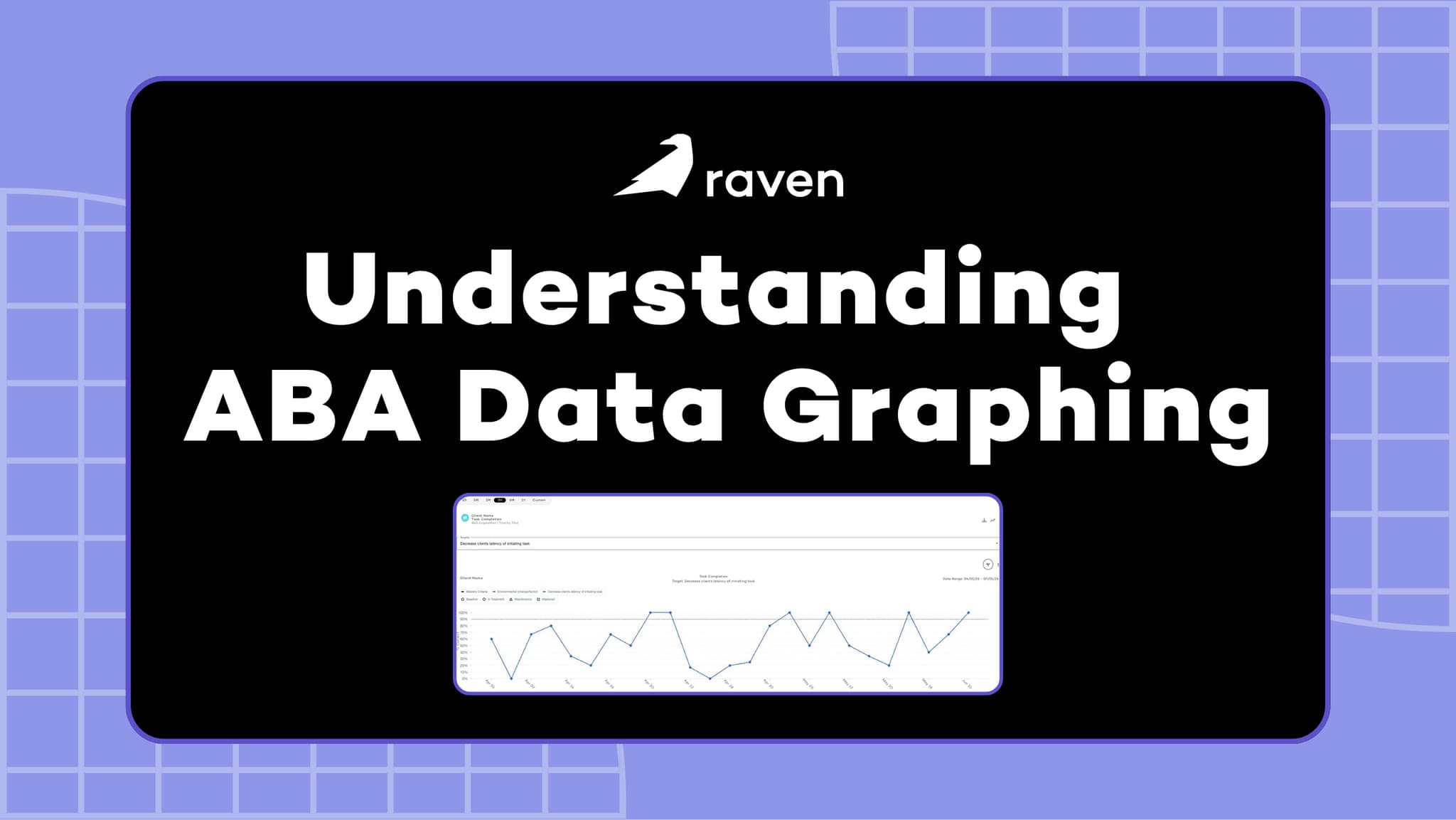
High-quality software allows the BCBA to view the live data graph and the written session note side-by-side. This ensures that the clinical supervisor has the full, accurate picture of what happened in the room, allowing them to make immediate, informed adjustments to the treatment plan without having to track down the technician to ask questions.
How to Choose the Right ABA Session Notes Software
Choosing the right tool starts with a close look at your daily operations, your budget, and how comfortable your staff is with technology. The best software is the one that fits the way your practice actually runs.
Start by asking your clinical team what they struggle with most day to day. If your technicians are losing paper data sheets or dealing with an app that crashes in the field, look for a system with reliable mobile data collection and offline syncing, like Raven Health.
If your billing department is constantly fighting denied insurance claims because of missing signatures, late notes, or authorization mismatches, look for an all-in-one system with strong compliance guardrails like Raven Health, CentralReach, or Theralytics.
Finally, always request a live demo and ask each vendor how their system handles customized note templates and parent signatures. Those are the features your staff will rely on every day to keep the clinic running smoothly.
Conclusion
Writing detailed session notes will always be a required, closely reviewed part of working in Applied Behavior Analysis, but it doesn’t have to be a time-consuming chore.
With dedicated ABA session notes software, clinics can streamline their daily documentation, stay compliant with insurance payers, and protect their revenue.
Whether you want an AI-powered, mobile-first platform that grows with your organization like Raven Health, an enterprise system like CentralReach, or a clinically focused tool like Motivity, the right software lets your therapists spend less time on paperwork and more time with the learners who need them the most.
Sources:
https://ravenhealth.com/key-features-data-collection
https://ravenhealth.com/key-features-ai-capabilities
https://www.motivity.net/blog/best-aba-practice-management-software
https://linksaba.com/best-apps-for-aba-data-collection/
https://www.theralytics.net/blogs/best-aba-practice-management-software